Sunday, August 25, 2013

Parade's End (BBC/HBO series), a Review

I am so very tardy to this party. Thank you, DVR recording technology!

So this adaptation of Ford Maddox Ford's tetralogy of novels hit our shores last winter, after having been aired in the UK last year. It seemed to be served up as a sort of methadone treatment to the Downton Abbey heroin withdrawal--a desperate need for large hats and Edwardian social hierarchy.
You know--luxe lives of leisure that we can both yearn for and disapprove of. 

But is it Downton 2.0? Well, the look is certainly there.


That is our introduction to the mad, bad, and dangerous to know Sylvia Satterthwaite (Rebecca Hall), speaking French into a hotel telephone, telling the concierge not to allow the caller up, as it is "trop tard." She hangs up and lapses into bitterness. "Too bloody late."

And then a man bursts through her door anyway, furious that she has tried to avoid him, even though it is apparent that he isn't going to divorce his wife for her, that's no reason for her not to sleep with him. Is she already pregnant? Des she have anything else to lose? Is there any way she can avoid him, as he hungrily tears at her clothes and throws her to the floor?

The feminist inside me pities her deeply. She has no power to make him stop, other than the force of her own honed social skills--and those are clearly not enough. This is "lie back and think of England."

Soon thereafter, she seduces Christopher Tiejiens on a train. Well, of course, he is Benedict Cumberbatch--wouldn't you?


Well, if he spoke to you, you would. He's her insurance. There is no way (pre-paternity testing and DNA analysis) if the pregnancy is his fault, and he's absolutely decent to the marrow in his bones, so they "marry quietly abroad"--a term that means "she's pregnant, get married before she starts showing." But Tietjiens isn't entirely resigned. "She's bitched me," he says, "but it was glorious."

Thus launches the battle of wills in this toxic marriage. One calculated (by her) and entirely uncharacteristic (for him) tryst in a railway carriage, and then--nothing. He is brilliant and nearly a parody of a withdrawn and taciturn Englishman. Possibly due to being from Yorkshire, even, the younger son of the great Groby House, famous for a two centuries old  spruce tree that the families and locals revere in a sort of pagan ritual of hanging charms and mementos for good fortune. Proposals and marriages have happened under Groby Tree "longer than memory." Sylvia hates it.

Sylvia hates Tietjiens as well. He sits (as in the photo above) at the breakfast table and marks errors in the margins of the Encyclopedia Britannica. He is so silent, so withholding, that the fiery and passionate Sylvia is reduced to crashing against him in a desperate attempt to elicit any kind of response at all. At breakfast, she throws a plate against the wall, startling him in to at least looking at her before he leaves for the office.

This is the complicated heart of this five part miniseries. Christopher Tietjiens is the Old Guard, the "last Tory," a man who holds so tenaciously to the antique standards of behavior that he is literally incomprehensible to those around him--especially his wife. She is also brilliant, and the scope of life offered to her in Edwardian upper society is so limited, so unfulfilling, that her brain has basically turned on itself and begun to consume her. So she bolts, and runs off to the Continent with the terminally pretty but otherwise unsatisfactory Potty Perbowne. 

Stoic and proper as he is, Tietjiens simply gives up the large house and takes rooms with his old friend Vinnie McMaster--the son of a Scottish tradesman who Tietjiens helped financially through university, and now repays the debt by standing by his friend. Four months later, Sylvia is hopelessly bored with Potty, and offers to come home. He accepts her--he will not divorce her, since no gentleman would do such a thing to a woman, and not to the mother of his (putative) child. She will not divorce him, due to her Catholicism. They are locked in a battle that he will not fight.


There are only a few possible outcomes to such a battle. One or the other of them could die; natural causes, murder, accident, war. Tietjiens could fall in love--with his wife, or with someone else. Enter Valentine Wannop.


They "meet cute" as she and a fellow suffragette attack the government minister playing in a golf foursome with Tietjiens and McMaster. She is the child of Tietjien's father's friend, and he creates a diversion so they are not apprehended, then later drives all night with her to get her fellow out of the area. They drive through a deep fog, and as the sun is about to rise, come close enough to kiss. 

He does not. Of course.

Then their horse cart is hit by a motor car. Pastoral idyll ruined by modernity? Anybody see that? Bueller?


Somebody is not happy with this turn of events.

So there's our love triangle, each corner representing a different ideal--Tietjiens the outmoded beliefs and behaviors of the 18th century country gentleman*, Sylvia the urban sophistication (read "decadence?") and the hunger for change at the beginning of the 20th century, Valentine--the pure and virginal pacifist and suffragette.


*I am not so sure that Tietjiens accurately represents the 18th century--have you read Moll Flanders? There was certainly plenty of debauchery and immoral behavior around then too. 
Of course, there is war--The Great War, in fact, and Tietjiens enlists and goes to France. And here is where the novel destroys its hero. Over and over, rumors are started and spread and Tietjiens refuses to address them. Some come from his furious wife, some from the men who are trying to win her--either by doing what they imagine she wants, so by ruining the marriage so she is free again.


But this is bound to fail--because Tietjien's very unassailability makes him more intriguing to her than these petty men. The more they try to bring him down, the smaller they look to her. Also because she is determined to be the one to make "that wooden face flinch."


Meanwhile, Tietjiens and Valentine remain in love, and subject to rumors about their continued sexual relationship (there isn't one and never was) even after they haven't even seen each other for years. Literally. YEARS. All of the disapprobation with none of the benefits. Yup. That's English for you.

Honestly--how stupid are you?

 There is a quite impressive list of negative rumors collected by Tietjien's father and brother, who are trying to figure out why he isn't progressing--he's got the connections, the education, and he's brilliant. But the persistent smear campaign has left notes in his file that he isn't to be trusted with confidential information, he's got a bastard child with Valentine, he has bounced important checks to his club and his officer's mess (thanks to the machinations of Sylvia's would-be lover). In each instance, he refuses to defend himself on the grounds that a true gentleman wouldn't have let things get so out of hand that these rumors and incidents could have even have started.


Fortunately, there is always money for frocks!

 There are large portions of the series devoted to the horrors of trench warfare and the eternal idiocy of military procedure. Generally, WWI horrors have been superceded by the horrors of WWII, but they had their own gravitas, and it is worth being reminded of them. Some of the military foolishness is right out of the Catch 22/M*A*S*H playbook, but was written forty years earlier. In one sequence, Tietjiens (who is invaluable at his various postings because he is the only officer able to make things happen, including getting men equipped and ready to fight) reports on his efforts to get fire extinguishers. Because he is an Imperial Officer managing Canadian troops, he is unable to get provisions from usual military supply, and is instructed to apply to a procurement office, which is unable to provide them due to some other military rule, and directs him to obtain them directly from civilian providers, who are under orders to sell only to the War Office. And of course, a general shows up and dings Tietjien's command because he has no fire extinguishers. And the general doesn't care WHY.

Things escalate, of course, when military regulations collide with social and moral imperatives--at the level Tietjiens's is operating, there are long memories and historical grudges and truly no way to obey all the orders being given. Things come to a head when Sylvia transports herself to France to see her husband. Tietjiens has already made things hard for himself by countermanding the discipline meted out by the military police who detained a Canadian soldier until after curfew and then arrested him. "General O'Hara loves his police like his own little lambs" warns Tietjien's sergeant--himself someone whose career has yet to recover from an incident 20 years in the past.

At night, in the hotel that houses officers for the post, Tietjiens and Sylvia reach a point where they just might--just might--find a way to understand each other, and Tietjiens is goaded into asserting his marital rights. And of course, that's when Potty Perowne tries to sneak into Sylvia's room for their arranged assignation. Tietjiens is furious, and pushes Perowne out the door, just as O'Hara hears the commotion and sees it as an assault on a senior officer. He shouts that Tietjiens is under arrest, while Tietjiens is trying to evict a man from his wife's bedroom. There is no way to reconcile the social rules with military discipline, and Tietjiens ends up at the front.

Again and again, Parade's End tries to break its protagonist, provoke him into rage, to elicit something other than dumb acceptance of the wicked unfairness of his burden, and again and again he simply bears it. No wonder he infuriates Sylvia so. "You forgive with no mercy," she says. "You are the cruelest man I know." I guess a saint is hard to live with. T.H. White said something similar in The Once and Future King when describing Sir Galahad--saints are not comfortable with small talk.

This is quite a sprawling work, covering a decade (1908-1918) and war, women's suffrage, sexual politics, romantic triangles, honor, duty, military incompetence, the end of the old England and the rise of the New World. . .so basically, it's about everything. And that everything-ness makes it hard to love this series. Tietjiens is so very stoic that he's hard to understand. Cumberbatch shows us that Tietjiens certainly feels things deeply, but why does he steadfastly refuse to act? Where does he get this stubborn refusal to engage with the world as it is--he certainly understands what is happening, and he's smart enough to do something else. He chooses not to.

Today, we would probably label him as on the autism spectrum, perhaps, and we would throw around the term "Aspberger's." There does seem something ridiculous about a man who could do something about the amount of suffering dumped on his head who chooses to do nothing about it. Sure, sometimes he choses to take the hit in order to prevent someone else suffering--but even when he is the only one involved, he just doesn't even step out of the way of the incoming damage.

It makes him seem like an allegory rather than a character--Tietjiens IS "England," clinging to the better, finer values of the past, even as the world goes to hell around him. Sure, maybe that's what's going on, but to what end? Tietjiens fails. He ends up in an empty flat (Sylvia has deliberately taken all the furniture), estranged from his son (whom he loves, regardless of whether he is the "real" father or not), socially far beneath his old friend McMaster who has been knighted even as Tietjiens has been destroyed, reduced to greeting a mixed lot of damaged and undesirable soldiers as the only comrades he has left. And Valentine.

Valentine agrees to be his mistress, because she loves him. Quite a feat, as he has exchanged only a few words with her over the past decade. Really, poor Valentine is herself rather an idea rather than a character. She remains innocent, pure, never looking at another man despite reaching more than marriageable age herself. She even dresses only in white--she simply never changes over the course of the series.

Which leaves Sylvia. Who is really quite an amazing character. As played by Rebecca Hall, she is not the bitch queen that some reviews have cast her as. Nor do the reviews I have read really grapple with the sexual issues that dominate the story only slightly less than the war does. Because as presented, sexuality is a sort of war, with the men effectively overrunning the women. As Sylvia puts it, it took her years to get over being angry with Gerald Drake, who refused to divorce his wife and left her with a baby to deal with. Now, in 1918, they have re-encountered each other and gone to bed. The scene unfolds in the aftermath, as Sylvia concludes her ablations--involving red rubber tubing at the bathtub. "Will you come back to bed?" mumbles Gerald. "Certainly no! I can't go through all that again" she announces coldly. And you know--you know--that she means more than just the douching. All of it--the sex itself, the complicated relationships with men, her marriage, the last ten years--and the douching. It's just not really worth it anymore.

Even from the first scene--Sylvia can't even keep a man out of her hotel room, she can't stop him from tearing her clothing and forcing himself on her. She can't summon anyone to remove him, she can't physically overpower him, all she can do is hope for the best. And she does land on her feet, despite having no power, no authority, and no point other than to be decorative. Which is FAR from being enough for her.

Really, for me, Sylvia is the reason for the show--the heart of the story. She has too much talent, too many brains, too much passion for the circumscribed life she has been assigned. So she tries to enlarge the world she moves in, and there are casualties to that effort. Notably, her husband. But she cannot sit still, she cannot life such a small life, and so her choices are to die by inches, or to rail against the restrictions. So she fights for herself and her needs. But English life has so successfully limited her choices that she literally cannot find anything to do with herself other than stir the pot with her husband and other men. It is really a tragedy how her life is wasted, and she is so brave to such little progress. She knows the past has to be torn down in order for the future to arrive, for her to have any hope of happiness and purpose. So she is Shiva, a force for destruction, but she is also a woman who lives a life of such painful pointlessness that she is truly unable to do anything else.

In the end, she manages to install herself at Groby, on behalf of her son--the eventual heir. While there, and before Tietjiens comes back from war, she orders the felling of the Groby Tree.

Of course, Groby Tree is an allegorical character--it stands for the antique past, the organic history of Yorkshire, the refusal of modernity. Several times throughout the series, it is pointed out that the tree threatens the structural safety of Groby House, and Tietjiens swears that he will rebuild the house by hand before he will sacrifice the tree.

Sylvia hates the tree--she hates how the branches cover the windows and make the house dark and gloomy. She hates the paganistic role it plays, where locals hang charms to ward off witches and wights. (This is about the only time she says anything that might be evidence of her religious belief--other than her refusal to divorce. And the refusal to divorce might just be an excuse as she tries to win the only man who has resisted her. She's complicated, and that's what makes her interesting.) She hates the way the past is overshadowing the lives being lived in the present, and she wants that tree gone before her child has to confront that long shadow of the past.

This is what finally breaks Tietjiens--I think. He walks out of Groby House, and takes two chunks of the tree with him back to London. He gives one to his brother, who has no use for it and burns it immediately. Tietjiens himself burns his log, at the gathering of the wounded soldiers in his empty rooms. The past is gone. Tietjiens has divorced himself from his wife, and takes Valentine as his mistress. Sylvia seems to have given up the fight for him as well. There is nothing left, Tietjiens apparently can be stripped no farther, so now he is turning toward joy over duty.

Did I like it? Yeeees. I liked it enough to watch the whole series in a couple of days. I enjoyed it more than the other prestige series I've tried this summer--House of Cards (the Kevin Spacey version) and Orange is the New Black, neither of which I have watched 5 hours of. Is it good? Also a qualified "yes." The acting is marvelous, and the settings and costumes and the look of it is sumptuous and wonderful. I am a bit troubled by the way that 10 years of story hasn't really changed anybody--either in their looks or style or relationships or character. (I may need to make an exception for Anne-Marie Duff's arc from the pitiable Mrs. Duchaime to the cold and unlikeable Lady McMaster.) But. But. What is the point, really?

And you know there has to be a point, because the screenplay was written by (Sir?) Tom Stoppard, who condensed four novels and some 600 pages of text into a particular 5 hours of story. So what was the aim? Was it to tell a particular story, or to try to give the feeling of the sprawling original? Perhaps that was it, after all--to do justice to a complicated and enormous story that has no easy answers.

I can accept that, in part because it lets me choose what I want to foreground as the most meaningful part of the story. And of course I am going to pick the utterly gorgeous and passionate Sylvia, the horrors of her own wars against gender limitations, the pathetic waste of her talent in an upper class woman's life, and her fierce belief that she deserved something that she wasn't being allowed. She is amazing and definitely worth watching.

On the whole--worth watching. It's not a decadent and gooey trifle like Downton Abbey--it's more tart and difficult to digest. But it has a lot of fodder for thought, and much to feast the eyes.


Tuesday, August 20, 2013

Match Point, a Review

Just finished watching Woody Allen's 2006 movie Match Point.

This is just the draft of a review, with just my most vivid thoughts, because it is very very late and I should go to bed.

Jonathan Rhys-Meyers is not actually sexy--he is like the corporation-developed version of sexy. He is to truly sexy what Dr. Pepper 10 is to a double Manhattan cocktail. Sure, it's being marketed as "extreme" and "manly," but there's no real intoxication available.

JR-M's character is an up and coming Irish lad who lands himself in the lush fields of a wealthy British family. He's self effacing and punctilious about paying his own way--is this really how he is, or has he calculated that this is the approach most likely to endear him to them? There is no way of knowing, which is kind of the problem with the whole movie. Is his character opportunistic? Is he consciously scaling the socio-economic pyramid, or is he just such a Nice and Charming Guy who really loves his wife but has a problem with a hyper-sexualized temptress (Scarlet Johansson)?

Chris and Nola (JR-M and ScarJo) are two lovely people, and their frantic affair is designed to give the movie some sizzling sex scenes, but somehow they end up feeling rather off. As though Woody Allen wants to shoot truly hot, R-rated sexuality, but for some reason, he's gone and cast his own grand-daughter in the temptress role, and he can't quite take the brakes off. So the scenes are fundamentally prudish, with Johansson so thoroughly clothed that the scenes are inert and unconvincing.

Rhys-Meyers is also not truly believable as someone who is addicted to this woman, especially as all the spit and fire of their first encounter (she's playing ping-pong against all comers for a thousand pounds a game) is immediately burned off in the subsequent encounters. After that first meeting, she retreats, no longer challenging him, but constantly failing to exercise agency in her career (her attempts to become an actress in London consists of nothing but failed auditions) and in her relationship with Rhys-Meyers's character. (He controls when they meet, and where, and she simply frets about whether they have enough time to go all the way to her flat. Egregiously, there is a scene where she doesn't want to go back to her flat, since they have already spent an hour in a hotel room--and then she does.) While he's apparently sexually voracious (he is also simultaneously performing at home in eternally unsuccessful attempts to get his wife pregnant), Johansson's character doesn't really seem to be getting much out of it, as evidenced by her objections to the amount of time they actually do spend in bed. She'd like to be doing other things--like eating, or going out for drinks.

Rhys-Meyers is also completely sure-footed doing some sort of high finance work in his father-in-law's company, which is obviously world dominating, since it's located in the Swiss Re building (also known colloquially as the "Erotic Pickle," although you won't learn that from the movie). The scenes of corporate life are oddly non-specific, as though Allen doesn't understand how finance works, and couldn't be bothered to learn anything about it. By the end of the movie, he's depicted as hyper-competent, speaking Japanese while bowing to foreign visitors.

It's basic Japanese--even I understood it--"Domo arigato gaizemas. Sayonara." The work environment scenes just crackle with the awkwardness that is Woody Allen not knowing how financial firms work and how people talk and interact in them.

Anyway, Scarlett Johansson's character simply gets worse and worse. She gets pregnant, blames JR-M, since he insisted on having sex without protection that time. She actually says "I told you that I didn't want to do it without protection, but you couldn't wait." So of course, she wants to marry this guy and raise a family, because that's going to work well. And she nags and harangues and calls him at embarrassing times, trying to get him to tell his wife and come be with her. Because by this point she has zero power of her own, and can only wait until JR-M can be arsed to take care of her.

Honestly, it's fundamentally sad. She starts the film like Lauren Bacall, all sultry sexuality and assertiveness, and then immediately gets turned into a victim by the script. It's very very sad, and it's made weird by her shrewish insistence that she wants to be married--because women love marrying their rapists, right? Coupled with the unsettling approach-avoidance dynamic in Allen's direction of the sex scenes, and this is ultimately a misfire of a movie.


Monday, August 19, 2013

Before Sunrise/Sunset/Midnight

I have now seen all three of these movies, and they are charming and will have a special place in my heart.

Here's what I wrote to my sister about the middle one--"Before Sunset:"
Yup. This one is even better.[Than the first one.]
I liked the setting of Paris, and Julie Delpy looks thinner and a bit older but also wiser and still elegant and lovely. I would totally miss my plane for her. Ethan Hawke is the least attractive of the three movies. She's a better actor than he is, but his moment where he reveals the emptiness of his marriage was moving and was really the heart of that film for me.
But Jesse doesn't actually hold up over the course of the movie, so I have to assume that she was really positively affected by reading the novel. And, of course, as the middle section of a trilogy, it's got some lovely themes that get revisited. There's the whole question of what sort of parents they are or want to be, the question of missed lives--if only she had been in Vienna, they might have been together all these years. You see the pull Jesse is going to have to feel between his son and his own happiness.
When you saw this one back in '04, without the third one--did you think Jesse was shallow? I mean, despite his moving monologue about "I would suffer any torture in order to be with him every day of his life" (he said about his son)--but then it's not entirely surprising that he moves to Paris to be with Celine and leaves his son behind with his psycho ex-wife. Maybe it's because I know the next chapter that I'm biased against him.
I did like it, though. Quite a lot. I kind of want to take some time, and then watch all three of them right in a row--or maybe read the screenplays, just to see the progression--especially of Celine. Her progression from naive girl from the first one, to the bitter woman who feels she is missing life in the third one--it's a nuanced arc and Delpy is marvelous at playing it.
I'm a little bit skeptical at the "One True Love/ All My Romance was bound up in That One Night" story. I really don't believe that Cleine was so enamored of Jesse that the night in Vienna ruined all her subsequent relationships. . .I do think it was a high point of their lives, and maybe they are better suited to each other than to the people they are with, and they seem very happy and vivid with each other. And that is enough--it doesn't have to be their destiny.
In fact, if it isn't "DESTINY"--that makes the fragility of the relationship in the third one more poignant. They chose to be together, and they might choose to separate as a result of that epic fight. But then, Jesse makes that huge effort to reconcile at the restaurant at the end, and so they beat on, boats against the current.
These are going to have a special place in my heart. I'm glad you got me into them. Thanks.

Thursday, August 01, 2013

Separated at Birth--Dirty Sherlock Edition

When I switched off Orange is the New Black (which I will review after I've seen more than 2 episodes), what should come onto the television but Dirty Dancing.

For many people, that was a defining movie. Not necessarily for me, because--OLD. But I came in just as Baby ends up at a staff dance party, and dances with Johnny--the lithe and cat-like Patrick Swayze.


Of course, I stopped to watch the dancing!


And there was an odd familiarity to Mr. Swayze in that scene--he reminded me of somebody.


Something about the slated eyes and chiseled cheekbones.


Wait! That's not Patrick Swayze!


Swayze.


Not Swayze.

The likeness is stronger in the film than these still images convey. But really, Swayze and Cumberbatch--both are worth watching in just about anything!

Sunday, June 23, 2013

Much Ado About Nothing--Movie Review

Joss Whedon has famously filmed Shakespeare's comedy in 12 days at his home, using actor friends from previous projects. Done in modern dress using Shakespeare's language, filmed in black and white, scored with smooth guitar jazz, it's a pleasant diversion and a lovely valentine to language.

But oh my goodness, does that plot creak!

This is the hazard of updating the presentation at all, and really, somebody has got to be brave and do something about it. For those of you who have a hard time remembering which plot goes with which generic play title (I'm looking at you As You Like It, Twelfth Night, and All's Well That Ends Well) I will summarize.

The prince, Don Pedro is home from war with an entourage of warriors, including the young and callow Claudio and the bitter Benedick. They arrive at the home of Leonato (played here by Agent Coulson from the Avengers movies), where Claudio falls in love at first sight with Leonato's daughter Hero. Also present is Hero's cousin Beatrice, who has a sketchy past with Benedick--they bicker so they must be in love!

Don Pedro has defeated his brother, Don John, and John is nursing a major grudge. Instead of accepting his brother's mercy, John plots with his few accomplices to spoil everybody's happiness. The night before the wedding of Claudio and Hero, he arranges for Claudio and Don Pedro to see a woman in Hero's bedroom "entertaining" a man. (Of course, it's the maid, not Hero at all, as the audience knows.) Claudio accuses Hero of being unchaste at the altar in front of the entire assembled wedding guests and she faints from shame. It is decided to put out the rumor that Hero has died, the plot gets uncovered, Claudio accepts his punishment is to marry one of Leonato's nieces, who turns out to be Hero. Benedick and Beatrice also admit they are in love, and Don John gets captured. Happiness abounds!

Except--it is nearly impossible to swallow this plot these days. Claudio might as well be dressed in red flags from the Bad Boyfriend department at Sears--he's rash, jealous, intemperate, and rude. When he first falls for Hero, he's unwilling to court her himself, so he lets Don Pedro do it on his behalf. Then it takes just a whisper from Don John for him to become convinced that Don Pedro is going to keep Hero for himself. So he rushes in, accuses everyone of playing him for a fool, and that isn't enough to alienate Hero? No, it isn't.

Now, to be fair, it's got to be awful to see your fiancee messing around with another man on your wedding night, even today. But the shock isn't that she's no longer a virgin--which is the substance of the Shakespeare text. No, the shock is that she's sleeping with somebody else, which has got to make you think twice about whether this marriage has any chance at all. But then, Claudio the Clod doesn't bring it up with Hero, or Leonato, he doesn't do anything sensible. Instead, he goes for the biggest humiliation he can arrange, by waiting until Hero has already said "I do" before he goes at her for being a "common stale." Don Pedro joins in, and even her father accepts the accusations at face value.

That poor girl. Nobody asks her "where were you last night?" Nobody talks to her at all. They do ask Beatrice if she was Hero's "bedfellow" last night, and for some reason--and for the first time ever--she wasn't. Nobody asks why, or where anybody was, or how Don John knew about this, or even questioned whether it might possibly be some other woman they saw. (Ashley Johnson, who plays the maid Margaret, is a solid 6 inches shorter than Jillian Morgese's Hero, and is an entirely different body type.) No, let's just get all the old, white, privileged men to scream at the scared girl, disown her, humiliate her, and then they can go on their merry way--back to their rooms in Leonato's house, because that's not awkward at all.

And then, the "punishment!" Claudio feels bad that Hero died, but only after he finds out that he had been duped, because under those circumstances, her death is unmerited. Because, whaaaa? Deflowered girls are apparently universally considered to be better off dead, I guess, depending on the whim of the men around her. (Beatrice, however, is shown to have slept with Benedick in the unspecified past, and Margaret seems to be allowed to live as well.) Anyway, Claudio's "punishment" for having "unjustly" caused Hero's death is that he has to agree to marry some other female relation of Leonato's, who he is promised looks exactly like Hero. Of course, she turns out to be Hero, revealed only when he agrees to marry whoever Leonato puts in front of him.

Does anybody ask Hero if she still wants to be married to this idiot? Does anybody foresee anything but domestic violence and unwarranted jealousy in this relationship's future?  This is where a reaaaaaaly long engagement would be a really good idea. Even better? Kick him out of your house and get a restraining order.

But, if you can overlook that horrible plot--and I couldn't really--the rest of the production is a delight. The lines are delivered crisply and the Beatrice/Benedick banter is worth the price of admission.

The Great Gatsby, A Movie Review

So Baz Luhrman bit at the biggest, gaudiest, showiest piece of literature out there, and managed to out-Moulin Rouge his own Moulin Rouge. This version of Gatsby is shinier, louder, brighter and more gaudy than you might have thought possible. As a movie it both slavishly adheres to the novel while simultaneously betraying everything the book stands for. It's a hot mess and I kind of loved it.

This is notable, because I hate everything.

I won't rehearse the plot, because you should know it by now.

The movie doesn't try to recreate the 1920s in any faithful way, but evokes our dreams about it. As such, it kind of falls midway between two other historical film pastiches: Joe Wright's Anna Karenina  (which I feel didn't quite cohere in any meaningful way), and Sofia Coppela's Marie Antoinette (which I do love). Luhrmann's Gatsby  isn't quite as successful as Coppela's Marie Antoinette,  but it is doing some of the same things stylistically while also working with a famously difficult text.

I would totally go see this again, and expect that any time it turns up on television I will be sucked into it for at least the first 2/3s. The last third, as the snares close around Gatsby, are well done, but nothing special. The visual flair of the first part of the movie dissipates as the machinery of the plot has to take precedence. But until then, it is gorgeous to look at.

I saw this in 3D, and the forced perspective gives the whole a faint feeling as though it's all being enacted on a model train set--not quite realistic, with odd details emphasized, making the whole more dream-like and odd, which seems appropriate as Carraway tries to explain to himself just what happened and why he is still haunted by that summer.

Let us address the framing device. The movie opens in 1927, winter at a sanitarium, where Carraway is being treated for a list of ailments, including "morbid alcoholism." He begins to tell the attending doctor about that summer of 1922, and finds he can't talk about it. "Then write it" the doctor says, launching Carraway into creating a typescript that he calls "The Great Gatsby." It's a little bit hokey, of course, and the rich and homey interior doesn't really seem anything like what a sanitorium would have been, even back in the early 20th century. Critics have near universally hated it, but I don't. I think it gives the movie the chance to honestly invoke the elegiac nostalgia of Fitzgerald's novel, that fragile and sensitive mix of longing and revulsion that makes the novel work. Because, face it, stripped of the delicacy of language, that ambivalence of narration, the story is lurid melodrama and trashy spectacle. Using the framing device, Luhrmann is able to use descriptive passages from the book, language that would otherwise be risible if delivered as dialogue. He is able to describe things he would never have seen, like Gatsby and Daisy's first kiss, back in Alabama, when Gatsby paused on the edge of falling in love, knowing that if he fell for this girl, "his mind would never again romp like God's." (Or something like that.) I allow that, because this is not a report, this is a story Carraway is telling himself, as he tries to make sense of something that touched his emotions and that his logic can't entirely understand.

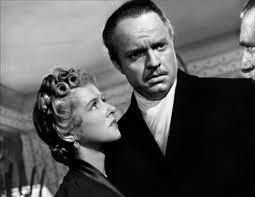
The movie owes an enormous and unacknowledged (so far as I have seen) debt to Citizen Kane. Leonardo DiCaprio even looks like Orson Welles, as if they are long separated siblings.


Honestly, I can't be the only one who sees the resemblance.

Both movies are reconstructions of the protagonists' lives after their death. And Gatsby dies whispering "Daisy" just as Kane says "Rosebud." I'm sure there's more, but that's enough for now.

The first two thirds of the movie are visually overwhelming, a design aesthetic that can only be described as "More is Not Enough." It's frenzied, it's ridiculous, and while it might technically fit the descriptions of the book, it kind of misses the point. Because Luhrmann so patently adores filming the excess, he kind of misses the fact that the excess is tawdry and misguided. Gatsby throws these enormous parties hoping that Daisy will hear about them and wander in, never recognizing that these are precisely the kinds of things that are too common, too nouveau riche for Daisy to actually come to voluntarily. Furthermore, they are the kind of bacchanals that Tom will prevent her from attending, even if he himself is willing to go--alone.

Luhrmann's film doesn't really seem to grasp the ways in which Gatsby is performing his own dream of what wealth looks like. Like Gatsby, Luhrmann seems to believe that Daisy would find this sort of thing exciting and appropriate. So the movie indulges in that excess, exactly as Gatsby does, and misses the edge of disapproval that permeates the novel.

To be fair, at first, Nick is also excited and charmed by this world, even if he ultimately rejects it. He starts out with that very American belief that the rich are somehow better than everybody else, that their money is proof of some sort of divine merit--like titles in Europe, the rich are the elect and to be accepted by them is to prove to yourself that you too are finer than the average man. Over the course of the summer, he learns that the rich are no better than the rest of us, and are in some ways infinitely worse. Jordan Baker cheats at golf (a detail left out of the movie), Tom cheats on his wife, Daisy can hit a woman with her car and retreat into her money and leave the mess to others to clean up. Wealth is not proof of worth.

I keep recalling Edith Wharton's The Custom of the Country as I watched this film. In that novel, the unutterably lovely and grossly common Undine Spragg erupts onto the New York social scene. She has gotten it into her head that she wants to sit atop the social hierarchy, and so she marries a man who is utterly inappropriate for her. Because there are two, parallel New York societies--the old Knickerbockers who have old money and don't spend it. Theirs is a live of inherited furniture and dining at home, good works and stolid values. Undine doesn't understand this world and doesn't like it. She craves the fast cars and flashy nightlife of the new demimonde, and is much happier when she is sneaking away from her husband to party.

Gatsby has some of the same DNA (the character, the novel and the movie). Daisy is a girl in an expensive white dress, lounging on a sofa as the breeze moves the gauzy curtains--not the flapper guzzling illegal alcohol while dancing the Charleston at a crowded party full of strangers. Gatsby doesn't really know who she is, in fact, he doesn't see her at all as a person, rather she is just the trophy that would seal his success in life. Charlie Sheen is not the first to mistake frantic activity for "winning."

And what about Daisy? Carey Mulligan is delightful (always) and fun to watch, but there really isn't very much there there with Daisy. Personally, I blame Fitzgerald. I don't think he ever understood Zelda either, and Fitzgerald's Daisy is kind of like Gatsby's Daisy--a symbol rather than a full person. Mulligan is winsome, and has some backbone--especially when she refuses to do what Gatsby wants and tell Tom that she never loved him. She is unhappy, but isn't willing to be Jay's puppet. Her decision to stay with tome is communicated as fear. She's killed a woman, she's afraid of what she's done, and Tom opportunistically uses that fear as a tool to keep her with him. It's a devil's bargain she is making, one she accepts from a position of weakness and social pressure. She knows better, but she's too frail to stand independently--she's never been allowed to before, why should we think she could now?

It's a gorgeous movie, full of fabulous set pieces and over the top visuals. The first full image of Gatsby is typical of the movie. It's Leo DiCaprio looking as beautiful as he has in years (apparently beauty is inconsistent with being a Serious Actor), toasting us as fireworks frame his golden head and the strains of Rhapsody in Blue swell. It's ridiculous, it's campy, it's too over the top, and that's why it works.

Alan Cumming's Macbeth--A Review

For my first ever Girls' Weekend, my friend and I went to New York for some serious Shakespeare immersion. We had tickets for Sleep No More, as well as Alan Cumming's Macbeth. We kicked off the time with Joss Whedon's new Much Ado About Nothing as well, because we are nerds like that.


Macbeth was at the Barrymore Theater, a block away from our hotel (the Marriott Marquis, which I can recommend as a lovely hotel in the center of Times Square). The doors seriously caution you against saying the name of the play while inside.


Once inside, Friend and I fortified ourselves with vodka-soda-&-limes in Broadway approved sippy-cups and found our seats. They were marvelous--center of the row, eight rows from the stage. I must remember to commend her seat selection.

The stage is open--no curtain. It's obviously a terribly neglected medical facility of some sort, tiled in that bilious institutional green that looks like being nauseous feels. The lower three rows of tile are dingy and the grout is stained, speaking to the years of indifferent mopping of the equally appalling linoleum floor. The tile runs up two or three stories, interrupted in the back by a large curtained window. There is a crummy sink and a small mirror to the right side, three bays for institutional beds, although only two hold beds. A tub sits just below and to the right of the observation window, oddly cantilevered so that it doesn't require any feet--presumably easier to sluice the floor underneath it then.

For a medical ward, there is some odd detritus--toppled and mismatched chairs, a baby doll on the floor. A door sits up on the right hand wall, with eleven metal steps descending. A keypad operates the door, and three television screens hang over the top of the stage.


You don't want to be here. Nobody wants to be here.

Lights go out, come back on, and three people are on stage. A older woman doctor. A large bearded orderly. Alan Cumming. Alan (or "Alan"--since he plays a nameless character, but we'll dispense with the quotation marks) is being gently wrangled. The orderly asks for his suit jacket, and Alan gives it up. It is folded and placed in a large paper bag marked "Evidence." The doctor swabs the inside of Alan's cheek. With a kind smile, the orderly asks Alan for his dress shirt. (The characters are obviously speaking, but the audience can't hear anything, as the eerie music/static blurs out their words.)


 The doctor sees the bloody "M" carved on Alan's clavicle, and swabs it with disinfectant, which obviously hurts. The orderly needs Alan's pants now, leaving him in just a pair of grey briefs. The doctor carefully  cleans under the nails of Alan's left hand. The orderly hands him a pair of ivory scrub pants, which he puts on. Alan seems docile, co-operative, tractable, grateful that someone is taking care of him.  Something terrible has happened, and the business with collecting the matter under his nails indicates that he is the suspect. Murder?


Oddly, the orderly gathers up the scrub shirt and surprises Alan by forcing it over his head. Until now, the orderly has been entirely respectful, apparently kind. Both the medical professionals have treated him as someone who is voluntarily present, willingly subjecting himself to their attention. Perhaps this is not true. Alan refuses to relinquish a paper evidence bag that apparently holds some object of importance, and the orderly does not insist.

Alan sits on the bed at the far left as the medics gather their items and start up the stairs. Alan calls out "When will we three meet again?" The tone is plaintive; he does not wish to be left alone. They stop, look at him with some pity, then leave the room.

"In thunderrrrr, lightning, and in RAIN!" Alan continues, and the show is underway.

What follows is an hour and 45 minute version of Macbeth performed at breakneck speed, almost entirely by Alan Cumming. The performance is impressive, as there are many different characters to be conveyed, and the actor uses voice, accent, posture, and props to make them distinct. It mostly works. Some of the stagecraft is very clever. When the three witches speak, three security cameras whirr awake, and the actor faces each one in turn so the three screens above the stage give three different perspectives, augmenting the illusion of three speakers. Banquo is denoted by the way he shifts an apple from one hand to the other. Lady Macbeth is generally given a slightly higher voice and a subtle posture shift which seems to give Cumming (who is a lean and wiry man) more feminine curves.

It's quite a feat, of course, and the sort of thing that audiobook narrators are often called upon to achieve--creating different characters with their voices. (I can't help but think about the achievement of Jim Dale's Harry Potter narrations--literally hundreds of different characters who are identifiable solely from how he voices them.) Cumming has the advantage of being able to use props as well, creating the characters visually as well. Lady Macbeth's "unsex me now" speech takes place in the bathtub (yes, technically a "nude scene" but entirely SFW) which leads to his use of a towel to denote the two Macbeths in the following scene: clutched to his chest as the Lady, draped casually at waist level for the Lord.

The doll is used for Malcolm, with Cumming as the ventriloquist. 
Perhaps the most impressive scene is as Lady Macbeth urges her husband to "screw your courage to the sticking point" as she climbs atop him, using sex as a weapon to get her way. Cumming flops onto his back, now the man underneath, all but orgasming as he cries "You should bear only sons!" 

Other parts of this setting work very very well. Sounds that are referred to in the text--Lady Macbeth hears an owl while waiting for her husband to kill the king, and the sound comes from an air vent in the wall. The famous sleepwalking scene gives the doctor and orderly a chance to speak lines, as they play the parts of the doctor and the gentlewoman from the observation window, viewing Alan's antics.

But on the whole, the framing device of the mental ward sits uneasily atop the Shakespearean story, and doesn't really provide anything new to that tale. Macbeth is rashly ambitious, and wades into murder without realizing the domino effect he has unleashed. The play shows how he has to pile murder on top of murder in an endless quest to feel safe, as the mounting horrors rattle his sanity. Starting the story with a man who is already "insane" robs the play of some of its subtle progression. Macbeth starts with an honorable warrior who falls into a madness of his own making, the consequences of his own hubris. Alan Cumming's Macbeth skips straight to the madness.

And the connection between the patient "Alan" and Macbeth is not explained at all, and is quite jarring to begin with. The docile patient of the silent prologue flips like a switch into a megalomaniacal declaimer of Shakespeare as soon as the security door slams shut on his medical team. So was he faking his cooperation? If so, then why doesn't he hide his posturing self when he sees himself being observed from the window? This isn't Edward Norton in Primal Fear, gaming the judicial system, because Alan continues his re-enactment regardless of whether he is watched or not.

Macbeth doesn't illuminate the patient's situation. He doesn't see himself as Macbeth any more than he sees himself as Banquo or Duncan or Lady Macbeth either. He fully inhabits each character while they speak, then moves on to inhabit the next one. There is no reason to think that by reciting Macbeth he is reciting the events of his own life--if he has committed a murder, one that has left traces under his nails, it wasn't by murdering a king. 

This is also not real mental illness either. This is "theatrical mental illness"--like "Ali MacGraw disease" from Love Story in which no actual, identifiable symptoms are present, only what is demanded by the plot. More egregiously, this is not mental health care either. The medics saunter casually back and forth across the observation window, only randomly glancing in to see what he's up to. There is no attempt to talk with him, offer him psychiatric care, therapy. Why would there even be an abandoned baby doll for him to use for Malcolm? Why would there be a bathtub left unlocked and unguarded? (Like Chekov's gun, it's not really a surprise that he tries to drown himself late in the play--that's exactly why it wouldn't be allowed.)

The witches' second prophesy is enacted with a bird he finds by unscrewing the cover to the air vent. Why would there be a bird there, and how would he know he would find it there? Plot necessity/ theatrical requirement isn't really an answer.

After he "murders" Duncan, Alan's hands are covered with blood, and the medical team responds as they should, treating it like a real emergency, washing his hands and looking for signs of injury. But there aren't any. There is no discoverable source for the blood. But it is real, they see it, they deal with it, this is not the imaginary spot that Lady Macbeth alone can see. So what is going on here? The production doesn't say.

There is no visible injury--so where did the blood come from?

The conceit continues to break down as the play progresses. Banquo's ghost appears, a large male figure (probably the same actor who plays the orderly) stalking about the stage in a suit and bondage mask. Why would there be anybody there? Why would Alan conjure up something like that, so inescapably real? Especially since just after that, he lies on a bed and the security camera comes on, showing him on the bed with a shadowy figure lurking at the foot--a figure that exists only on the screen because the stage is otherwise empty. That is a scary ghost, more genuinely eerie than the cartoonish horror figure from earlier.

(But then, as the masked figure comes around to the side of the bed, looming ominously, it suddenly looks up into the camera, the mask disappears, and it's Alan Cumming looking into the camera. What is this supposed to mean? He has killed himself? He is watching himself? It's a nifty effect without any meaning.)

In the end, I gave up trying to make any sense of the "reality" of the hospital. It's just a setting, just a stage design in order to invoke a frisson of horror around insanity. Which is irresponsible, really, because mental illness is a real condition that affects large numbers of people on a daily basis. To represent it on stage like this is to stigmatize it without explaining anything. 

Alan Cumming's character is not a "mental patient," despite what the publicity and reviews might say--he doesn't have a real mental illness, and he's no "patient" since he's not receiving any care either. It's a cliched use of out-of-date notions of what mental illness is, used for a cheap thrill, that doesn't illuminate anything new about the play or the characters in it.


It's too bad, because the framing device Baz Luhrman uses in The Great Gatsby has been largely criticized as maudlin and off-putting, as outside the scope of the book, or even laughable. Yet that device, of Nick Carroway narrating his memories of the fateful summer, allows the film to recreate the elegaic tone of the novel and to use some of Fitzgerald's beautiful language that would frankly sound silly if simply presented as dialogue. Yet the far less thoughtful framing device of this play is routinely praised as a "radical re-imagining" of Shakespeare.

Let's be honest, it's not. It doesn't really do anything new to Shakespeare, but it doesn't do any harm either. If you go, go because it's exciting to see a human being work so hard to tell this story, because Cumming's Scottish burr is lovely to listen to as it wraps itself around the poetry of the play. Go because it's a good production of Macbeth, and it is entertaining. Go because you are in the city, and you are a Shakespeare nerd, and you have just seen Sleep No More and you want to catch up on the language of the play as well.

It's a worthwhile two hours, because Shakespeare is always worth your time.


Wednesday, March 13, 2013

The Good News, Gym Division

Hit the gym for the first time since breaking my ankle back in December. I haven't just been sitting around since then--there was a good month of PT to get the muscles back into shape. Today was the first time I got on the elliptical and the weight machines.

The good news is that I didn't have to start all the way back at the very very beginning--I managed to retain some of my fitness during that time. I did a complete circuit, re-establishing my weight settings, and managed better cardio than I thought I would.

Now to keep it up!

Tuesday, March 12, 2013

Oz The Great and Powerful, a Review

I saw this, in IMAX and 3D, for the biggest, most spectacular Spectacular method possible. And there is no denying that this is amazing to look at. The technology is hyper-realistic, color saturated, and overall a good match of subject and technology. There a are lot of special effects that are Very Special, and Mila Kunis, Rachel Weisz and Michelle Williams are gorgeous to look at, and hold their own against the wonders of Oz. James Franco is perfectly fine, grinning and hamming it up like he's doing a satire of George Clooney's persona. If you are going to go see it, go ahead and see it in IMAX and 3D, because that's the reason to see it--to be blown away by the visual design.

Because, let's be frank, the story just doesn't measure up.

Look, I understand the appeal of looking at a classic work from a new perspective. There is a lot of built in excitement--how did things end up the way we "know" them? Why are there two witches who are sisters, but they live on opposite sides of the world? What made them Wicked? (Incidentally, Wicked, the book, does this in spades and from a very sophisticated perspective. The musical, not so much.) Why is the Lion so cowardly? Who made the Scarecrow? How did the Wizard get from being a carny from Omaha to the Ruler of the Emerald City anyway?

This movie sets itself the task of answering the first question, but fundamentally fails at it. Now, unlike Dana Stevens from Slate (who I like and respect a great deal, but disagree with on this movie), I don't think it's a fool's task to take on retelling this story. The Warner Brothers' movie is a "universally beloved classic," but it is also nearly seventy-five years old! So much has changed in terms of what can be done, and how we watch movies. I mean, just try watching an old kids movie, like Doctor Doolittle with Rex Harrison. Oh. My. God. The pacing! It is soooo slow--it's like an endurance test. Granted, Wizard of Oz holds up much better, but there's no reason to think that there is nothing new to say or see. And to be honest, the visuals are pretty amazing. Sam Raimi takes his movie into different places in Oz from the 1939 movie, so we get to see new things too!

But--and this is a big "but"--Oz the Great and Powerful fails to provide a story worth telling. I mean, we all know that the carny becomes the wizard, so showing us that he does just isn't enough. I wanted to see the How and the Why of it. What combination of circumstances and character created a man who was able to remain the ruler of a magical land for decades, with no magic of his own? And why does he stay? What is the fundamental truth about this character that makes this all work?

The answer is--nothing, really. He's a guy, he wants something, there are only women standing between him and what he wants, so of course he gets it. Of course he gets to be the Ruler of Everything, because he's A Man! And in case you doubt that as justification enough, there is A Prophecy! So really, that should answer all your objections about realpolitik and social contract and consent of the governed.

Plot summary in a thimble: turn of the century carny gets caught in a tornado while flying his hot air balloon, lands in Oz, has a few adventures, becomes the ruler of the Emerald City. Anything you didn't know already? No.

There are some conscious nods to the original, most overtly in the structure of the whole movie. The first part takes place in black-and-white in Kansas, where Oscar [many many middle names] Diggs is a carnival magician that everybody calls "Oz." While in Kansas, he has an assistant, a would-be girlfriend, and a devoted fan who believes in his magic, all three of whom show up again in the Land of Oz.

There is a contretemps with an adversary, this time the carnival strongman (who does NOT show up later) instead of Miss Gulch, a flight through a destructive tornado, and a crash landing in the technicolor landscape. There he meets a good witch who sets him on the path to the Emerald City, and he gathers companions on the way.  Once there, he is given the task of killing a wicked witch, this time by destroying her wand rather than bringing back her broom, after which he is promised great rewards. The biggest difference is that instead of going back home at the end, he stays.

This might actually be the platonic ideal of a sequel format--all the fundamentals are in place, so then we can enjoy the new parts. Sadly, the new parts are uniformly clunkers, story wise. Let's get into the spoilers.

The first twenty minutes of the movie show us Oz in his native habitat. Cleverly shown in a nearly square aspect ratio and filmed in black and white, the movie establishes itself as set in The Past. As the circus magician, Oz has a sort of oily charm, because he is James Franco, and we are placed firmly in his POV, aware that his job is to amaze and fool the rubes. However, the Oz is not so much a magician as he is a horn dog and he is also obsessed with getting laid. He pulls an obviously well worn routine on his newest "assistant," presenting her with a music box that "belonged to my grandmother" in exchange for a kiss and likely more later.

This is insulting, really. The "simple country girl" is being used and the moves are obvious to the audience, but somehow she doesn't catch on, being too dazzled by the glamor of her new role I guess? It's a profoundly offensive view of a woman, and doesn't make me like James Franco/Oz at all. Then he is abusive to his technical assistant (played by Zach Braff), and once on-stage, bedazzles a young girl in a wheelchair who asks him to make her walk again. Instead of turning the moment into a human one--"I wish I could, but my magic doesn't work like that" or something, he blusters his way into an early dropped curtain in front of an audience he has alienated. Once safely off stage, he again berates Zach Braff for not dropping the curtain fast enough to save him from the encounter with the crippled girl. Not at all a nice person, nor someone I have any reason to root for at all.

But it swiftly gets worse. Back in his caravan, a woman knocks on the door, and Zach Braff offers to "wind up another of the music boxes." In case you didn't see it as a practiced scam the first time he used it on a gullible young woman, you see. But this is Annie, who he has some history with. Annie is Michelle Williams, so she is very blonde and beautiful and gentle and pure and everything Oz is not. So what does she see in him?

(That's the problem with this film, and one I am tempted to explain as a Male Problem. I assume that the intent was that we would see things from Oz's point of view, would immediately identify with him and his desires, and take his part as the story unfolds. But since I am not a Male, I didn't default into a pro-Oz camp. Thus, as the life of the carnival frustrates him, I saw him not as a beleaguered hero, but as a squirrelly creep who had not earned my favor. When Michelle Williams turns up as his Dream Girl, I'm rooting for her to run far away from him, because he is neither kind, nor trustworthy, nor anybody she should waste her time with. Perhaps, if I had been more inclined to ally myself with Oz's worldview, I would have liked this movie better. As it is, I think Oz the man was unfairly rewarded for being a creep and I can't condone it.)

Anyway, Michelle Williams has come to visit, like she always does when he's in the county, and John Gale has asked her to marry him. So she is Dorothy Gale's mother? Which makes her doomed, right, because she's dead by the events of Wizard of Oz which is why Dorothy lives with her Auntie Em. Still, though, it's probably a better life than one spent with James Franco, the serial seducer of the circus.

Oz has a speech about the difference between being a "good" man and a "great" one. John Gale is a good man, Annie should marry him, while Oz still wants to do great things. This is news to us, the audience, because so far we've just seen him doing the barest minimum to meet his basest needs. He manipulates and disrespects the woman he's seduced, he's antagonized his audience and cut the show short, he's shortchanging his assistant in splitting the box office take, and now he says he wants to be "great?" Doing what? He's venal, greedy, lecherous, disrespectful, a phony through and through.

Then it turns out he's pulled the "music box seduction" on the strong man's girlfriend, and the strong man is determined to wreak some physical damage in retaliation. Don't even get me started on what's wrong with this one. Oops--too late. Men fighting over a woman like this entirely overlooks that a woman has her own agency and has to be allowed to make her own choices about who she loves. Nope--she is Strong Man's Woman, and Oz has poached her, so he must be punished. This is Men Folks' Business, honey, so you just stand out of the way. Because it's not like maybe she didn't want to stay with a man with such a violent temper or anything--she doesn't get a say.

So Oz hops into a balloon that isn't entirely his property. (Unidentified carny: Hey! That balloon's half mine! Oz: And the other half is mine! So now we can add property theft to his list of charming attributes.) He narrowly escapes the strong man, and gets tossed into a twister. There the items swirling in the cyclone are more threatening than Dorothy encountered, and Oz is nearly impaled by several piece of white picket fence.

(This is used for 3D effect, as the pickets come flying out toward the audience. It's also probably a commentary on his fear of commitment with Annie--nearly being crucified by the symbols of agricultural domesticity in Hardly Subtle.)

At any rate, Oz is reduced to a gibbering heap, frantically pleading with god to "Let me live! I promise I will do great things!" Despite being Theologically Suspect (God does NOT bargain with terrorists!), Oz gets to pratfall into Oz and land at the feet of Mila Kunis. Who for some reason (*cough*fanservice*cough*) is wearing tight black leather pants and boots, which provoke exactly NO reaction from Oz the Great Horn Dog, despite being as UNlike anything he's seen on a woman's body in turn of the century Kansas.

Why does she wear black leather pants anyway? Nobody else in Oz dresses like that--the other witches wander around in ball gowns, and the female citizens of Oz wear outfits that would meld seamlessly into a Dr. Seuss book. But Mila Kunis skips along in her dominatrix gear, topped with a crimson jacket and enormous hat. She's Mila Kunis, so of course Oz hits on her, but he's actually less interested in her than in The Prophecy and the promise of wealth. Because, of course, about the first thing she says to him is "The Prophecy was true! You are here to become our King and return Oz to its former greatness!"

Does anybody else immediately flash back to Ghostbusters?


Gozer: ARE YOU A GOD?
Dan Akroyd: No?
Gozer: THEN DIE!!
Ernie Hudson: When somebody asks if you are a god, you say YES! 

Exactly like this--more than once.
Everybody in this movie:"Are you The Wizard?"
James Franco: "Maybe? But probably not."
Everybody in this movie: "But if you are then you get gold/a throne/the girl/popular adulation!"
James Franco: "Yes! Yes I AM THE WIZARD!"
So, as he wanders around Oz, there is talk about a "terrible curse" and how the Wizard is supposed to "save the people" and "return us to our former glory." But frankly, it's hard to see anything wrong in Oz. Colors are hyper-saturated, fields are stuffed with corn, horses are many different colors, and there's a Smaug-sized gold hoard in the Emerald City vault. Oz totally does a Scrooge McDuck and rolls around in it even.

The only--and I mean THE ONLY--evidence of a problem is the appearance of the flying baboons, who are pretty destructive, but they are deployed because The Wizard has arrived. There's no evidence of oppressive tactics, or general unhappiness, or even irritable civil servants. Everybody is well fed, well dressed, racially integrated, and capable of breaking into elaborate choreography at the drop of a hat. Sure, there's some talk about "The Wicked Witch" and "The Curse," but what's the problem? Honestly?

(There is the matter of China Town, which was reportedly destroyed by the flying baboons on the orders of the Wicked Witch--and this is where James Franco meets the same little girl who can't walk that he met in Kansas. The China Girl says "we were all celebrating the arrival of the Wizard when they came." Again--not clear that there was anything wrong with Oz before James Franco showed up.)

Once in the Emerald City, he meets Rachel Weisz as Evanora, who is apparently the Cardinal Mazarin of the place, keeping the place running for the indeterminate amount of time between the death of the former king and the arrival of James Franco. We know she is evil because she's not willing to turn over supreme executive power just because he fell out of a hot air balloon. She wants some proof that he's a legitimate candidate before she turns over all governmental authority and an enormous amount of specie to some moistened wanker who is capable of forming the words "I am the Wizard."


I know! How unreasonable!

She also has the temerity to tell her sister, the dangerously naive and gullible Theodora (Mila Kunis) that maybe, just maybe, she shouldn't be ordering her coronation wardrobe just yet, because James Franco doesn't seem to be the commitment type. He just might not have actually promised that Theodora will rule as queen--which is pretty darn savvy of Evanora, because hello! That's exactly who he is.

Well, Mila Kunis overreacts, because the twenty minutes she spent with James Franco has rendered life unliveable without him--I'm skeptical. I mean, she is a witch, presumably she has a day job of witchery, right? She does something other than waiting around for eligible bachelors to fall out of the sky so she can maneuver them into marriage and rule the kingdom, doesn't she?  Anyway, she sees him walking next to Michelle Williams (now as Glinda), and she goes full-on psychopath. Anything is better than watching him on the crystal ball cam, busily not killing the blonde witch. Because there are no other men in Oz, apparently. Or maybe there's an obscure marriage law that requires men and women captured on the Oz equivalent of a security camera to be irrevocably affianced. It's also a personal rejection, a message sent intentionally by James Franco, to signal his lack of interest in Mila Kunis. She's not "Theodora the Good," she's "Theodora the Whack Job." I mean, Bro! Beeyotches be cray-cray, amirite?

(Not of fan of this characterization--can you tell?)

The movie pretends to have a twist--which witch is the wicked one? Of course, if you've been paying any attention, there are plenty enough clues. For one, Theodora and Evanora are sisters, which means they are the witches of the East and West. Also, they are brunettes, and Michelle Williams is blonde, so that's proof beyond a reasonable doubt.

Anyway! Theodora and Evanora tell James Franco that Michelle Williams is the Wicked Witch and must be killed. And he believes them, because. . .because Rachel Weisz tells him he can't have the gold until he kills the witch, which he has to do because Prophesy! (Do we ever actually hear this prophecy? No, we don't. Just pieces. As convenient to get the plot to the next beat. Personally, I think everybody is just making all this up as they go along.)

What is the one thing we know about the "wicked witch" who is so oppressing Oz? She has flying baboons. Where do the flying baboons come from? Well, the many times they get sent out, they come flying out in an enormous black cloud--from the Emerald City.

Is Michelle Williams in the Emerald City? No, she's been banished to the Dark Forest, allegedly for killing her father, the king, so she could rule. So she's been exiled, she's far away, and nobody wonders who's running the flying baboon circus since she's been gone?  PEOPLE!! USE YOUR BRAINS!! THAT'S WHY YOU HAVE THEM!!

So, in case you are surprised, Rachel Weisz has been running Oz and doesn't want to give it up to somebody who's major qualification seems to be the ability to bounce when dropped from the sky. James Franco fails to kill Michelle Williams, because he notices that she's blonde, and he realizes that she can't be evil. So he cooks up a plan to use his stage magic to scare the witchy sisters out of the Emerald City so he can get the gold.

There is a half-hearted attempt to make him into Han Solo from the first Star Wars movie, setting him up as a guy who is going to take the gold and run away--honestly, do we think we don't remember there is a Wizard in the Wizard of Oz movie? There is running around, there are steampunk goggles and a face projected onto smoke, and the true proof of evil--Rachel Weisz is actually old and ugly! It was just a spell that kept her looking like that! See! Old people don't deserve to rule!

Honestly, it's just such a mess. It's in no way clear that James Franco has any reason to rule in Oz--there is almost nothing about him that is anything other than self-interested. There is an odd sort of pacing too, as though large swaths of the movie were just left out--the journey with Theodora and Oz to the Emerald City starts with them walking, then suddenly there is a carriage with a military escort. How? Why? How much time has passed anyway?

Nor are the themes well parsed. The little girl in Kansas who wanted to walk again was disappointed, but James Franco manages to repair the broken china legs of the China Girl. But that was just a matter of having glue--there wasn't any change of heart, or particular sacrifice involved. It wasn't even magic--it was just glue.

Nor does he change his relationship with Zach Braff, who is a flying monkey in a bellhop uniform in Oz. He starts out the movie manipulating the monkey for his own convenience, forcing him to carry a heavy bag that keeps him from being able to fly. Then--they just stop interacting? The bag goes away somehow? There's literally no resolution to that subplot.

In summary--apparently, Oz needs a ruler with a Y chromosome, because women in charge just ruin things, even though there's not really any evidence of things being ruined. (There is the matter of murdering the king, which apparently happened, and Evanora did, but not clear how, or why, or what the rules for succession were, or ANYTHING.) Just take it on faith--women can't run a country, and nobody inside Oz has any claim, and they are all perfectly happy to let a foreigner come in and take all their gold! Because he's a man?

And there is a completely spark free kiss between James Franco and Michelle Williams--so Oz and Glinda were a thing? Really? And how did that work out? Not well, judging by the lack of passion between them.

And it could have been good! Really!

But it is gorgeous to look at. Just don't think about it too much.


Sunday, February 24, 2013

OSCARS!! Big Awards Edition

And here we are at Director, going to Ang Lee for Life of Pi. I didn't even call this category. Have to say Jane Fonda looks amazing in bright yellow. Did they seriously just give this award and then go to ads?

How much time would we have saved by cutting Seth McFarlane out entirely?

Oh, and the ad for Baileys reminded me that I should be drinking! Fortunately, I have some Baileys in the house!

Best Actress, introduced by the still charming Jean Dujardin--wait, wasn't he a character in Les Miz? Jennifer Lawrence won! Wow. And she tripped on the stairs. I bed she mentions it in her speech. And she gets a standing O--yes! She mentioned it! She was charming and flustered and DeNiro looked like it was past his naptime.

Nice move, McFarlane. You were right--Meryl Streep needed no introduction. This is DDL again, although the clip of Hugh Jackman makes him unrecognizable. That's the kind of role that wins often, but not against DDL. Also, Denzel should win for his role as a drunk, but the DDL thing is hard to beat, especially him playing an American icon like that. Yup. Who knew? First actor to win 3 in the Lead Actor category? Wow.


DDL is so gracious, but he couldn't sell that joke. I guess we won't ask him to host the show next year.

I do not love Jack Nicholson. Seriously, why is he still being trotted out all the time? I never got him. I saw Five Easy Pieces and could not get the love. 

WTF? Michele Obama? That WAS a surprise!  And a great dress too! Go M.O.!  And the winner is going to be Lincoln, isn't it? Michele Obama gets to open the envelope? ARGO? ARGO?!?!

Wow. That was not what I expected. But it's got two really good looking producers to bring to the stage. And the funny looking one takes the mic.  Turns out he's funny too.

Now we get a closing musical number and it's almost 11--will they cut it?  Will they play these guys off? No, it's a direct steal from Neil Patrick Harris's closing number at the Tonys. Having Kristin Chenoweth helps sell something that is pretty weak. 

Let's not have him back next year, but ask Adele to host! Or Shatner. Or Tina and Amy. Somebody who is actually funny. Or nobody at all, and just have excellent traffic control to send people onto the stage without the person "hosting." A word which here means "tells stale jokes that are both boring and cringeworthy."

Congratulations to the winners. See you next year!

OSCARS!! In Memorium Edition

Babs was a nice choice, making this the Oscars all about women bringing the voices--Seth who? Maybe we don't need a "host," maybe we just need great voices and a traffic director backstage to get people to their marks?


Have to say Greg Louganis still looks awfully good in a Speedo--but no way am I watching "Splash."

Oh good, a gay joke from McFarlane! Offensive and not funny--that's what we want in our telecast!

Ten years since Chicago won it's Best Picture oscar. Zellweger looks especially scrunchy faces--like she can't even see out of her tiny eyes any more. The years have not been kind to her, but Queen Latifa looks WONDERFUL! And they are introducing Film Score--again, not one I feel qualified to predict. And the Oscar goes to Life of Pi.

Wow, it's after 10 p.m. here, and there are still a whole lot of awards to be given out. Are we going to be here until the wee hours!

Original song--who knew Scarlet Johanson performed one of them? Chasing Ice? I didn't even know it was a movie, much less a song. And what's the deal--two of the five nominees are in a film clip mash-up while Skyfall and the one from Les Miz are performed live? Do. Not. Get. We have time for Chicago and Dreamgirls but not the actual nominees? And Seth McFarlane's song from Ted gets Norah Jones onstage? Guess we know who are the favorites?

Actually, everybody knows Skyfall is going to win this. No question. But would Joshua Bell and Scarlett Johanson have come if they were asked?

Zellweger is all but unrecognizable--I feel like a bitch for saying it, but girlfriedn does not look like herself. She's totally rocking that gold dress, though.

And an Adele acceptance speech--too emotional, and very sweet and plenty of time for her co-winner. Lovely.

Oh no--Jimmy Kimmel is having an Oscar show afterwards. No, I am not going to watch that too. Although I am kind of surprised that I'm not also checking out what E! is doing now. Weren't they going to be counter-programming with more fashion analysis? Oh, I just checked, it's a Kardashian show, so I'm not missing anything.

Argo won adapted screenplay! I was wrong, I thought sure it would be Silver Linings Playbook--I overestimated the Harvey Weinstein factor, which I didn't think was possible to do!

Amazing how Quentin Tarantino can say words that might read as humble, but he still makes it all about himself. I had picked Moonrise Kingdom for screenplay, but this is the year of "Everybody Gets Some Love!" The Best Picture nominees are going home with a couple each it seems.

OSCARS!! The Nine O'Clock Hour

Scientific and Technical Awards awarded by Star Trek actors? Well chosen dudes.

Ted is presenting--I don't like it. Not funny, not cute. Technically impressive, but a crudeness too far. Sound mixing--goes to a musical do you think? As someone who doesn't understand technical awards, that's what I would vote for. Apparently so does the rest of the Academy.

A TIE for sound editing! So nice they both get to win. I was afraid we were going to have to do something unsavory with the damn animated teddy bear to break it.

Now a Von Trapp Family Singers joke. Which works almost, until McFarlane laughs at his own set up. And then we introduce Christopher Plummer.  And now here we are with Supporting Actress. And I was right about Hathaway.  I like her, but I'm preparing for a lot of backlash in the recaps. I even like her pink Prada dress. Hey, I didn't know that she was married to a Baby Goose Celebrity Impersonator!

And what are the popcorn usherettes doing? Is that usual? To keep people from passing out before dinner?

ADELE is awesome. She changed her hair from the red carpet, and it's gorgeous. I kind of wish her dress were floor length, but then we wouldn't be able to see her sparkly shoes. She totally killed that song. (I checked, her shoes were not the ruby slippers Kristin Chenoweth was teasing during the red carpet--but if she clicks them together three times, will they take her home? Or to a world of bimetalist fiscal policy?)

And now Nicole Kidman, looking human and not at all plastic. The best picture nominees: Silver Linings Playbook, Django Unchained, and Amour. What ties these together--medical care/dentistry?

Dan Radcliffe and Kristin Stewart--I heard she was on crutches? Is that actually true? I wasn't paying attention. Production design goes to Lincoln--kind of predictable because so many of these go to period pieces. Not surprised to see Anna Karenina nominated, for example.

Snotty intro to Selma Hayek--she looks gorgeous, and she's using her second language. Let's see you be an artist in your non-native language, McFarlane. Thanks for being a jerk and a racist as well. These were pretty big awards given to big Hollywood players. Way to minimize them.


OSCAR!!What Happened to my Posts Edition?

And now, A TRIBUTE TO BROADWAY! Seriously, why doe movies on television need live stage performances? But I still love Chicago, thought Dreamgirls was adequate--with a special nomination for Beyonce's unplucked eyebrows. I have zero interest in Les Miz. It's Hugh Jackman singing--just like on Broadway!

I'm not buying this as necessary. A medley of tunes that all sound exactly the same as each other. That's an easy clip job. Love Samantha Banks though. Do we bring the whole cast on because we know the movie isn't going to sin anything? And where was Helena Bonham Carter during the red carpet shows? She's looking cracked out as usual, but that's apparently in character for the movie. I do like Hathaway's dress too. But I want to see more of Banks!

Oh guess, a standing ovation for this? I guess is twas guilt to create one. Either that, or there were actual electrodes implanted in the seats so everybody HAD to stand up

I think I had some posts that got lost, but they were mostly about how little there was to comment on, so no great loss, and maybe they will show up. We're back to ads, and I'm going to post this.

OSCARS!! The Part Nobody Cares About Edition

What is there to say about these awards? Life of Pi sure was pretty--so visual effects awards make sense, bunch of movies I have never heard about. Seth McFarlane is mercifully absent mostly. A good speech from a guy who I don't know what the movie was. Short documentary--I don't know anything about these. Jamie Fox and Kerry Washington are doing a good job and not embarrassing themselves.

This is probably as good a time as any to go check some other live bloggers. I personally want Linda Holmes and Stephen Thompson to be sitting on my sofa and talking me through these awards, but their life feed is full of commentary and so it's terribly diffuse and hard to follow.

I love the Fug Girls, but their comments on fashions will keep.

Any others recommended?

Liam Neeson! Still attractive, but I don't like his devolution into an action hero. Argo, Lincoln and Zero Dark Thirty--these are the political movie nominees. I see why they are together.  Too bad the hair and beards of the 70s weren't nearly as attractive as Ben Affleck's are. Victorian facial hair is also pretty weird, and who know that they had Grecian Formula for Men in 1863? (Yes, I'm looking at Tommy Lee Jones's hairpiece.)

Searching for Sugarman wins documentary. Shot on a iPhone, I hear. So now there is really no excuse for the rest of us not to be making movies too.

Hey--Marchesa is coming to JCPenney's? Harvey Weinstein is EVERYWHERE! Quick! Revise your Oscar picks--SLP for EVERYTHING!!