Have you heard about this game? It's a huge game, set in a quasi-medieval semi-Nordic/Scandinavian land that is experiencing the return of dragons. It's swords and sorcery to the nth degree, and totally not my kind of thing.
So why am I playing it?
Because I have read about this game as a breakthrough in gaming--and entirely non-linear adventure game, in which the player can control the experience. I get to choose what quests to take on, I get to decide what order to do them. The game doesn't lead me through a single narrative in a specific order, and that intrigued me enormously. What kind of story telling could you create, if you didn't have to be limited to a single narration?
I am not much of a gamer generally, I am a reader. I am deeply engaged in what stories tell us about ourselves and how they can give us visceral understanding of lives that are different from our own. Books, movies, television; and now, possibly computer gaming?
Before I get into the inevitable squawking (the heart, it remains cold and dead) I do want to acknowledge some of the remarkable achievements of this game. To begin with, it is outrageously gorgeous. The landscapes are amazingly beautiful, and the way the light changes over the course of the day is exquisite. Honestly, this is high praise from somebody who refuses to go camping. Some of my favorite time spent in this game is just wandering around the environments, looking up at the night sky (two moons! the Aurora Borealis! the sunsets!), bobbing in the rivers, as the visual field breaks the surface of the water. Truly gorgeous stuff.
The music is also wonderful, sweeping, epic at times, quietly moody and melancholy at others. It fills in and underlays the environment without overpowering it. Delightful to listen to. The voice work is solid, and although there are some exaggerated characters I don't particularly care for, I won't complain about that either. Even the sound effects of footsteps is carefully done, subtly changing as my character moves from paved roads to grassy meadows to snow fields. So much has been done to make the experience of this game effectively immersive. Playing it in a dark room on a large screen TV is an amazing experience.
The non-linearity as as promised as well. In my first iteration of the game, I made it out of the "training" portion and my companion recommended that I should head to a nearby town and talk to his brother the blacksmith. Instead, I went the opposite direction and tried to avoid whatever I was asked to do. There are some limitations to this liberty; for example, I met some witches who were far to strong for me, and so I just died over and over again, which effectively blocked me from that particular quest. I also think that had I successfully climbed the mountain to the dragon's lair, I'd never have had the weaponry or skills necessary to do anything but die a fiery death.
But there are plenty of quests, large or small, that one can accept or decline--delivering letters to lovers, joining the imperial guard, seeking out new scrolls for the library at the college of magic. Even if the game is not entirely non-linear (and really, I didn't expect that), it's sufficiently non-linear for the characters to have a realistic appearance of free will.
So with all that said--why is Skyrim so disappointing? And the answer for me is simple--the storytelling simply fails to live up to the standards set by the other elements of this remarkable game. Because while there is an overarching narrative--the return of the dragons--and several complicating sub-arcs (the conflict between the Imperial government and the rebellious Stormcloaks, the fractures caused by the banning of a single religion in an otherwise pan-theistic world, the indications tensions between the various races and ethicities), the game basically comes down to "Meet new people, kill them and loot the corpses."
Sure, there are subtleties that justify the killings--these are bandits, these are zombies, these are vampires, these are people who attacked you first. Even so, these "stories" are sketchy at best. What you spend an ungodly amount of time doing is figuring out just how you are going to kill them: two-handed battle axe versus steel sword and hide shield, or maybe bursts of magical flame. The the more you use any particular weapon, the better you get at it, and thus you can kill more people faster, and take on the even more dangerous characters.
A couple of nights ago I decided that I was going to learn magic at the college, and I spent a (game-time) night traveling north on foot to the college at Winterheld. I could see the location on a map, but the route isn't marked and I had to simply strike out in the general direction, guided by the on-screen compass. Of course, the game landscape is not just beautifully rendered, but is also geographically complicated, and there is no straight-line course to follow. So I looked to the landscape for clues--animal paths, the remains of paved roads, gaps in the rocky terrain. And as I ran along, I would "discover" locations that were inevitably dens of bandits, or vampires, or zombies, or something where the whole point was to go in, kill everybody, and then loot their corpses and anything else in the vicinity. But I didn't want to do that, so instead I would get the notification that I had discovered a new location, I would use internet walkthroughs to determine if there was any other reason to visit the place, and (since there never was) then run away as fast as possible to avoid being killed.
In this manner, I reached the magical college, where I collected two spells before being sent out to explore an archeological excavation. And here's where the game completely lost me, because guess what? The point of this location is to kill zombies and loot.
Now, this isn't just a matter of stumbling on an abandoned fort that has been adopted by bandits, this is a location being explored by the academics of the college who are seeking information about the ancient culture and their knowledge of magic. You and your classmates are led there by your professor and given tasks. And yet, once in this dig, you end up grabbing any artifacts you can find, as well as looting corpses--both the ones you kill and the ones that were buried their eons ago. Because this is basically a necropolis, and there are sarcophagi and wall niches holding ancient bodies. There are burial urns scattered around. And periodically, as you enter new rooms (intent, as you are, on looting the place) occasionally a couple of draigur (Skyrim zombies, basically) try to stop you.
So, let's put this in some broader context. Imagine this is Egypt, and you are in the Valley of the Kings. For millenia, the Egyptian Pharaohs have been sealed in their tombs, surrounded by their grave goods, part of a vanished culture and the objects of now-forgotten religious beliefs and rituals. What goods are present, how they were arranged, what was considered valuable and necessary for a trip to the afterlife provides information about a culture now lost to time. Many of the items are intrinsically valuable--gold, jewels, alabaster. All of them are priceless for the information they can give modern scholars about the past.
So, when something like Tutankhamen's tomb is discovered, Harold Carter should have brought in a handful of freshman students (none majoring in Egyptology or archeology, but maybe business majors looking for careers in finance--because they understand gold, right?) and just turning them loose. "Hey--just run on ahead and see what you can find. Go ahead and pocket any coins or gold bits for your own use. Since, hey! Private tuition can be really expensive, and what better way to pay for tutoring than using ancient coins for their face value!"
I mean! Sure, most Egyptian tombs were looted, usually soon after they were sealed by men who had worked on the tombs. And that's a tragedy because of the loss to our understanding of the culture of this great (and long lasting) nation. But it's also kind of understandable, since many tomb thieves needed the gold more than the corpses did. So the trade in stolen artifacts is a double-edged sword: the loss to world culture is incalcuable, but many of the people who engage in that trade really are desperately poor and the money goes to support the living rather than decorating the dead.
So you might find the situation in Egypt to be regrettable, but understandable. Knowledge is lost when artifacts are stolen and sold on the black market, but there are people who are also trying to understand and preserve the past and who conduct their archeological explorations with precision and care.
In contrast, Skyrim sends you to a site of unparalleled import--the professor keeps exclaiming about how unique it is, how the burial practices are unlike any he has encountered before. But the game is designed so that you will loot the corpses and throw away anything you don't want, with no attempts at documentation. It's bad enough that you murder bandits and leave their bodies lying around as you scavenge anything of value--it's even worse to desecrate a heritage site.
This may be where I stop playing this game. Because this is where I realize that what I am looking for in a game is to engage at a deeper level in the narrative of the land. I want to explore the dig for information, not just for loose gold coins. I want to understand the religious beliefs that inform the burial practices, not just fight sword-wielding zombies. I want a game that has a story that matches the standards set by the design and art and music of this amazing world. I want more than killing and looting, and that's my personal quest.
Sunday, July 08, 2012

Thursday, July 05, 2012
Magic Mike, Encore
I just finished listening to the commentary about this movie by the pundits of Slate's Culture Gabfest, and one again they have demonstrated why I listen to them. It's worth listening to--only about 12 minutes worth, and I was left wanting them to keep talking and say more!
[Link to the Culture Gabfest is here.]

I rather glibly quipped that Magic Mike was Up in the Air with Thongs. Stephen Metcalf had a similar take--he felt that every scene, every dialogue outside the strip club itself was a devestating portrait of how people have to hustle in this economy and what they have to do to make ends meet in a shattered economy. He pointed out (and I'm embarrassed that I didn't see this myself) that the early scenes at the construction site was a portrait of non-union employment. None of these guys has any benefits, has any training, has any safety net. They are all hired off of CraigsList, and they all work for ten bucks an hour.
So this makes me think about the nature of a post-union economy. These guys aren't qualified to do the work they have been hired to do--Adam shows up in sneakers, not workboots--and it's implied that Mike has to rustle up a new crew every day. Adam quits/gets fired over taking a second can of Pepsi off the site at the end of his first day. Mike has to teach him how to do the work. This is simply an unsustainable economic model for the contractor. (It's also unsustainable for the workers, but we will take that as a given for now.) In the immediate aftermath of union busting "right to work" movements, you have a pool of experienced, conscientious, well-trained workers who are getting squeezed (screwed) by the systematic cuts in pay and benefits. The squeeze works for a while (possibly even a decade or two) because those guys are still around and still want/need to work. But as that old guard ages out of the field--who's left?
Adam, that's who. A guy who is unqualified to even do the work, and who cares so little for the job that he jeopardizes it --and the princely sum of $80 a day--for a can of soda that he could buy for less than a $1.30. And the contractor is operating on such minimal margins (or is such a control freak, or has such disrespect for the people he's been able to hire) that he fires Adam for taking that can, which probably only cost him about a quarter.*
The movie never shows us what happens the next day. We never see Mike go back to the site. We never see how much time Mike has to spend every damn day rustling up enough guys of any competence level. But I'm guessing the next day's crew is even less talented. Because who would stick around to do that job if they could make more money doing something else--like stripping, and then selling drugs?

At some point, the "utter casualization of labor" (as Metcalf put it) will result in a workforce so utterly unqualified to actually do the work, that something is going to have to change. Whatever that will be, it probably won't be a return of the unions, in their traditional form. It might be the return of technical colleges, probably on a for-profit model. It might be the rise of employer-provided training and retention programs (which would require employers to once again offer attractive benefits and pensions to make it worthwhile for employees to remain at the job). It might be a wholesale reversal of our thinking about immigration--maybe we will stop seeing them as a threat, and recognize our current immegration "problem" as the potential workforce of hard-working, family-centric, culturally conservative, religious economic entrepreneurs that they are.

Metcalf also mentioned the "demasculinazation" at work in this movie. That for all the hustling Mike is shown doing, what he really makes his money at is a performance of the kind of hyper-masculinity that is no longer available outside the club. Think about it--how many of the acts are based around the kind of "man's jobs" that are really no longer valued outside that club: construction worker, fireman, soldier, cowboy. These are archetypes of maleness that really have no role to play in the hustler economy because they just don't pay enough to sustain families and a middle class existence. (I'm being overly broad here--maybe it would be more accurate to say that they are no longer aspirational jobs, that culturally they are no longer relevant in the way they once were.) Instead of performing these actual jobs, the men of Magic Mike turn them into stage offerings to women, who respond not with actual lust, but with hooting and laughing.

After listening to this, I am convinced that this is a deeply thoughtful movie, and that the brilliance of it is that it's slipping the medicine in under the bright candy coating, so you don't object. Maybe you don't notice it either, but I don't think Soderbergh is worried about that. Magic Mike is a good-time, party people movie, and it can be enjoyed entirely on the level of watching very pretty men with very pretty muscles flaunt their beauty. At the same time, the real hopelessness of that as a career, the real lack of social stability from that economic model gets shown to us over and over. And that's going to get itself into the cultural conversation.

Which explains something to me about the cinematography. I was struck by the odd sepia tones of everything that happens outside the club. Sure, I get that you might want to have some visual variety--but why do you want that visual variety? What does that mean that the inside of the club is so visually appealing and outside is so--bland? Certainly, that's not how I think of Florida. To me, Florida sunshine is almost too bright, the architecture and the flora and the clothing is saturated and vivid. In contrast to the pale weak light of Minnesota (especially in the winter) where bright colors just look garish and eye-searing, Florida light makes color come alive.

And if the story is that stripping is ultimately a dead-end for a guy like Mike, who has to grow up and move on, then it's more logical that the club would start to reveal the tawdriness under the slick lighting. The real world should reveal itself as a better place to be precisely because it is real. Certainly, popular culture is rife with seedy strip clubs were the veneer of glamor has already worn so thin that anyone fooled by the illusion
is either willfully blind or in denial.
I think Soderbergh is doing something different here. Reality is hard, it's a long slog toward uncertain rewards. There is no certainty that effort will be rewarded, only that effort is inevitable. The club offers the illusion that talent will pay off, that there is a better life available. After all, all the women are young, well-groomed, compliant in playing the roles assigned to them by the club--they cheer, they offer money, they respect the dancers, they participate when pulled up on-stage. There are no gay men in this bar to challenge that cheery illusion. However attractive it appears, however, the club only actually supports the life-style aspirations of one guy--the owner. Everybody else gets a smaller slice of the pie, and eventually they will have to move on due to age, physical condition, maturity. There is only one guy in seven or eight (given the cast of the movie that is) who can make a true living at this life, and he's the guy who owns the real estate. So Soderbergh shows us a legitimately attractive club, with a hazy, browned-out "real life" and so cues us into the exact experience of life that Adam and Mike have. Life is better in the club, and Adam is young enough that he doesn't see the illusion. Mike does, and by the end of the movie, even he sees that he has to re-think his life entirely--and that hazy browned-out world is hard to see clearly.

BUT! There is plenty of joy and casual fun in this movie that that story can slip by you entirely if you want it to. And even that is a message of the movie. I tell you, I am loving this movie in retrospect more and more.
Photos from Filmofilia.
_______
*I'm assuming that Adam buys his cold can of Pepsi at a 7-11 or similar convenience store, while the contractor buys cases at Sam's Club--because of course Adam can't afford a Sam's Club membership, and he's not the kind of guy who plans ahead and goes to the grocery store. Thus the differential cost of that can of Pepsi. Of course, in some sense, that can just cost Adam $20,000, because that's about what $10/hour annualizes to.
[Link to the Culture Gabfest is here.]

I rather glibly quipped that Magic Mike was Up in the Air with Thongs. Stephen Metcalf had a similar take--he felt that every scene, every dialogue outside the strip club itself was a devestating portrait of how people have to hustle in this economy and what they have to do to make ends meet in a shattered economy. He pointed out (and I'm embarrassed that I didn't see this myself) that the early scenes at the construction site was a portrait of non-union employment. None of these guys has any benefits, has any training, has any safety net. They are all hired off of CraigsList, and they all work for ten bucks an hour.
So this makes me think about the nature of a post-union economy. These guys aren't qualified to do the work they have been hired to do--Adam shows up in sneakers, not workboots--and it's implied that Mike has to rustle up a new crew every day. Adam quits/gets fired over taking a second can of Pepsi off the site at the end of his first day. Mike has to teach him how to do the work. This is simply an unsustainable economic model for the contractor. (It's also unsustainable for the workers, but we will take that as a given for now.) In the immediate aftermath of union busting "right to work" movements, you have a pool of experienced, conscientious, well-trained workers who are getting squeezed (screwed) by the systematic cuts in pay and benefits. The squeeze works for a while (possibly even a decade or two) because those guys are still around and still want/need to work. But as that old guard ages out of the field--who's left?
Adam, that's who. A guy who is unqualified to even do the work, and who cares so little for the job that he jeopardizes it --and the princely sum of $80 a day--for a can of soda that he could buy for less than a $1.30. And the contractor is operating on such minimal margins (or is such a control freak, or has such disrespect for the people he's been able to hire) that he fires Adam for taking that can, which probably only cost him about a quarter.*
The movie never shows us what happens the next day. We never see Mike go back to the site. We never see how much time Mike has to spend every damn day rustling up enough guys of any competence level. But I'm guessing the next day's crew is even less talented. Because who would stick around to do that job if they could make more money doing something else--like stripping, and then selling drugs?

At some point, the "utter casualization of labor" (as Metcalf put it) will result in a workforce so utterly unqualified to actually do the work, that something is going to have to change. Whatever that will be, it probably won't be a return of the unions, in their traditional form. It might be the return of technical colleges, probably on a for-profit model. It might be the rise of employer-provided training and retention programs (which would require employers to once again offer attractive benefits and pensions to make it worthwhile for employees to remain at the job). It might be a wholesale reversal of our thinking about immigration--maybe we will stop seeing them as a threat, and recognize our current immegration "problem" as the potential workforce of hard-working, family-centric, culturally conservative, religious economic entrepreneurs that they are.
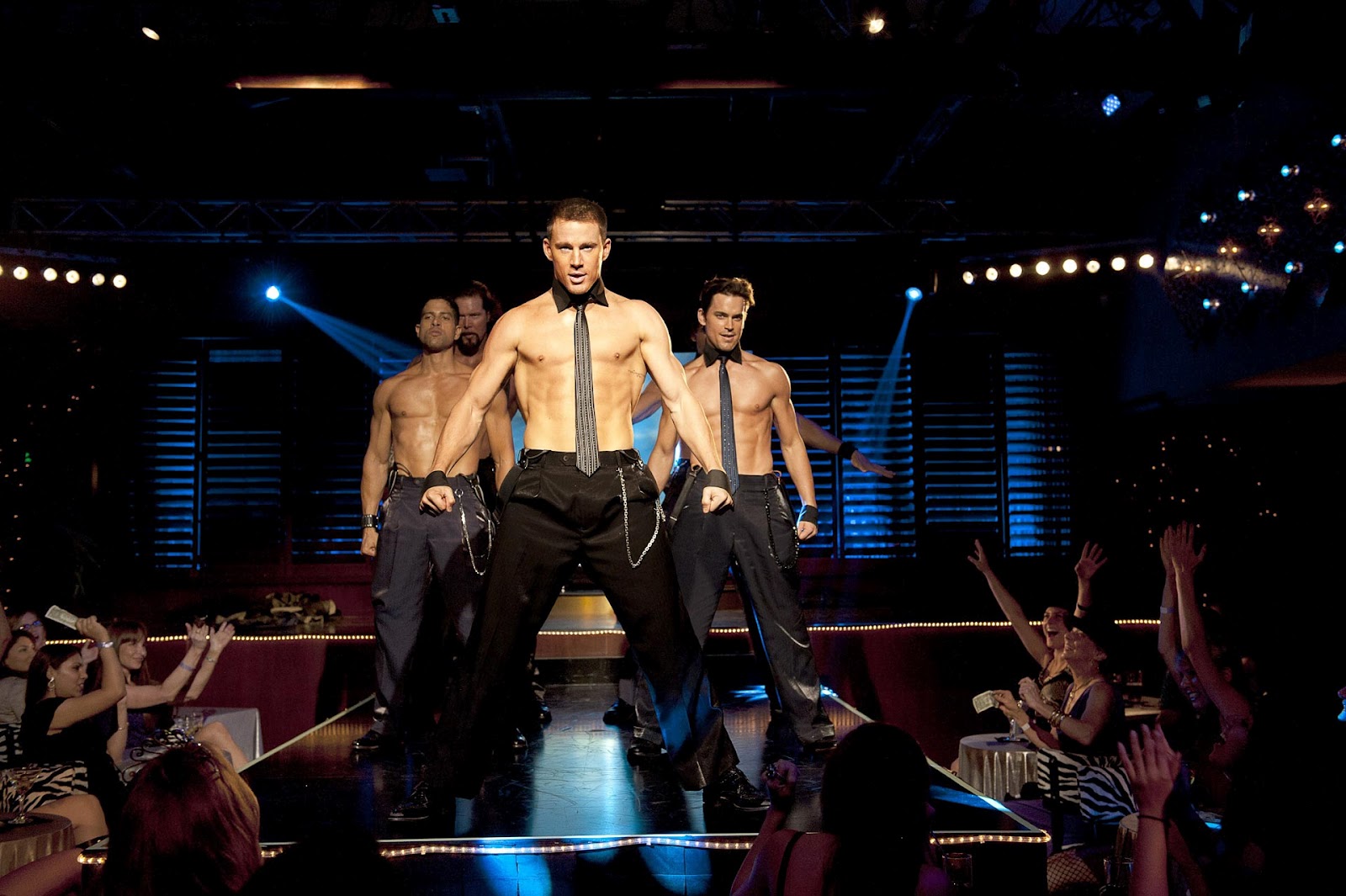
Metcalf also mentioned the "demasculinazation" at work in this movie. That for all the hustling Mike is shown doing, what he really makes his money at is a performance of the kind of hyper-masculinity that is no longer available outside the club. Think about it--how many of the acts are based around the kind of "man's jobs" that are really no longer valued outside that club: construction worker, fireman, soldier, cowboy. These are archetypes of maleness that really have no role to play in the hustler economy because they just don't pay enough to sustain families and a middle class existence. (I'm being overly broad here--maybe it would be more accurate to say that they are no longer aspirational jobs, that culturally they are no longer relevant in the way they once were.) Instead of performing these actual jobs, the men of Magic Mike turn them into stage offerings to women, who respond not with actual lust, but with hooting and laughing.

After listening to this, I am convinced that this is a deeply thoughtful movie, and that the brilliance of it is that it's slipping the medicine in under the bright candy coating, so you don't object. Maybe you don't notice it either, but I don't think Soderbergh is worried about that. Magic Mike is a good-time, party people movie, and it can be enjoyed entirely on the level of watching very pretty men with very pretty muscles flaunt their beauty. At the same time, the real hopelessness of that as a career, the real lack of social stability from that economic model gets shown to us over and over. And that's going to get itself into the cultural conversation.

Which explains something to me about the cinematography. I was struck by the odd sepia tones of everything that happens outside the club. Sure, I get that you might want to have some visual variety--but why do you want that visual variety? What does that mean that the inside of the club is so visually appealing and outside is so--bland? Certainly, that's not how I think of Florida. To me, Florida sunshine is almost too bright, the architecture and the flora and the clothing is saturated and vivid. In contrast to the pale weak light of Minnesota (especially in the winter) where bright colors just look garish and eye-searing, Florida light makes color come alive.

And if the story is that stripping is ultimately a dead-end for a guy like Mike, who has to grow up and move on, then it's more logical that the club would start to reveal the tawdriness under the slick lighting. The real world should reveal itself as a better place to be precisely because it is real. Certainly, popular culture is rife with seedy strip clubs were the veneer of glamor has already worn so thin that anyone fooled by the illusion
is either willfully blind or in denial.
I think Soderbergh is doing something different here. Reality is hard, it's a long slog toward uncertain rewards. There is no certainty that effort will be rewarded, only that effort is inevitable. The club offers the illusion that talent will pay off, that there is a better life available. After all, all the women are young, well-groomed, compliant in playing the roles assigned to them by the club--they cheer, they offer money, they respect the dancers, they participate when pulled up on-stage. There are no gay men in this bar to challenge that cheery illusion. However attractive it appears, however, the club only actually supports the life-style aspirations of one guy--the owner. Everybody else gets a smaller slice of the pie, and eventually they will have to move on due to age, physical condition, maturity. There is only one guy in seven or eight (given the cast of the movie that is) who can make a true living at this life, and he's the guy who owns the real estate. So Soderbergh shows us a legitimately attractive club, with a hazy, browned-out "real life" and so cues us into the exact experience of life that Adam and Mike have. Life is better in the club, and Adam is young enough that he doesn't see the illusion. Mike does, and by the end of the movie, even he sees that he has to re-think his life entirely--and that hazy browned-out world is hard to see clearly.

BUT! There is plenty of joy and casual fun in this movie that that story can slip by you entirely if you want it to. And even that is a message of the movie. I tell you, I am loving this movie in retrospect more and more.
Photos from Filmofilia.
_______
*I'm assuming that Adam buys his cold can of Pepsi at a 7-11 or similar convenience store, while the contractor buys cases at Sam's Club--because of course Adam can't afford a Sam's Club membership, and he's not the kind of guy who plans ahead and goes to the grocery store. Thus the differential cost of that can of Pepsi. Of course, in some sense, that can just cost Adam $20,000, because that's about what $10/hour annualizes to.
Tuesday, July 03, 2012
Magic Mike, a Review
So Steven Soderburgh and Channing Tatum have made a male stripper movie. This was not something I was necessarily on-board for, but it turns out it's quite fun and not only on the Linda Holmes Index.*
*Linda Holmes Index calculates how hot it has to be before you will go see a movie for the air conditioning. Named for the host of NPR's Pop Culture Happy Hour and host of the pop culture blog Monkey See--which are both definitely worth the time you waste with them.
Of course, if it hadn't been shoved down our throats for the last seventeen years that this was the Channing Tatum STRIPPER MOVIE, we might have shared a little more curiosity about the first ten minutes of the story. We could have been in Alex Pettyfer's shoes, following Channing Tatum's character around, thinking we are just club hopping, and finding out that he's A STRIPPER! Trying to get women to come to his MALE STRIPPER SHOW!!
So, in case you have been living in a convent with no access to the Internet and a life of enforced celibacy, I will summarize the plot. CHANNING TATUM IS A MALE STRIPPER!!!
Okay, there is slightly more than that. Channing Tatum plays Mike Lane, a thirty-something Tampa man who has entrepreneurial dreams and an affable manner. Not to mention muscles and dance moves. So between working construction, (apparently) owning a car detailing service, and building custom furniture from beach debris (!), he is the second in command at a male strip review. And once we establish his stripper job, we never go back to any of the other "jobs" he has. (We do get to see him turned down for a bank loan to launch his furniture business--we never actually see him ever *make* any furniture.) Because why? Because this is not a movie about a guy hustling in a crappy economy to make his dreams come true, this is a STRIPPER MOVIE.
Okay, secondarily, it is about a charming guy trying to get it together in a crappy economy, one who has business dreams, but crucially lacks the knowledge of what it would take to actually get ahead. In the scene at the bank, he gets turned down for having a bad credit score. He could take the cute loan officer's advice and get into a program to improve that number, but he doesn't seem to understand how important that score is to achieving his dreams. There is a lot of talk about "equity" in the new stripper club, but I'm not sure anybody knows what that means in a cash business. It's also not clear that for all his "businesses" that he is anything more than a tricked out handyman. So he's got dreams, he's got 80% of what it would take to achieve them, but he doesn't have any clue about the missing 20% that is going to make those dreams unachievable.
But Soderbergh doesn't really care about that. This isn't Up in the Air in a Thong--or maybe it is, since the most interesting part is what it takes to actually be a stripper. That's what the bulk of the film is about, that's what the ladies in the theater came to see, that's where the colors and lights and glamor of the movie are concentrated. And it is interesting, and full of pretty men with muscles and dance moves and hairless, oiled bodies. In case you weren't sure what you were going to be getting with this movie--see above, re: convent, lack of internet access, etc.--within the first three minutes of the movie you get to see Channing Tatum's magnificently muscled butt as he climbs out of bed and heads to the bathroom.
He then goes to a job laying tile roofs for the endless new construction in Florida, and there he meets Adam (Alex Pettyfer) who is a complete noob, so Mike shows him how to do the job, and gives him a hand when his car won't start. Later that night, the two run into each other, and Mike drags Adam along, pushing him into talking to some girls at the bar. Turns out he's wrangling audience members to come to the strip club--which we already knew about because UNRELENTING INTERNET INFORMATION. So there isn't the kind of "Oh, this isn't what I thought it was going to be about" which is what Adam's arc is. Instead it's more of "when are we going to get to the club?" But what the scene does show is Mike's easy good nature, and establishes that the stripping is also going to be good natured and fun, not sleazy and desperate. In fact, the entirety of Mike's life is a "go along to get along." His charm is what has allowed him to achieve as much as he has (however much that actually is); it's his foot in the door, the opening that allows him to introduce his talents.
But it's not enough. As the movie progresses, Adam ends up stripping and loving the life of easy cash, alcohol and women. He tries to leverage his own situation by dealing drugs, but since Adam is a screw-up, that goes almost as badly as it can. Mike ends up paying off Adam's debt, nearly depleting his savings and probably giving up his furniture dreams. Somehow, this doesn't come off as a major change in his life, and it's not clear that Soderbergh considered the drug subplot to be actually central to the movie.
So what is central to this movie? Well, obviously, it's the stripping. It's almost like a "slice of life" documentary rather than a "movie about the turning point in a man's life." If not for Adam and the drug debt, there's not much fraying to Mike's life at all, really. He seems pretty happy, he's got a nice place to live, he's got a sweet car, he's got easy access to beautiful women--he's kind of living in a timeless bubble that has probably enveloped him since he was 19, just like Adam.
There are hints that he wants a different life, that he's finally maturing enough that what he has isn't going to be enough for the long term. His friend with benefits, played by Olivia Munn, gets engaged, ending that part of his life. The strip club is moving to Miami, so he needs to decide if he's going to move with it or stay in Tampa. And, because this is Hollywood, there is a girl.
Played by nepotism candidate Cody Horn, she's Adam's big sister, and so Mike continues to mentor Adam in part for her sake. The reviews have generally not been kind to her character or Horn's acting ability, and I get that. She's able to banter with Mike well enough, but there's no there there. Which makes the ending kind of unsuccessful.
HERE BE SPOILERS.YE HAVE BEEN WARNED.
Mike abruptly decides to leave stripping, to stay in Tampa. He shows up at Brooke's house with only that decision and nothing else Some reviewers (a phrase which here means Tara Ariano on Extra Hot Great--love you guys!) don't see what Mike sees in her that he would give up his life for her. And while I totally understand that criticism, I think there is something more subtle, more Soderberghian going on. Will Mike and Brooke be soul mates and is this their One True Love. No way in hell. They will be lucky to last more than a year. But! What Brooke does do for Mike is show him that he can be vulnerable, he can be something other than perfectly charming and accommodating, and he can still be accepted.
This is where those first scenes are so very important. Mike gets saddled at a construction site with a guy who not only doesn't know how to do the job, but arrives wearing sneakers--clearly a guy who is not even capable of recognizing the safety precautions he needs to take for his own sake. (This is Adam, in case that wasn't clear.) Mike teaches him how to do the job, and rescues him from himself when Adam's car won't start, and again that night when Adam can't get into a club. Mike remains affable, charming, and puts up with repeated instances of Adam's fuckwittery. So it's really no surprise that Adam screws up a sorority dance gig by giving one of the women a pill, which leads to a fight, which leads to the two of them having to leave without getting paid. Again, Mike covers for him with their boss. Then, when it turns out that Adam left behind the drugs he was supposed to sell, Mike pays off the debt, again saving Adam from himself. He doesn't even challenge the thugs about the amount Adam owes them--Adam lead him to believe that it was $1000 worth of Ecstasy, the thugs tell him it was $10,000. Mike doesn't challenge, doesn't argue--he remains affable and "in control" of the situation, even as it spirals out of control around him.
Brooke doesn't see Mike as the successful, fun guy he presents himself as. She sees him as the guy who got her idiot brother into a lifestyle that was beneath Adam's talents, and which seduced him with the easy cash and glamor into remaining an indolent screw-up. Brooke sees Mike's mistakes with Adam, and she calls him on them. For a guy used to taking his clothes off in front of women, this is actually a new experience, because she sees him for what he is. There is even a scene when she screams at him "I see you, I see you." [At least, I think this is in this movie--it's been two days now, and I am forgetting some of the details.]
She does. She sees him in his imperfection, past the glossy glamor he projects, and she is still able to accept him as worthwhile. I think this is an entirely new experience for him, and it comes at the time when his life isn't holding together quite the way it used to. This is the thin edge of the wedge that is his maturation--this is the beginning of the time when he learns that he is not going to be able to stay young and golden forever, and that the coming changes are going to be harder than he expected. Having someone--even someone as two-dimentional as Cody Horn's Brooke--able to see and accept him for who he really is inside is exactly what he needs at this moment.
So there is a great film lurking inside the shiny carapace of Magic Mike. There is also a crowd-pleasing fantasy of what male stripping could be (but probably isn't, actually, not in real life). Like Mike's actual life, the glossy surface is appealing, but ultimately is unsustainable. Soderbergh has given us the story of the first cracks in that facade, and has traced the trajectory. Mike will not fall hard and fast, but he will have to change, and it's up to him to control that new trajectory.
Monday, July 02, 2012
Random Thoughts
Went to see the Soderburgh/Tatum movie Magic Mike today. Not many men in the theater. No large groups of women. . .although a few groups of large women.
Not a movie I would have wanted to see with either my mother or my daughters, especially. That didn't stop some women from bringing a teen-aged daughter with them. Did they think it was a PG movie? Of course, seeing it with your mother/daughter gives an extra 3D kick to the "ick factor" when Adam's sister comes to see him dance. . . .
How the heck do you program previews for a movie like Magic Mike? I guess you just throw a bunch of stuff up and see what sticks. Meryl Streep and Tommy Lee Jones in sex therapy for geriatics rom-com? Yes! Many in the theater thought they might like to see that! Horror movies about kids possessed by demons and paranormal experiments gone horribly wrong? Not really the right crowd. Oddly, not many straight white males between the ages of 15-24 at a screening of Magic Mike.
Let's play a game! Which of the following is the title of a movie previewed before Magic Mike, and which is the name of a New Wave band from the 1980s?
The Words
The Pretenders
The Silencers
The Possession
The The
The Apparition
The Association
(Answer: Numbers 1, 4 and 6 were the names of movies that I saw the previews for today. Numbers 2,3 and 5 are/were New Wave bands. Number 7 was a band from the 1960s. I thought we had moved beyond the whole "definite article + noun" naming thing back when it had become a cliche.)
Is Cody Horn the knock-off handbag of Elizabeth Banks' Coach purse? Discuss.


Up next--an actual review of Magic Mike.
Not a movie I would have wanted to see with either my mother or my daughters, especially. That didn't stop some women from bringing a teen-aged daughter with them. Did they think it was a PG movie? Of course, seeing it with your mother/daughter gives an extra 3D kick to the "ick factor" when Adam's sister comes to see him dance. . . .
How the heck do you program previews for a movie like Magic Mike? I guess you just throw a bunch of stuff up and see what sticks. Meryl Streep and Tommy Lee Jones in sex therapy for geriatics rom-com? Yes! Many in the theater thought they might like to see that! Horror movies about kids possessed by demons and paranormal experiments gone horribly wrong? Not really the right crowd. Oddly, not many straight white males between the ages of 15-24 at a screening of Magic Mike.
Let's play a game! Which of the following is the title of a movie previewed before Magic Mike, and which is the name of a New Wave band from the 1980s?
The Words
The Pretenders
The Silencers
The Possession
The The
The Apparition
The Association
(Answer: Numbers 1, 4 and 6 were the names of movies that I saw the previews for today. Numbers 2,3 and 5 are/were New Wave bands. Number 7 was a band from the 1960s. I thought we had moved beyond the whole "definite article + noun" naming thing back when it had become a cliche.)
Is Cody Horn the knock-off handbag of Elizabeth Banks' Coach purse? Discuss.

Up next--an actual review of Magic Mike.
Wednesday, June 20, 2012
The Adjustment Bureau, A Review
Yeah, yeah, yeah, this is an ooooooold movie and nobody bothered to go see it in the theaters so why review it now, get over it and move on. Ooooo, look! Prometheus!
Fine. Yes. So it's a year old and I saw it on HBO. Too bad--I'm posting about it!
The story. Matt Damon plays a young rising political star, who meets Emily Blunt and immediately recognizes her as The One. She may feel the same way. But! There are Men in Hats, lead by the dapper John Slattery/Roger Sterling who are some kind of bureaucratic heavenly host, who have to keep steering humankind back onto track. Turns out that if Matt and Emily stay together, the Plan will be thwarted and. . .what, exactly? Who knows, but kind of bad, apparently. (We get hints--when the Adjusters stepped back, the world got the Dark Ages. So they intervened, gave humanity the Renaissance, the Enlightenment, spent 400 years teaching us how to grow properly. They stepped back and we invented WWI, the Great Depression, the Holocaust and the Cuban Missile Crisis. They forgot to mention the mullet and Nickleback.) The Men in Hats won't let it happen.
There are also carrots to go with that stick--if he gives her up, Matt Damon will eventually be president, and Emily Blunt will be the leading choreographer of the age. If he doesn't give her up, Matt will destroy his own dreams and hers as well. So he tries giving her up, but it political success isn't fulfilling enough. But she's getting married! Matt Damon has to enlist his own personal Man in Hat to help him evade all the other Men in Hats. Can he get to her in time?
But of course. True Love Always Conquers All in Hollywood Movies.
Love Emily Blunt. Too bad she's more an accessory than a full human being, a kind of manic pixie dream girl who at least gets some token dreams of her own. However, she is of interest to the Men in Hats only in so far as she either helps or hinders Matt Damon from becoming President. She inspires him to go off message in a concession speech early in the movie which allows him to continue to be a viable candidate four years later. But then the Men in Hats see that she will make him happy and he won't have that drive to fill his empty center caused by the deaths of all his immediate family--so they have to keep them apart.
Bechdel test? I don't see it passing--even when she's performing with her experimental dance troupe, Emily Blunt is the only female. There may be a technical pass, as she's heading into her wedding at the courthouse, she turns to her maid of honor and excuses herself to go to the bathroom. Hey--at least it's not about a man!
Matt Damon--still youthful looking, but not the most charismatic I've seen him.
John Slattery--dapperly ominous. Not something you see from a lot of villains generally. He's got a lovely weariness to him, but I don't really buy him as a bureaucrat.
Terence Stamp as the District Manager of the Men in Hats. (Yes, I made up that title. He's higher up in the hierarchy, but not by much.) Is he the go-to when you can't get Malcolm MacDowell? Are they Two Stars, One Slot? Discuss

 Final summation? Acting is fine, writing is not up to par. The "ordinary reality" doesn't ring quite true, so the fact that there's surreal disruption isn't as jarring as it should be--it all feels slightly off. The concept that angels have to constantly intercede with humanity to keep God's plan on track is so high concept, but fails to really conform to mainstream theology about the nature of humanity, the nature of God, and the limits of free will. So the theology is off, the "reality" is off, the idea is a hoot but the last 15 minutes feels like the "race for your love" cliche.
B-, but Emily Blunt gets an A.
Fine. Yes. So it's a year old and I saw it on HBO. Too bad--I'm posting about it!
The story. Matt Damon plays a young rising political star, who meets Emily Blunt and immediately recognizes her as The One. She may feel the same way. But! There are Men in Hats, lead by the dapper John Slattery/Roger Sterling who are some kind of bureaucratic heavenly host, who have to keep steering humankind back onto track. Turns out that if Matt and Emily stay together, the Plan will be thwarted and. . .what, exactly? Who knows, but kind of bad, apparently. (We get hints--when the Adjusters stepped back, the world got the Dark Ages. So they intervened, gave humanity the Renaissance, the Enlightenment, spent 400 years teaching us how to grow properly. They stepped back and we invented WWI, the Great Depression, the Holocaust and the Cuban Missile Crisis. They forgot to mention the mullet and Nickleback.) The Men in Hats won't let it happen.
There are also carrots to go with that stick--if he gives her up, Matt Damon will eventually be president, and Emily Blunt will be the leading choreographer of the age. If he doesn't give her up, Matt will destroy his own dreams and hers as well. So he tries giving her up, but it political success isn't fulfilling enough. But she's getting married! Matt Damon has to enlist his own personal Man in Hat to help him evade all the other Men in Hats. Can he get to her in time?
But of course. True Love Always Conquers All in Hollywood Movies.
Love Emily Blunt. Too bad she's more an accessory than a full human being, a kind of manic pixie dream girl who at least gets some token dreams of her own. However, she is of interest to the Men in Hats only in so far as she either helps or hinders Matt Damon from becoming President. She inspires him to go off message in a concession speech early in the movie which allows him to continue to be a viable candidate four years later. But then the Men in Hats see that she will make him happy and he won't have that drive to fill his empty center caused by the deaths of all his immediate family--so they have to keep them apart.
Bechdel test? I don't see it passing--even when she's performing with her experimental dance troupe, Emily Blunt is the only female. There may be a technical pass, as she's heading into her wedding at the courthouse, she turns to her maid of honor and excuses herself to go to the bathroom. Hey--at least it's not about a man!
Matt Damon--still youthful looking, but not the most charismatic I've seen him.
John Slattery--dapperly ominous. Not something you see from a lot of villains generally. He's got a lovely weariness to him, but I don't really buy him as a bureaucrat.
Terence Stamp as the District Manager of the Men in Hats. (Yes, I made up that title. He's higher up in the hierarchy, but not by much.) Is he the go-to when you can't get Malcolm MacDowell? Are they Two Stars, One Slot? Discuss
B-, but Emily Blunt gets an A.
Moonrise Kingdom, A Review
Saw Wes Anderson's latest movie Moonrise Kingdom on a whim last weekend. I might best be described as "agnostic" about his work--I have seen The Royal Tennenbaums and The Fantastic Mr. Fox, and liked them well enough, but not so much that I was compelled to devour his entire oeuvre. I am a fan of Bill Murray, which might make you think I would have gone out of my way to see The Life Aquatic with Steve Zissou, but then you would be wrong. And I have never seen Rushmore, although I have an idea that Murray might be in it?
So, I'm not in a position to completely explicate the precise location of this latest movie in Anderson's development as an artiste. On the other hand, I am not jaded about his quirks and tropes. I am a casual movie-goer who likes the discipline of sitting in a dark room where I cannot be interrupted, and I go to be told a story. Moonrise Kingdom entertained me and gave me some lovely things to look at and told me a story about people I had not already seen. Plus there was a refreshing lack of car crashes, fireballs, and snarky one-liners delivered before murdering another human being.
The story is simple: In September of 1965, twelve year old Suzy Bishop lives on the Maine-like island of "New Penzance" with her distant parents (Frances McDormand and Bill Murray) and three younger brothers. Twelve year old Sam Shukusky is on the island as a "Khaki Scout"--highly decorated and disliked by all the other boys. The two met the previous year, at a performance of Benjamin Britten's "Noye's Fludd" where Suzy played a raven. They wrote letters to each other and plotted to run away together. Sam brings his survivalist knowledge acquired during his years as a Khaki Scout, as well as the requisite gear. Suzy brings half a dozen large library books and a battery operated record player. Plus extra batteries. Between them, they make an idyllic existence that lasts only a short while. But while it lasts, they live with a sureness of purpose and an unshakeable belief in their love for each other that is both highly stylized and fundamentally true about first love.
In contrast, the adults in the movie are at best befuddled, all of them more than a little lost in their own lives. Suzy's parents share a roof and little else. Bruce Willis plays the chief of the Island police force: he seems ill equipped to handle the case of the missing children, and his "affair" with Frances McDormand seems to consist of sharing cigarettes and the occasional handshake. Edward Norton is the Khaki Scout leader who "loses" first Sam, and ultimately his entire troop. The only truly competent adult is Tilda Swinton, as "Social Services" who is dispatched to the island to "intake" Sam and find him a new placement--most probably an orphanage.
So what happens? Sam and Suzy run away and camp for a few days across the island. The Khaki Scouts and police mobilize to find them. Suzy is sent home, and Sam is sent to bunk with Bruce Willis until he can be sent to Social Services on the mainland. However, the rest of the scouts have a change of heart, and decide to re-unite the young lovers and help them escape. They enlist the help of Cousin Ben (Jason Schwartzman) who also marries them in a brief Scout-Jamboree type ceremony, while explicitly acknowledging that due to their youth, lack of parental consent, and other problems, the ceremony has no legal force but may have some moral effect. The kids then sail to a larger island, where the Khaki Scouts are assembling for a summer's end celebration. There is another chase, a major storm, flooding, some heroic saves, and ultimately resolution. Suzy remains at home, where Sam visits her, driven surreptitiously by his new [foster? adoptive?] father, Bruce Willis.
The joy in the movie is in the details--which is probably self-evident, given that it is a Wes Anderson film. The opening scene pans through Suzy's home, each room as squared and tidy as a doll house. When Sam is discovered missing from his tiny tent, Scout Master Edward Norton finds a hole cut in the canvas and covered by a map, like the escape route from Shawshank Redemption. One night, as the scouts are helping them escape, Suzy reads to the whole troop from one of her books, in a scene reminiscent of Wendy telling bedtime stories to the Lost Boys in Peter Pan.
The island is lovely, the acting is extremely low key, the plot is largely incidental to the visual beauty--even the campsites Sam sets up make little objective sense. Why put Suzy's suitcase there? But the style is in service to the overarching nostalgia of the theme--this is what a first love feels like, and these are the artifacts of that time that evoke that memory. So the period props--the record player, the library books, the clumsy suitcase, the badly stenciled scouting equipment--are deployed as totems of a time that exists only in memory, that can only be roughly re-created, just as the feeling of being twelve and on an adventure can only be vaguely understood by the adults in the movie or communicated to a movie-going audience.
Worth seeing? I'd recommend it--it's lovely storytelling in a highly fictive fashion, using the inherent realism of movies to de-familiarize the visual and making it all feel like the stories Suzy reads aloud around the campfire.
Also--the charming official website for the movie is worth exploring.
Saturday, June 02, 2012
Amen Corner at the Guthrie Theater, a review
First--let's acknowledge that I am apparently dead to joy. My cold dead heart keeps interfering with my ability to engage emotionally with movies, books, and now theater. I am also informed that the fact that I don't care for lychee is further evidence of my emotional stuntedness. Or maybe I am just too old and crotchety to do anything but yell at the kids these days to get off my lawn. Either one.
Second--my quarrel is with the play, and possibly the decision to stage it at all. The acting was uniformly excellent, and the music was outstanding. The stage set was detailed and effective, the costumes were perfect. As a period piece, as a cultural artifact of African-American experience, it was a perfectly presented 1954 play.
That said--this is the first play James Baldwin wrote, and it focuses on a pivotal week in the life of Margaret Alexander, a pastor in a tiny church in 1954 Harlem. Margaret, called Maggie, is a charismatic leader of a "praise Jesus" testifying type of church, who seems to have a truly sanctified life. She preaches against cards, liquor, and jazz music, even specifically warning one of the congregants not to take a job driving a truck for a liquor company so as not to enable alcoholism in others and not to jeopardize his own salvation. Her 18 year old son David plays piano for the services, and they live downstairs in the building with Maggie's sister Odessa. As the play opens, we see a church service that ends with a collection taken to send Maggie to spend a week in Philadelphia ministering to a sister church with a dying pastor.
Into this situation comes Maggie's husband and David's father, a jazz trumpeter named Luke, who is dying of tuberculosis. In front of several members of the board of elders, Luke reveals that Maggie is the one who left him, rather than the other way around. He then collapses, and gets installed in a bedroom where he is expected to die within days. Maggie leaves for Philadelphia, and in her absence everything changes.
The congregation begins to question her leadership, sparked by the situation with her husband. What kind of woman leaves her marriage? What kind of woman leaves her dying husband--and if she couldn't bring him to accept Jesus and the sanctified life, why were they allowing her to lead them? And just how much does it cost to go to Philadelphia anyway--that collection was over $40, and it only costs $3 if you go by bus. Maggie's obligation to her family should take precedence over her job, even if her job is God, shouldn't it? The bitterness grows--Brother Boxer is only trying to provide for his family, why shouldn't he take that truck driving job?
Meanwhile, David is facing his own crisis of conscience. He's nearly adult now, and studying music, and his mother's circumscribed world of church and home is no longer enough for him. The appearance of his father gives him a tangible model for a different kind of life, and he longs to go out into the world. He doesn't want to hurt his mother, but he also can't live the life she envisions for him, where he stays forever and eventually takes over the church.
At three and a half hours, this is just too much play. The structure shows its age, and it creaks more than a little bit. The testifyin' and amenin' at the beginning goes on well beyond what the audience needs to get the context. The self-satisfaction of the congregation smells hypocritical well before the cracks start to appear, which unbalances the message. These people aren't struggling with profound questions and self-doubt. They are spoiled and self-satisfied, angry at being berated by a woman, eager to turn on her and seize power and control from her at the first sign of weakness. Which makes the whole "give you life to God" appear less like a legitimate spiritual quest and more like self-medication to deal with the pain of life. The cracks in Maggie's facade of holiness don't occasion any soul searching--it's more like "Mean Girls Goes to Church." It's purely a power struggle for tiny stakes (the leadership of an impoverished organization) rather than a search for the transcendent.
Luke's appearance raises a kind of weird dichotomy, that's hard to really take seriously in 2012. Can contemporary audiences really take seriously a claim that jazz is "devil's music" and even listening to it is to risk damnation? Seriously? I understand that may have been a real issue back when the play was written--the strict divide between church music and popular music made Ray Charles deeply controversial, bringing gospel tropes to his music the way he did. Now, it just seems like a quaint belief that carries no moral force.
Ultimately, the play works through several layers of superficial conflict to the real question--do you live in the world and accept all the joy and pain, or do you hide from it--and find out that hiding doesn't protect you like you thought it would. Maggie and Luke had a second child who died as a baby, and the pain of that loss was more than Maggie could bear. She fled to New York and struck a bargain with God--she would deny herself anything remotely connected to worldly pleasure, and he would keep her safe from pain.
Of course, God doesn't work like that, and so David grew up anyway and Maggie couldn't keep him "out of the world." He leaves to join a combo, touring and playing music. The congregation rejects Maggie's total control over their lives, and vote her out as pastor. Luke dies, and Maggie realizes that she never stopped loving him. She confronts her own deepest fears, and wonders whether she threw her life away, now that she has lost her church, her husband and her son--couldn't she have done better living some other way? She mounts the pulpit at the (hostile) church and recognizes that loving God means loving "all his Children" with all their faults. She goes back downstairs and curls up against Luke's body as the lights go out.
The play owes great debts to Eugene O'Neill and Tennessee Williams. The entire David plot is basically The Glass Menagerie in Harlem--the domineering mother, the son's need to establish his independent identity. I guess the church plays the role of the crippled sister. Everybody has a monologue moment of crisis, a series of set pieces that follow each other like pearls on a string, and the play ain't over until everybody has had their solo. The creakiness of the format just gets louder the longer the play carries on.
Nor is it possible to swallow some of the basic assumptions that fuel the plot--at least for me. Apparently it's acceptable for a woman to have a career if her husband has left her; it is not acceptable for a woman to have a career if she leaves her husband. That betrays a fundamental failure as a woman, and marks her as unworthy to be a pastor. The sinfulness of jazz music is not explained, just assumed, and so it comes off as a silly prejudice equivalent to the kind of things mocked in The Music Man:
The issues here are big ones, and they continue to affect us. How does one deal with the loss of a child? It's obvious that the pain of that was so great that Maggie literally could not face going through it again and in a era where birth control was probably sketchy at best, it's not clear that she could have avoided another pregnancy if she had stayed. She felt that she couldn't rely on Luke--and there is evidence that he did his best, but she wanted him to be more consistent that he was. When she couldn't take his inconsistency, she turned to religion--who is more reliable than the omniscient, omnipotent God?
The problem for contemporary understanding is that the play doesn't really get all the way down to Maggie's character, on her specific issues. I would be interested in a play that explored the deep divide between what she needed from her husband and what he was able to give her--and how she responded to that. What were her options, realistically? Luke claimed that he still loved her, and Maggie seemed to feel that she had never stopped loving him, and their decade apart was caused by her fear and pain, based on the text of the play. Was that really a waste? Where is she going to go from here? Those are the real questions of the play, and by asking them but not answering them, Amen Corner seems to be making an argument that African-American church life is merely the opiate of the oppressed and powerless, a place to hide that will ultimately fail its members. Kind of bleak, really, but also something the play told us in the first scene, with all the congregants and their posturing sanctity. The message had been delivered in the first ten minutes--the extra three and a quarter hours wasn't really necessary.
But the music? The music was GREAT!
Second--my quarrel is with the play, and possibly the decision to stage it at all. The acting was uniformly excellent, and the music was outstanding. The stage set was detailed and effective, the costumes were perfect. As a period piece, as a cultural artifact of African-American experience, it was a perfectly presented 1954 play.
That said--this is the first play James Baldwin wrote, and it focuses on a pivotal week in the life of Margaret Alexander, a pastor in a tiny church in 1954 Harlem. Margaret, called Maggie, is a charismatic leader of a "praise Jesus" testifying type of church, who seems to have a truly sanctified life. She preaches against cards, liquor, and jazz music, even specifically warning one of the congregants not to take a job driving a truck for a liquor company so as not to enable alcoholism in others and not to jeopardize his own salvation. Her 18 year old son David plays piano for the services, and they live downstairs in the building with Maggie's sister Odessa. As the play opens, we see a church service that ends with a collection taken to send Maggie to spend a week in Philadelphia ministering to a sister church with a dying pastor.
Into this situation comes Maggie's husband and David's father, a jazz trumpeter named Luke, who is dying of tuberculosis. In front of several members of the board of elders, Luke reveals that Maggie is the one who left him, rather than the other way around. He then collapses, and gets installed in a bedroom where he is expected to die within days. Maggie leaves for Philadelphia, and in her absence everything changes.
The congregation begins to question her leadership, sparked by the situation with her husband. What kind of woman leaves her marriage? What kind of woman leaves her dying husband--and if she couldn't bring him to accept Jesus and the sanctified life, why were they allowing her to lead them? And just how much does it cost to go to Philadelphia anyway--that collection was over $40, and it only costs $3 if you go by bus. Maggie's obligation to her family should take precedence over her job, even if her job is God, shouldn't it? The bitterness grows--Brother Boxer is only trying to provide for his family, why shouldn't he take that truck driving job?
Meanwhile, David is facing his own crisis of conscience. He's nearly adult now, and studying music, and his mother's circumscribed world of church and home is no longer enough for him. The appearance of his father gives him a tangible model for a different kind of life, and he longs to go out into the world. He doesn't want to hurt his mother, but he also can't live the life she envisions for him, where he stays forever and eventually takes over the church.
At three and a half hours, this is just too much play. The structure shows its age, and it creaks more than a little bit. The testifyin' and amenin' at the beginning goes on well beyond what the audience needs to get the context. The self-satisfaction of the congregation smells hypocritical well before the cracks start to appear, which unbalances the message. These people aren't struggling with profound questions and self-doubt. They are spoiled and self-satisfied, angry at being berated by a woman, eager to turn on her and seize power and control from her at the first sign of weakness. Which makes the whole "give you life to God" appear less like a legitimate spiritual quest and more like self-medication to deal with the pain of life. The cracks in Maggie's facade of holiness don't occasion any soul searching--it's more like "Mean Girls Goes to Church." It's purely a power struggle for tiny stakes (the leadership of an impoverished organization) rather than a search for the transcendent.
Luke's appearance raises a kind of weird dichotomy, that's hard to really take seriously in 2012. Can contemporary audiences really take seriously a claim that jazz is "devil's music" and even listening to it is to risk damnation? Seriously? I understand that may have been a real issue back when the play was written--the strict divide between church music and popular music made Ray Charles deeply controversial, bringing gospel tropes to his music the way he did. Now, it just seems like a quaint belief that carries no moral force.
Ultimately, the play works through several layers of superficial conflict to the real question--do you live in the world and accept all the joy and pain, or do you hide from it--and find out that hiding doesn't protect you like you thought it would. Maggie and Luke had a second child who died as a baby, and the pain of that loss was more than Maggie could bear. She fled to New York and struck a bargain with God--she would deny herself anything remotely connected to worldly pleasure, and he would keep her safe from pain.
Of course, God doesn't work like that, and so David grew up anyway and Maggie couldn't keep him "out of the world." He leaves to join a combo, touring and playing music. The congregation rejects Maggie's total control over their lives, and vote her out as pastor. Luke dies, and Maggie realizes that she never stopped loving him. She confronts her own deepest fears, and wonders whether she threw her life away, now that she has lost her church, her husband and her son--couldn't she have done better living some other way? She mounts the pulpit at the (hostile) church and recognizes that loving God means loving "all his Children" with all their faults. She goes back downstairs and curls up against Luke's body as the lights go out.
The play owes great debts to Eugene O'Neill and Tennessee Williams. The entire David plot is basically The Glass Menagerie in Harlem--the domineering mother, the son's need to establish his independent identity. I guess the church plays the role of the crippled sister. Everybody has a monologue moment of crisis, a series of set pieces that follow each other like pearls on a string, and the play ain't over until everybody has had their solo. The creakiness of the format just gets louder the longer the play carries on.
Nor is it possible to swallow some of the basic assumptions that fuel the plot--at least for me. Apparently it's acceptable for a woman to have a career if her husband has left her; it is not acceptable for a woman to have a career if she leaves her husband. That betrays a fundamental failure as a woman, and marks her as unworthy to be a pastor. The sinfulness of jazz music is not explained, just assumed, and so it comes off as a silly prejudice equivalent to the kind of things mocked in The Music Man:
Mothers of River City! Heed the warning before it's too late!I mean, the music they sing in church is syncopated and swinging, not all that far removed from jazz, a point underscored by the fact that Luke is able to play along at least once.
Watch for the tell-tale sign of corruption! The moment your son leaves the house,
Does he rebuckle his knickerbockers below the knee?
Is there a nicotine stain on his index finger?
A dime novel hidden in the corn crib?
Is he starting to memorize jokes from Capt. Billy's Whiz Bang?
Are certain words creeping into his conversation? Words like "swell?"
And "so's your old man?"
The issues here are big ones, and they continue to affect us. How does one deal with the loss of a child? It's obvious that the pain of that was so great that Maggie literally could not face going through it again and in a era where birth control was probably sketchy at best, it's not clear that she could have avoided another pregnancy if she had stayed. She felt that she couldn't rely on Luke--and there is evidence that he did his best, but she wanted him to be more consistent that he was. When she couldn't take his inconsistency, she turned to religion--who is more reliable than the omniscient, omnipotent God?
The problem for contemporary understanding is that the play doesn't really get all the way down to Maggie's character, on her specific issues. I would be interested in a play that explored the deep divide between what she needed from her husband and what he was able to give her--and how she responded to that. What were her options, realistically? Luke claimed that he still loved her, and Maggie seemed to feel that she had never stopped loving him, and their decade apart was caused by her fear and pain, based on the text of the play. Was that really a waste? Where is she going to go from here? Those are the real questions of the play, and by asking them but not answering them, Amen Corner seems to be making an argument that African-American church life is merely the opiate of the oppressed and powerless, a place to hide that will ultimately fail its members. Kind of bleak, really, but also something the play told us in the first scene, with all the congregants and their posturing sanctity. The message had been delivered in the first ten minutes--the extra three and a quarter hours wasn't really necessary.
But the music? The music was GREAT!
Wednesday, May 30, 2012
Warning: Schmoopy Sincerity Ahead. Abort! Abort!
With a post title like that, you must be here for the sappy sentimentality. Well, here you go, as promised.
Today was the final assembly of Elder Daughter's high school career, and it was awards day. Did you know that some high schools actually still give out academic recognition awards? I thought it was something they only did in English all-boy public schools and Monty Python sketches.
But such things still exist at my kids' school, and today was the day. And it was a day of some anxiety, because she is a very smart kid and a very responsible and committed kid, who has struggled with depression and other issues, and still managed to show up every day and be reliable and thoughtful and deeply engaged with learning.
Over the four years of high school, she has been a solid and reliable member of the school orchestra, anchoring the second violin section for four years; one of the few, the proud, the egregiously outnumbered altos in the extra-curricular choir and chamber choir; as the second (or third) level character in the plays. She's rarely been given solos, she hasn't been asked to conduct, she hasn't had showy lead roles, and she's never quite had the opportunity to burst into full color on stage in a way I see her doing at home regularly. She's been solid, reliable, she's always stepped up and performed beautifully, in a supporting role kind of way.
Yesterday, she was anticipating the awards and who would win them, preparing herself to not be recognized with a theater award because other seniors had done slightly more performances, had slightly more hours invested in the program. I saw her struggling to set her own expectations, to rank herself with the other seniors so as to not be disappointed or emotional during this assembly, and my heart broke for her a little bit. Because she is wonderful, but also quiet, unassuming, never self-aggrandizing, and so easy to overlook--as she had been, a little bit.
(I am aware that I am her mother and so of course I think this--everybody's mother feels this way, that their own precious darling specially gifted prodigies are not well served by the education establishment blah blah blah. Sure--that's true. But you try watching your kid preemptively manage disappointment and not get verklempt.)
The drama awards went to all the usual suspects exactly as she had suspected, not to her. Then the orchestra leader stood up and recognized the concert-mistress, and there was an award for a girl who had also accompanied the spring musical. Then there was another award. One that recognized that "You have played in the orchestra since middle school and also played in the chamber orchestra. You sang with the choir and the chamber choir. You have performed characters from tragedy to comedy. I am pleased to present the Somebody V. Something award to--" and it was my girl.
She had no idea this was coming, and I had no idea that it was coming and it felt so right. It was not about her being a diva, it was not about her snagging all the solos, or her starring in all the plays. It captured who she has been--supportive, reliable, talented, dedicated, there. Not only that, but it was awarded by three of the major faculty figures in her life: the choir director, the orchestra director, and the theater director. It was the only award that spanned all three fields.
Back when we were looking at kindergarten programs, we tried to be clear-eyed about her strengths and her weaknesses, and at the time we said "No matter what school she ends up in, she will be fine. But she will always be the kid who does well and doesn't cause problems, and in a large public school classroom, she will be invisible. At this school, she will be seen."
Today, she was seen. And my broken heart broke again a little bit, for the gift that she had of teachers who saw her and loved her for who she is.
[In an anti-climactic coda here, I will also report that she won the highest honor for her Chinese studies as well--the other major academic love of her life. After some serious hard times over the last few years, she got some important validation and she deserved it.]
Thursday, May 24, 2012
Some Things I Like
Okay, in contrast to the last post, I am going to make a list of a few things that I have come across in the last month that I have actively liked and tried to get others into:
So maybe my heart isn't entirely cold and dead--maybe it's just too small. Like the Grinch.
- Sherlock on PBS--the British production created by Stephen Moffat and Mark Gatiss, starring Benedict Cumberbatch and Martin Freeman
- The Drowsy Chaperone--a Broadway musical pastiche, presented as a contemporary man playing a record of a (fictional) musical from 1928
- Tumblr
- Menchie's frozen yogurt shop
- Blunderbuss--the new album by Jack White
- Running on an elliptical
- Prime rib and Lillet at Salut
- Lunch with my girlfriends
So maybe my heart isn't entirely cold and dead--maybe it's just too small. Like the Grinch.
Checking the Heart--Still Cold and Dead
It has come to my attention that I hate everything.
Yes, that is kind of a sweeping statement, but not untrue.
Over the last month, I have read at least four books and seen three Major Movies, and as I sat down to write my reviews and impressions, I realized that I hated them all.
"Hate" might be too harsh of a word for how I actually felt, but "negative" is accurate. Dark Shadows--can't recommend it, because it has no idea what it wants to be. The Best Exotic Marigold Hotel--great cast, shoddy script that the best talents of British acting can't save. The Avengers--a lot of sound and fury, but to very little point. Yet if asked, I would say "I love to go to movies."
Books are worse, in part because now I have read so many of them that I see their problems more than I see their strengths. Weird Sisters, by Eleanor Brown--fails to create any real conflict, fails to create characters I care about, fails to master the small innovations that Brown attempts. Bring Up The Bodies, by Hilary Mantel--extends the brand she established in Wolf Hall but fails to achieve anything with it. Boring. Fifty Shades of Grey--do I even need to say anything? Okay--in brief, it makes Stephanie Meyer look like a master of suspense and plotting, and is boring porn on top of it. There is better stuff out there, even for free.
Wait! you say. You said there were four books, and that's only three. What is the fourth?
That's the exception that proves the rule. The book I am currently reading is Jenny Lawson's Let's Pretend This Never Happened and I am really loving it. She is funny, while recounting a childhood that could make you cry. (I believe Jeanette Walls took that approach in her own book, The Glass Castle.) A (young! still so young!) woman who was raised in poverty, has battled anorexia, crippling anxiety disorder, multiple miscarriages, and rheumatoid arthritis still manages to make me laugh out loud. I may be able to represent her life and her writing in two sentences about the first time she brought her (now) husband home to meet her parents:
Not only does her father--for no discernible reason--decide to throw a wild animal at an unsuspecting young man, but this animal is only one of several wild animals he could have chosen for the task.Is there any need to go on and explain that Lawson's father keeps the bobcats in the yard in order to collect the urine? No, I didn't think so.
But this is where I think I have perhaps gone over the line into privileged, spoiled, unpleasant bitch territory. Jenny Lawson grew up with tap water from a well poisoned with radon, subject to the humor of a father who makes hand puppets out of squirrel road kill, wearing bread wrappers stuffed with newspapers in the winter. Meanwhile, I sit back watching movies and reading books that hundreds of people have spent thousands of hours and millions of dollars to create, and all I can do is say "meh--it wasn't very good. It could have been better."
Could it have been better? How? Okay, you over-privileged jerk--why don't you try to make something one tenth as good. Once you really experience the difficulty of actually creating something that is as good as you expect it to be--then you can come back here and bitch about other people's failures. Until then--shut up!
Is it too late for me? Has my heart really turned into a lump of singed carbon in my chest? Can I possibly raise my cultural response to something more than a tepid "Well--it wasn't a complete waste of time." I think I can, because there are so many things out there I don't know about. I could read novels from other countries, about lives wildly different from my own. I could read non-fiction. I could engage in other art forms that are not so familiar as to be boring--painting, dance, classical music, sculpture, photography. I could learn to read foreign languages and pursue their literature. I could read drama, poetry, experimental fiction. I could study business, economics, politics, rhetoric, history, theater arts. I could start a theater company, learn to program computers, write my own damn books.
But will I?
Yes, that is kind of a sweeping statement, but not untrue.
Over the last month, I have read at least four books and seen three Major Movies, and as I sat down to write my reviews and impressions, I realized that I hated them all.
"Hate" might be too harsh of a word for how I actually felt, but "negative" is accurate. Dark Shadows--can't recommend it, because it has no idea what it wants to be. The Best Exotic Marigold Hotel--great cast, shoddy script that the best talents of British acting can't save. The Avengers--a lot of sound and fury, but to very little point. Yet if asked, I would say "I love to go to movies."
Books are worse, in part because now I have read so many of them that I see their problems more than I see their strengths. Weird Sisters, by Eleanor Brown--fails to create any real conflict, fails to create characters I care about, fails to master the small innovations that Brown attempts. Bring Up The Bodies, by Hilary Mantel--extends the brand she established in Wolf Hall but fails to achieve anything with it. Boring. Fifty Shades of Grey--do I even need to say anything? Okay--in brief, it makes Stephanie Meyer look like a master of suspense and plotting, and is boring porn on top of it. There is better stuff out there, even for free.
Wait! you say. You said there were four books, and that's only three. What is the fourth?
That's the exception that proves the rule. The book I am currently reading is Jenny Lawson's Let's Pretend This Never Happened and I am really loving it. She is funny, while recounting a childhood that could make you cry. (I believe Jeanette Walls took that approach in her own book, The Glass Castle.) A (young! still so young!) woman who was raised in poverty, has battled anorexia, crippling anxiety disorder, multiple miscarriages, and rheumatoid arthritis still manages to make me laugh out loud. I may be able to represent her life and her writing in two sentences about the first time she brought her (now) husband home to meet her parents:
(1) This probably would have been my exact worst nightmare of brining a boy home to meet my parents, if I'd ever had enough creativity to imagine my father throwing a live bobcat on the boy I was trying to impress.
(2) In my father's defense, it was a smallish sort of bobcat that my dad was nursing back to health so he could release it back into the wild, rather than one of the full-grown ones from the backyard.(pp. 88-89)
Not only does her father--for no discernible reason--decide to throw a wild animal at an unsuspecting young man, but this animal is only one of several wild animals he could have chosen for the task.Is there any need to go on and explain that Lawson's father keeps the bobcats in the yard in order to collect the urine? No, I didn't think so.
But this is where I think I have perhaps gone over the line into privileged, spoiled, unpleasant bitch territory. Jenny Lawson grew up with tap water from a well poisoned with radon, subject to the humor of a father who makes hand puppets out of squirrel road kill, wearing bread wrappers stuffed with newspapers in the winter. Meanwhile, I sit back watching movies and reading books that hundreds of people have spent thousands of hours and millions of dollars to create, and all I can do is say "meh--it wasn't very good. It could have been better."
Could it have been better? How? Okay, you over-privileged jerk--why don't you try to make something one tenth as good. Once you really experience the difficulty of actually creating something that is as good as you expect it to be--then you can come back here and bitch about other people's failures. Until then--shut up!
Is it too late for me? Has my heart really turned into a lump of singed carbon in my chest? Can I possibly raise my cultural response to something more than a tepid "Well--it wasn't a complete waste of time." I think I can, because there are so many things out there I don't know about. I could read novels from other countries, about lives wildly different from my own. I could read non-fiction. I could engage in other art forms that are not so familiar as to be boring--painting, dance, classical music, sculpture, photography. I could learn to read foreign languages and pursue their literature. I could read drama, poetry, experimental fiction. I could study business, economics, politics, rhetoric, history, theater arts. I could start a theater company, learn to program computers, write my own damn books.
But will I?
Wednesday, May 23, 2012
Dark Shadows, a Review
Cut to the chase--is it worth seeing? Well, all the jokes are already in the trailer, so save yourself 110 minutes and watch that instead.
Or, go see more of it, but it's not any different, or any better--it's the same as the trailer, just longer.
While it's fashionable to blame Burton for needlessly prolonging a creative partnership with Depp that has gone stale, the real problem here is the script. It's clear that Burton wanted to do "Dark Shadows" without the glacial pacing and chintzy production budget of 1960s television soaps--but he needed a story, and he didn't really get one. Instead, he got a script from Seth Grahame-Smith, the instigator of the current fad of mashing up classic (public domain!) literature and monsters. So the man who gave us "Pride and Prejudice and Zombies" is the writer of what passes for a story in this movie.
[Just a comment on "PP&Z"--the idea is very funny; the execution is tedious in the extreme. Appreciate the concept, but don't bother trying to read it, since it doesn't go anywhere from the premise. Just like the movie!]
The problems are many--the movie fails to be scary at any level, fails to be funny most of the time, fails to offer any insight into why the Collins family believes that family is important--they just keep saying it, but is there any reason to believe them? After all, fully half the remaining family can hardly stand to be around the place at all. The snotty teen played by Chloe Moretz and the loathsome brother played by Johnny Lee Miller don't believe in the family. That leaves Michelle Pfeiffer (looking DAMN FINE) as the impoverished remaining Collins, the little boy who sees ghosts, and Johnny Depp.
And really, the only reason you are going to see a Johnny Depp/Tim Burton movie is to see Johnny Depp. And he delivers a variation on the many foppish, mannered, fish-out-of-water characters he has played in all the Tim Burton movies. His Barnabas Collins has creepy long fingernails, lacy sleeves, a walking cane, and a grudging acceptance of his need for blood. He does pull off looking like a callow teen in the early moments of the film, when he first rejects Eva Greene's affections--is that acting or post-production that gives him that dewy-skinned look? He manages to look both repellent and attractive as a pasty vampire, which is kind of a sweet spot occupied only by Jack Black in my personal pantheon. Differently, of course.
The plot is stupid, and only sketched in as necessary to allow for Burton's patented artistic design. The docks at Collinsport are suitably nautical, the decaying Collins plant is creepy and then fixed up just in time to be gloriously burned down. The Collinses put on a "ball" or a "happening" which is an excuse to get Alice Cooper to perform. He's about as creepy as the rest of "Dark Shadows"--the man may be in his mid-sixties, but he doesn't look bad in the make-up. The Collins mansion, despite having ostensibly been built in 1775 is full on Edgar Allen Poe Victorian gothic, full of hidden panels and subterranian vaults. Not sure how this was done in pre-American Revolution Maine on the proceeds of a fishing business, but it's best not to ask.
Also, don't ask how the Revolutionary era Collinses amassed a treasure hoard of gold and large gems either. Fish must have been a better business back in those days, back when Maine was still part of Massachusetts.
But with the treasure hoard and vampire hypnosis, Barnabas manages to rebuilt the Collins fish cannery and supposedly re-establish the family as the premiere social force in this incredibly tiny town. But his old spurned lover Eva Green (okay, her character is Angelique) is still around and still immortal, and still holds a grudge. She tries to seduce him, tries to re-bury him, and finally tries to kill him and destroy everything he loves. There is the obligatory final battle scene, most impressive for the way Eva Greene's skin cracks like the shell of a hard boiled egg as they fight. There is the completely superfluous element of Chloe Moritz's character also being a werewolf, which--wha? Why, and who cares, and don't even bother.
There is a governess with wide eyes and a Christina Ricci-ness look to her who is the double of the woman Johnny Depp loved back in 1775 and Eva Greene killed back then--so of course she is going to get killed again, except that Depp manages to bite her in time to turn her into a vampire so she survives the fall that her predecessor didn't. Helena Bonham Carter does some fun stuff with a character that is as superfluous as the werewolf thing. In fact, she seems to be around mostly because she is in every Burton film, and because there was a psychologist in the original soap. Other than that, she pulls off a few funny bits as a drunk who wants to use Depp's blood to stop her own aging.
Mostly pointless, only for people willing to overlook the lack of point, or die-hard fans of the original series. The entire project smacks of being an American version of the Doctor Who reboot--a director with a deep love of a neglected original, wanting to give the property the kind of attention possible with a decent budget and the advances in CGI. However, Russell T. Davies got some good storytelling into his reboot--Burton didn't.
The Best Exotic Marigold Hotel, a Review
The pedigree on this movie is amazing--directed by John Madden, the man who directed Shakespeare in Love, which is fashionable to hate but I still really love. The cast list is full of lovable English actors: Dame Maggie Smith, Dame Judith Dench, Bill Nighy, Tom Wilkinson, Penelope Wilton, and Celia Imre. The trailer is gorgeous, full of the color and life of Jaipur, India. Take a look--how could this movie fail?
All the elements were there--except the script. Predictable, cliched, manipulative, boring. Honestly, these actors deserved something much better than they had, and they are good enough that they managed to make it seem like more than it was. It's not offensive, exactly, but it's not inoffensive either. More damningly, it hasn't got much to say, and it doesn't say that particularly well.
It's television grade writing at best, edging along the perimeters of racism and mocking the elderly for being old. It's Enchanted April with less charm and more death.
Even the set up is mostly predictable. We start in England, with the sad stories of our elderly heroes. Tom Wilkinson is a judge (with the red robe and wig on a stand in his chambers) who attends someone's retirement party and realizes it's time to take care of some old business in India. Judy Dench is a new widow, who spent 40 years trusting her husband only to find that she has to sell her home to pay off his debts. Bill Nighy and Penelope Wilton are married and have lost their life's savings when they invested in their daughter's internet business. Maggie Smith is an obnoxious racist who needs a hip replacement and can get one more quickly/cheaply in India. Celia Imre wants to stop babysitting her grandchildren every night and find some action of her own. There is a seventh old coot who wants to go to India to get laid, played by Ronald Pickup who looks like someone I should recognize, but I don't. They all independently decide to go to India and nobody approves.
Really, there is not a single person in the UK who approves of anybody going to India for any reason. Family members, co-workers, real estate brokers all can't understand why anybody would leave London. Only Maggie Smith's doctors approve of her travel to India, but they don't count because 1) they are Indian themselves; and 2) she doesn't want to go.
So--India=Bad Idea. Did you catch that, because that's the plot, such as it is. Old people will leave England, be horrified at India. Would be you be surprised to find out that most of them learn to love it? Of course not, because you are sophisticated enough to realize that nobody would finance a movie about old people who go to India to find out that England is Better but Unaffordable for Old People who have to go to India to die so they don't clutter up London. That would be a terrible movie and not uplifting in any way.
Back to the "plot." Everyone comes upon the internet ad for the eponymous Best Exotic Marigold Hotel for the Elderly and Beautiful. The idea is that the hotel is looking for paying guests, and will pay for the airfare in return for cheap rates? The idea is that it will be an elegant retirement community that is less expensive and more gracious than these characters can afford at home.
[Oddly, the trailer has Bill Nighy's golf partner comparing India with "the coast of Florida?" To which Nighy replies "Yes, but with more elephants." In the movie, the line is "like the Costa Brava?" Not sure what assumptions trailer makers have about Americans' intelligence.]
After some not at all comical scenes involving airports, canceled flights, and overcrowded Indian buses, our Magnificent Seven arrive at the hotel. But Oh Noes! The hotel doesn't look the brochure, which was misleadingly Photoshopped! Penelope Wilton is irate and demands a refund which hotel owner/manager Dev Patel promises to give right away in three months. So now we have 7 people stuck in India in the Bad Idea Hotel. What will happen now?
To start with, Penelope Wilton proceeds to be a pill in every possible way; she hates the food, hates the crowds, mocks the smells, and refuses to leave the hotel, even though she hates it, because she hates India even more. (She spends her time reading "Tulip Fever," a book by Deborah Moggach, who wrote the novel this movie is based on.] To further make her a complete jerk, she throws herself at Tom Wilkinson in a cringe-inducing display of status climbing, and despite already being married to the charming and self-effacing Bill Nighy. Wilkinson rebuffs her, not because she's married (or because she is a pill), but because he is gay. Embarrassed, Penelope tries to pack her bags to return to England, but can't afford the plane fare and breaks down as her ineffectual husband stands ineffectually by offering ineffectual bromides like "we just have to make the best of it."
In contrast, Judi Dench manages to find her way to a call center company which seems to exist to make cold calls to sell something--not clear to me what it is. Their goal seems to be to get people on the phone and keep them on as long as possible. Dame Dench seems to be there to get a job? (According to a web site about the novel, the character is supposed to think it is a place where she can call home to England. Not sure this is what the movie is trying to do, but it could be. You tell me.)
Once there, Dame Judi tells some stupid anecdote about dipping biscuits into something called "builder's tea" and the head of the company hires her to be a "cultural consultant" or something. Which is great for her, since she needs the money (her dead husband's debt problem, after all), but what the hell does she know about how to close a sales call? Why does one tedious anecdote about dunking biscuits and one bad experience with an Indian call center make her an expert? Don't worry so much! It just does--take the movie's word for it. Besides, you can tell Dame Judi is a good guy, because she starts to adopt Indian-ish clothing, long tunics over light pants and a decorative scarf/shawl around the shoulders. You see--in India, Judy becomes the person she never was back at home! India turns out to have been good for her! Not a Bad Idea at all!! Surprised?
Of course, it was obvious that she was going to thrive in India--because she was already Dame Judi Fucking Dench, to start with. Also, she was no fragile hot-house flower of a sheltered housewife, suddenly thrown into the cold hard world by her husband's death. She found out about his financial mismanagement, and stood up against her children's plans for her with steely determination and packed herself off to India against their disapproval. So of course she was going to come out all right. There was never any doubt.
In a major bit of what-the-fuckery, Dame Judi has a silly C plot about wanting to call home, but the telephones at the Marigold Hotel don't work! Ha ha ha, nothing in India works! Isn't it funny how erratic these developing nations and their technology can be! As unfunny and backwards as that "humor" is, the WTFery is that Dame Judi is keeping a blog. She has a laptop and a wireless internet connection--why the hell doesn't she Skype? Dev Patel makes booty calls to his girlfriend on a cell phone. Who flies off to India without an international cell phone--or doesn't find one? Who waits around for two months waiting for a land line? What is this--1950? (Can't blame the age of the novel--it was published in 2004.)
Tom Wilkinson has a Deep Dark Secret that he has kept hidden for over 40 years--when he was a teen, he fell in love with one of the servant boys who worked in his parents' home in Jaipur. The feeling was mutual, and they spent a perfect night together, and watched the sun rise over a river (somewhere a day's trip from Jaipur?). Wilkinson thought he would never be as happy again, and was right because they fell asleep, were discovered, and the Shameful Secret revealed. The servant boy (Minaj) and his family were sent away, Tom was sent back to England for university, and now he is back. "What could I have done?" He asks, confessing his four decade old secret to Dame Judy after knowing her for about 2 days. "It should have been something more than nothing." So he spends his days trying to find his old lover, which involves playing street cricket with the youngsters.
Of course, this is showing the Large Point of how India is his True Home--because nothing says India like cricket? It also raises the question of "how the hell did such an idiot get to be a high court judge?" He gets delivered via motor scooter taxi to an address that was presumably his old address? The address of his old teen-aged lover? And not only is there nothing there, but the remaining nothing is covered with wild plants and graffiti. So he asks the 10 year old street cricket boys "What happened to the buildings? And the people who used to live here?" Like they are going to know. So he goes to the public records office and just keeps asking them to search for somebody--Minaj, I assume. But see, he's conflicted. What if Minaj doesn't want to see him?
But this isn't really a problem, because Minaj is a Magical Native Person, who has long ago told his wife that he was gay, and has a life long One True Love with Wilkinson, so that when Wilkinson shows up at his house, the wife knows all about it and Minaj can deliver the Magical Bro Hug of Forgiveness. See! There were no hard feelings, nor overtones of colonialism, or power inequities, or even any other meaningful relationships for Minaj the Magical Native--he just remained in suspended animation for forty years in order to provide absolution to the Tortured White Man. Then, in a surprising twist (not really)--Wilkinson dies peacefully, assured of his forgiveness! Because we don't want to have to deal with gay elderly sex--that is just too much. So martyr the gay and make it a happy ending!
But don't think we won't make fun of straight elderly sex--because that stuff is comedy gold! (No it isn't.) Poor Celia Imre joins a colonial country club, and tries to pass herself off as a member of the royal family, but picks the one who's been dead for nine years! Ha ha ha not funny. She tries to bribe the maitre d' to seat her with some rich royal bachelor, and guess who it is! It's Ronald Pickup from the Marigold Hotel also trying to work the same scam, but smart enough to pick a living royal to impersonate! In about the only plot element that isn't entirely predictable, these two do not end up together. Instead, lovely Celia helps obnoxious Ronald hit on a lady at the bar who certainly deserves better. But after a couple of completely fake and unsuccessful moves, Ronald admits that he's lonely, and the two hit it off. There is a scene where he goes to get Viagra, and a scene where he dances in the shower. The "humor" is apparently in seeing his skinny old body being naked and visible from afar! And we know he's getting ready to have sex--old people sex!
Frankly, with the way he was jumping around on the wet tiles, I was expecting to see him go down with a broken hip. But he gets laid, and gets to brag about it to Gay Martyr Wilkinson, who reveals that he spent the night with this old gay lover--just talking mind you!--so they are totally bonding and then Wilkinson kicks the bucket.
Who's left? Bill Nighy learns how to take something to be repaired, thus teaching him how to be less ineffectual. He also saves Dame Judi from being run over by a motor scooter, thus igniting their True Passion. But they are both Honorable Sahibs, so they don't do anything but behave perfectly correctly. However at some point, Judi gets overwhelmed by the imtimations of mortality caused by Wilkinson's Happy Martyrdom, and she cries and Bill Nighy comforts her. Penelope Wilton gets all obnoxious about it--conveniently forgetting her attempts to do rub herself all over Wilkinson's upper crust. They have a few cross words, and Penelope reveals that their daughter has paid back the money they loaned her and they can go home to England. Bill doesn't really want to go, but he's decent and loyal, and he packs up but there's a traffic jam! The only way to get to the airport is for Penelope and her suitcases to take a bicycle cab, and Bill can't come too!
In a set piece that Wilton is almost able to sell (but can't quite due to the total lack of script support for her character as anything other than a complete pill before this point), she faces the reality that she and Bill both deserve better and their marriage has been dead for a long time, and he would be doing her a favor if he stayed in India and fell in love with Dame Judi. She leaves, and he goes and smokes some kind of drug, and comes back to make a passionate declaration of love to Judi. And by "passionate declaration" I mean "how do you like your tea?"
Maggie Smith has been mostly forgotten by this movie, and that is probably because her story actually dates from before the invention of movies. It seems she was a housekeeper/governess for an aristocratic family with a stately home, but got pushed out once she was old. I know for a fact that Anne Bronte used this very same plot! She got her hip replaced successfully, but remained stubbornly racist except when trying to tell the untouchable servant girl how to clean. This was misinterpreted as kindness, and servant girl invites Maggie home to meet the 27 members of her family who live in a single room. Maggie has to confront her racism, which she overcomes by being ashamed of being rude to their faces. So now she's become a better person in India too!
Finally, there is the Dev Patel plot--he is in love with a girl who he is willing to sleep with, but won't say he loves her. Nevertheless, she crawls into his bed naked one night, only to find that it's not Dev, but Celia Imre! Because Celia insisted on a room with a door, so they switched rooms and Dev never mentioned it during his booty phone calls. Also, Dev's mother has arrived to squelch his dreams! He is to sell the hotel and marry the girl in Delhi his mother has arranged for him. Fortunately, Maggie's housekeeper job included running the family accounts, so she is able to find financing and save the hotel hurray! And Dame Judi gives Dev a 7 second pep talk that gives him the courage to stand up to his mother! In the final seconds, we see the hotel all spiffed up and running successfully, and boys and girls and old people couples on scooters! Only poor Celia Imre doesn't get her happy ending, which is fine, because women who want sex (especially old women) aren't actually allowed to have that happen, so it's fine. Oh, and Ronald's girlfriend switched his viagra with baby aspirin and he was totally fine--so India is good for male virility too!
Honestly, if Madden hadn't gotten such a great cast (and wasn't so adept at lovely scenes) this would have been a Mystery Science Theater 3000 contender. Poor Maggie Smith is actually forced to utter the line "I can't wait that long. I don't even buy green bananas at my age"--a joke that was stale when the velociraptors told it. And I predicted it two lines before she got to it. (Her UK surgeon tells her that a brown person will perform her surgery, but she's on a waiting list and it will be about six months. Yep--everybody saw it coming.) The first day in India is played for stereotype in an oddly semi-comedic way. Meaning that seeing English old people confronted with scooter taxis isn't actually funny unless you are a racist, so you aren't actually required to laugh at it--but you are kind of expected to. And the dozen other people at the screening did laugh, which made me supremely uncomfortable, because there was nothing actually funny about the scene. The pacing and the scene composition made it look like there was a joke--it was definitely a joke set up--but no punchline other than "Things are different here!"
Final summation--a great cast sold short by a terrible script. Scenery and masterful acting not enough to create substance. Dumb movie made significantly less dumb by the talent involved.
Wednesday, February 08, 2012
Lord Grantham on the Roof
After I posted the last bit about Downton Abbey, I realized that I hadn't made my prediction about Lady Sybil. Will she marry Branson, the IRA-sympathizing chauffeur?
Well--who else is there for her? How many men can these women even meet? And then it hit me--Julian Fellowes is mining Fiddler on the Roof for his plot points! Think about it--a man who has no sons, but too many unruly daughters.
 Daughters of Downton
 Fiddler's Daughters
In Fiddler, Tevye arranges a very lucrative and socially desirable marriage to the somewhat unattractive butcher for his oldest daughter Tzeitl. However, Tzeitl is in love with another man, and so doesn't want to marry the butcher. Lady Mary isn't actually going to marry Sir Richard, not while she is really in love with Matthew. It's just not going to happen, and I'll put money down on it.
Tevye's second daughter falls in love with a revolutionary, and when he is captured and sent to Siberia, she goes to him, leaving behind the comforts of her family. Lady Sybil isn't the second daughter, but she is totally going to commit to Branson, and they will be work to create the modern world.
Poor Lady Edith--Tevye's third daughter elopes with a non-Jew, and Tevye cannot accept the marriage outside the faith. He loves her, but treats her as if she has died. I can't quite make this one fit the template, since the Granthams aren't the least little bit religious, and I can't see what Edith could rebel against that had similar impact on the family. Maybe she'll fall for "Peter Gordon" and emigrate to Canada?
We'll meet back here at the end of the series--or even series 3--to check on how well my predictions turned out.
Well--who else is there for her? How many men can these women even meet? And then it hit me--Julian Fellowes is mining Fiddler on the Roof for his plot points! Think about it--a man who has no sons, but too many unruly daughters.
In Fiddler, Tevye arranges a very lucrative and socially desirable marriage to the somewhat unattractive butcher for his oldest daughter Tzeitl. However, Tzeitl is in love with another man, and so doesn't want to marry the butcher. Lady Mary isn't actually going to marry Sir Richard, not while she is really in love with Matthew. It's just not going to happen, and I'll put money down on it.
Tevye's second daughter falls in love with a revolutionary, and when he is captured and sent to Siberia, she goes to him, leaving behind the comforts of her family. Lady Sybil isn't the second daughter, but she is totally going to commit to Branson, and they will be work to create the modern world.
Poor Lady Edith--Tevye's third daughter elopes with a non-Jew, and Tevye cannot accept the marriage outside the faith. He loves her, but treats her as if she has died. I can't quite make this one fit the template, since the Granthams aren't the least little bit religious, and I can't see what Edith could rebel against that had similar impact on the family. Maybe she'll fall for "Peter Gordon" and emigrate to Canada?
We'll meet back here at the end of the series--or even series 3--to check on how well my predictions turned out.
Downton Abbey, Now You Are Just Being Silly
Back in the 1980s, the heyday of American nighttime soaps, an entertainment writer made a cogent operation. You could instantly convert trashy television melodrama into respectable cultural fare simply by pronouncing it with a British accent. The most effect example was to take the campy histrionics of Dynasty and turn it into BBC-quality material by pronouncing it "DIN-a-sty."
Try it--it works!
(And Krystl in a Henry VIII costume! Of course it's classy!)
But the trick is not infallible. Exhibit A: Downtown Abbey, season 2. Okay, the first season was perhaps a bit to heavily salted with uncomfortable silences and suggestive glances. So much so that the Red Nose Day parody hit best with close ups of eyes shifting around.
This week--this week we got too much all at once, and all of it of equal import. The worst offender is, of course, The Return of the Lost Heir. Amid all the handsome and dapper officers convalescing at Downton--perhaps their mustaches were suffering from exhaustion?--comes a single man whose grotequely bandaged burns are matched only by the ugliness of his "Canadian" accent. With 60% of his face obscured by gauze, a deformed ear, oddly lashless and bulging eyes--and yet a full head of unsinged hair!--this grotesquerie claims to be Peter Crawley. You don't recognize him? Well, why should we--he never actually appeared in the show. He was just the heir, engaged to Lady Mary (who did not love him) and lost on the Titanic.The first we heard of him was the report that the Titanic sank.
Of course, "Peter Crawley" of season one was just a plot device to introduce the missing demongraphic--middle class Matthew Crawley came in to bridge the social classes of aristocracy and servant contained inside Downton itself, and Peter Crawley disappeared from the narrative. Until this week's episode, where he was ghoulishly resurrected, shamelessly manipulated poor Edith, and then disappeared. Meanwhile, Matthew's paralysis might be less than permanent, Bates' wife has complicated the divorce plot (reported by reading a letter) and then gotten herself killed. Edith--the ruined maid and single mother--learned her baby-daddy also died in the war, again by a report from a letter. And Lord Grantham gathered all the Downton residents: family, servants, convalescent officers--into the hall to mark the end of the war. He called for a recognition of the sacrifices made by the soldiers, and the moment of silence lasted the length of the clock striking 11. A longer pause was taken to mark the decision by the butler, Carson, to leave Downton and serve Lady Mary in her new home. Because war? and butler? Same dramatic impact.
Will I continue watching it? Possibly. Depends on my schedule and whether reading recaps is faster and as satisfying. I will make a few predictions.
Daisy will continue to refuse her widow's benefits from the deathbed marriage to William. Edith will claim it instead.
Thomas (who for some reason is always hanging around in the servants quarters, even though he's employed by the army) will find some way to stay at Downton, and will continue to not be gay. (This was the source of his evilness in Season 1--now it just seems that his scheming is caused by smoking too many cigarettes.)
Bates will be accused of his wife's murder, and Anna will stand by him. Neither of them will be allowed to be happy.
Mary and Matthew will lose their inconvenient fiance(e)s, but will not marry until at least the end of Season 3.
Edith will continue to be ritualistically humiliated for her unloveability and will never find a suitable husband.
"Peter Crawley" will never show up again.
Sunday, February 05, 2012
The Ice Cream Koan
The other day, Sursels offered me the following:
If you have no ice cream, I will take your ice cream.
If you have ice cream, I will give you ice cream.
This is an ice cream koan.
Delivered with her bright blue eyes sparkling and wide open, the rest of her face completely dead pan--which it never is, except when she's doing stuff like this--it totally cracked me up. The secret of comedy is in the timing, and timing is very difficult to deliver in print.
I was thinking of this as I made tea for myself this morning. I have a nasty cold coming on, and although I am drugged to the gills, symptoms are sneaking through and making me both grumpy and a bit loopy. I put a large white mug of water in the microwave to heat, and when the timer beeped, I noticed for the first time that the display doesn't just show numbers at that point, but converts to a scrolling message. I noticed this as I already had my hand on the door handle and pulled it open, this preventing all the text from scrolling across the small screen. The message that did make it across was:
FOOD IS
Sometimes, having a cold makes the world seem a little surreal. It's nice to have that kind of reassurance on a day like today.
Wednesday, January 11, 2012
Coda and Spoilers: Tinker, Tailor, Soldier, Spy
I guess it must be a great movie, because I am still thinking about it. And the point I want to make--if I didn't make it before, or make it clearly enough--is that the story of the mole is not the real story of the film. "Who is the mole?" is the plot, and it engages the mind and pulls the viewer through, but the real story is located in the few moments that edge that plot.
The real story, the story underneath the mechanics of who the suspects are, how to locate them, what has been compromised, is that political ideology has no reality. Humans work to uphold political ideals, but those ideals don't make anyone's life any better. It's the dispiriting realization that all the members of the Circus work to keep Britain safe from the Soviets, but that their lives as lived are no better for it.
The emotional cosh comes in some off-hand moments, especially at the end. [SPOILERS!!]
Gary Oldman, as George Smiley, goes to "The Cottage," a small cabin in a wood, fenced in and topped with barbed wire, where the captured mole is being held until he can be returned to the Russians in some unexplained diplomatic exchange. The mole here is Colin Firth, standing a bit awkwardly in this rustic location--he was "Tailor" and his urbanity is at odds with the natural surroundings. This is a man for cities, not trees and falling leaves. As he smokes casually, he unburdens himself to Smiley. I don't even remember if Smiley asks him any questions, even, but it is obvious what he wants to ask--Why?
"It was as much an aesthetic choice as anything," Firth says, blowing out cigarette smoke. "Britain had become so ugly." And that was the revelation, at least for me.
My experience of the Cold War was most vivid during the Reagan years, when those Bad Soviets drove so much of Reagan's world view and foreign policy. And at that time, we were deep into the 1980s aesthetic, where big hair and asymmetric clothes and neon colors signaled an era of excess. Greed was good, fortunes were being made in mergers and acquisitions, luxury goods were trickling down into department stores and within the reach of more and more people.

Oh, sure, it looks silly now, but at the time it was such a breath of fresh air after the drab Earth-shoe earnestness and ugliness of the 1970s. The Soviet Union, in contrast, remained stuck in the aesthetic of concrete construction and bland clothing. The popular image was of ugly people in drab clothing waiting in long lines to just buy bread.

Well, isn't it obvious how much better Western freedoms are? Sure it is! That's why the Soviet Union collapsed--Mikhail Gorbachev let his lovely wife Raisa go shopping in America, and it was all over!
What is apparent in every detail of the production design of Tinker, Tailor, Soldier, Spy is that life in Britain of the 1970s wasn't much different than life in the Soviet Bloc. The work done by the Circus was no more noble or enriching than the machinations of their opposites of the USSR. That Colin Firth could stand on English soil and believe that Russian life was more aesthetically pleasing felt accurate after the two hours of living in the recreated world of the movie. Britain was ugly, and was about to get uglier as Thatcher policies inflamed class resentments. The thing about this mole--he was a traitor to the country, but he wasn't wrong.
The movie ends with brief vignettes of the lives of the characters we have been seeing, including Smiley walking into his home and approaching his faithless wife. She betrayed him with Bill Haydon (Colin Firth), herself a victim of Haydon's deliberate campaign to seduce her. He was under orders to do so, because the Soviet Spy (Karla) believed that this would exploit Smiley's weakness and make it harder for Smiley to see Haydon accurately and allow him to continue operating as a mole. And it worked--to a point.
So the future relationship between Smiley and his wife is now compromised--she was unfaithful, but she was targeted because of Smiley. How much is he to blame? And equally important, what else does he have to keep him tethered to life without her? She is far from perfect--is she better than nothing? What other options does he have, given who he is and what he does?
So much of this movie is told through the production design--the changing world signaled by the passing of the Old Guard and their short hair; the rise of the New Generation with their longer hair and casual shoes; the spare ugliness of the buildings and materials that surround the Circus; the ugly cars and grubby streets. Even the use of color is so restrained--some of the only bright spots are Benedict Cumberbatch's matching tie and handkerchief, which are themselves coded to convey his character's homosexuality.
Finally, the reality of the British spy game is so demoralizing because the whole point of Karla's putting a mole into The Circus was not because he had any interest in British intelligence--Britain was virtually useless and marginalized, a tiny island of no value. Karla was trying to hook the Americans, and using The Circus as bait for the big fish. All this human cost, all this pain, all these lives sacrificed and destroyed, and they were only the pawns of a larger game.
Smiley is no James Bond, and spy work is not glamorous, rewarding, or even useful, and the more clearly you see the work of espionage, the less you can see the difference between one side and the other. That's the real story LeCarre was telling, and that's the real story of the movie.
Wonderful.
Subscribe to:
Posts (Atom)
