I chickened out on a couple of the Best Picture Nominees and didn't go see them--12 Years A Slave, Captain Phillips, and Wolf of Wall Street just felt like the ratio of punishment to enjoyment was too far out of whack to do to myself voluntarily. (I saw trailers for Captain Phillips months ago, and was turned off to that right away, and have never really felt I needed to revise that opinion.)
BUT--I think 12 Years a Slave is such a likely winner for Best Picture--it's Meaningful, it's Historic, it Speaks To Important Issues Today (Racism)--that's like catnip so often! Lupita Nyong'o is also getting such love that she seems like a real contender.
So--just so I can go back and see what I thought, here are my Oscar pool picks.
The Biggies
Best Picture: 12 Years a Slave
Best Actor: Matthew McConaughey for Dallas Buyers Club
Best Actress: Cate Blanchett, Blue Jasmine
Best Supporting Actor: Jared Leto, Dallas Buyers Club
Best Supporting Actress: Lupita Nyong'o, 12 Years a Slave
Best Director: Alfonso Cuaron, Gravity
Best Animated Feature: Frozen (a JUGGERNAUT!)
Best Original Song: "Let It Go" from Frozen. Could lose out narrowly to "Invisible" from Mandela, but I'd prefer "Happy" from Despicable Me 2 over that.
Best Original Screenplay: Her, although I want it to be Nebraska.
Best Adapted Screenplay: 12 Years a Slave
Random Technical Awards:
I would like to see Best Costume Design to go to either The Great Gatsby or American Hustle, but I'm guessing it will go to 12 Years a Slave. Same for Scenic design, although Her might steal it.
Hair and Makeup should go to American Hustle, since hair is SO MUCH a part of that movie, but it wasn't even nominated. So instead, it should be Dallas Buyers Club, since apparently the entire budget for hair and makeup for the entire movie was literally $250. That's some magic right there.
Gravity will take Best Visual Effects, and probably Best Cinematography too.
Honestly, show--can you tie up your loose ends please?
In this episode, a bomb has gone off in a restaurant, killing several people at a table for eight, including a big wheel at the mythical financial corporation and the Department of Labor people he was meeting with. Two survivors of the blast are available to talk, and Gareth Lestrade returns.
Lestrade in this series is a hack, who gained some measure of fame in London working with Sherlock and taking credit for Sherlock's solutions. In an earlier episode, Sherlock calls it an "addiction to fame." Now Lestrade is in New York, serving as the "security czar" for this corporation and swanning about showing off his wealth and prestige. It's obvious this guy is all hat, no cattle, or as Den of Geek calls him, "The Guilderoy Lockhart of Scotland Yard."
He also sets Sherlock's teeth on edge--Johnny Lee Miller is doing such a good job with conveying his physical distaste of Lestrade's grandstanding, it nearly comes out of the television and into the room. The script sets up the antagonism even before they meet up again, as Sherlock objects in principle to anyone calling themselves a "czar" of anything.
So, the mystery is set up, the conflict is set, we only need the B plot, which is also thematically appropriate--Sherlock has broken up a cock fighting ring and brought home two of the roosters to try to train to not fight each other. He names them Romulus and Remus, but they are really named "Sherlock" and "Gareth." (We will also accept "Sherlock" and "Mycroft" as correct.)
So first order of business is to interview the two casualties who can talk. One is an undersecretary of labor who was there with her boss, sitting at the far end of the table. (Her name is "Not Sheryl Sandberg" apparently.) The other is the restaurant manager. Sherlock asks Not Sheryl Sandberg for a seating arrangement, and the restaurant manager says the only unusual thing was that there was a waiter who came in but left early complaining of stomach ache. So--two lines of inquiry--who was the target, and was the waiter involved?
(Meanwhile, Lestrade is doing some hokey stuff, and then he continues to be a jerk, even trying to look suave in front of Sherlock while clumsily fishing for information he can appropriate. There is also a sub-B semi-plot around Lestrade's assistant that isn't worth discussing.)
Waiter is a dead end--he's got some Ayn Rand posturing on the internet, so went to ground. The seating chart shows that the three people closest to the bomb (and who are all conveniently dead now, so no info from them) are two Department of Labor people, and the up and coming shark at Lestrade's firm. Now there's a motive--Lestrade's boss wanted to erase the threat to his own position. A fake name at the hotel next door, evidence that Lestrade checked his boss in, evidence of corporate surveillance ordered on the young shark by Lestrade's boss--
Nope! Boss is a sexual fetishist who uses Lestrade to be his first contact with women. Basically, Lestrade's a corporate pimp.
Someone calls into the police station, claiming responsibility. It's Elementary's version of the Unibomber, named "Aurelius." But this time it's a copycat "Aurelius" because Sherlock and Joan find the real one dead in his bomb making shack--been there for more than a week, so not a suspect.
Then, a demand note comes in to Lestrade's boss, ordering certain trades to happen, spread out so they are untraceable, or Fake Aurelius will disclose Bosses's skeevy sex life. Oh noes! And then, suddenly, Sherlock sees the connection! For these trades to work, somebody needs access to Labor reports before anybody else sees them. So it's Ms. Not Sheryl Sandberg who planted the bomb, so she could kill the two people who were in front of her to see the Labor numbers. Now she gets them first! And she's just about to leave the hospital to go to the airport and fly off to Place with No Extradition Agreements. But she's arrested instead! The end!
Like--assuming that this is the plot--that this undersecretary planted a bomb (a BOMB!!!) to kill her two superiors, so she could get reports before they went public, so she could arrange an arbitrage situation in the financial markets, but that to pull off those trades, she had to blackmail the CEO of a major trading firm to do it. That's the plan. Ooooo-kaaaay.
So, I have questions.
First of all--seriously? This woman can figure out market arbitrage, and she thinks she has to blackmail a finance guy to do the trades? Has she not seenWolf of Wall Street?
Where did she get the bomb? The only bomb maker we know about has been dead for a week, and no reason to believe that she knew him. Where did it come from?
When did she tape the phone to the table in the restaurant? There was no break in--she just came in and crawled under the table while the restaurant was open?
Why did she give Sherlock an accurate seating chart? She's the only living person (apparently?) who could do that--why point out the intended victim?
How was she so sure that a bomb was even going to work and take out the right people?
Why did she bother with the Aurelius decoy? Why pretend to be someone else, and take "credit" for the bombing? (No, you can't say "because we need an Act 2 complication.") (Unless that was a copycat copycat, but that was not addressed.)
How did she plant the faux Aurelius claim, and plot out the arbitrage plan, plus send the demand--all from her hospital bed? Let's recognize that in 2014, insurance doesn't pay for lounging around in a hospital bed if you are actually well enough to be managing Labor Department reports and analyzing financial markets. If she's still in the hospital, she's not managing the mechanics of this plot.
Here's my suggestion, show. I get that as an hour-long procedural, you need a certain number of dead ends, and a certain number of twists and complications to lead into commercials. And, since it's a detective show, the plot is going to be less than straightforward as presented. BUT! You need to go back and reconstruct the plot from the plotter's point of view. That way, it will make sense once it's all revealed. This, though--this is needlessly complicated, and makes very little sense. What kind of financial genius is risk averse enough to work for the government, but willing to SET OFF A BOMB and KEEP SITTING AT THE TABLE HERSELF? Go get a job in the financial industry and risk an insider trading conviction. That way, if you do get caught, you go spend time in a federal penitentiary, minimum security, rather than state prison and possible death penalty. And surely there are ways of sneaking access to report numbers, hacking into the computer system at work, ways to get those Labor numbers without SETTING OFF A BOMB.
I went into The LEGO Movie hoping for something like Wreck-It Ralph, last year's paean to vintage arcade video games--a movie that uses toys to illuminate something about living in the adult world, while mining the past for jokes. Technically, that is what I got, and yet The LEGO Movie doesn't quite hit the target it is aiming for.
I have a couple of theories about why that is.
1. Expectations.
Expectations are so important in how much one enjoys a movie: too many assurances that "you're going to love this movie" and "this is so funny" inevitably oversell the experience. Even if it is funny, and you do like it, somehow you don't like it as much as you were promised.
I tried to remain unspoiled about The LEGO Movie, not reading reviews or listening to podcast discussions, because I already knew that I wanted to see it, and I didn't want to risk being oversold on it. Yet somehow, I think that is what happened. Somehow, the very volume of the discussions I wasn't participating managed to signal that this was something worth talking about. The theater showtimes page showed the Rotten Tomatoes score of over 90%, so even when trying to just get the information about when to see it, I got some strong indication that this was going to be a Very Great Movie--possibly even awesome. Even knowing that the signature song was "Everything is Awesome" may have fed into the inflation of my expectations.
And there really isn't anything to be done about that. I was aware of the risk, but it's a tricky proposition: how do you dampen your excitement enough so you aren't disappointed, but not so much that you just don't go at all?
Perhaps I could have gone when the movie first came out, and that was my plan originally, but life (and a nasty head cold) intervened. I went as soon as I feasibly could, and that won't change unless I stop making choices and just go see everything.
In any event, I am willing to concede that my disappointment in this movie might be idiosyncratic.
After seeing this movie, I did go back and read quite a few reviews, many of which started with the traditional Critic's Jaded Skepticism about whether a branded movie could be any good, before swiftly reassuring the reader that this one was. I didn't go into this with that kind of discouragement.
2. Uncanny Valley
Ordinarily, this term is used to describe the place where animation tries to look like live action, but falls just short. Human brains are apparently happy with actual humans on screen, or else exaggerated and stylized versions, but there is a point where the animation approaches looking life-like where the brain can only process the "off"-ness. That's not strictly the problem here.
Instead, there is a sort of blending of stop action animation and CGI that creates its own Uncanny Valley. The brain knows that actual LEGO blocks don't work like that. It's hard to point to specific examples, but some of the environments seem fudged--the water on which the pirate ship sails has an eerie curviness to it that just can't be accomplished with square edges. So at some points, I abandoned the storytelling in favor of trying to decide just how my brain was being fooled. Did they create the wave shape they wanted, and then superimposed LEGO forms digitally? And if "water" is made out of LEGOs, then what is "underwater" made of? And how relationship does the "water" in the "ocean" have to the "water" that came out of the shower at the beginning of the movie?
And then we are off into questioning the world building--how much artistic license am I willing to grant? Am I supposed to believe that everything represented onscreen is an actual, pre-existing LEGO item? Do LEGO sausages actually exist, or were they just created for this movie? If they do exist, why do they exist?
Once you are on that level of critical thinking, it's hard to appreciate the movie. Because the fundamental premise--this is a movie about LEGOs--has been undermined. It isn't a movie about LEGOs, it's about LEGO-like items that have been digitally rendered and deformed. It's inconsistent, which makes the jokes about the oddity of LEGOs no longer work. How do the figures' hands work when they are just claws--it doesn't matter, because other rules have already been broken, so there's no reason to expect this one won't be either. (For the record, I don't know if it was or not.) The limitations of the story are being flouted, and I'm no longer seeing a clever movie about clever things one can do with basic blocks--I'm seeing a simulacrum of LEGO.
I go into a movie willing to suspend my disbelief. In return for buying into the premise of the movie, I want to be told an interesting story about that premise. In this case, I go in willing to accept that LEGOs actually operate the way the things they look like operate. I'm willing to give them facial expressions for purposes of the storytelling. I'm willing to believe that LEGO televisions actually display programming that is filmed using LEGO cameras. I will accept that LEGO food is actually edible by LEGO people, and that LEGO showers dispense LEGO pieces that look like water and that water actually cleans LEGO bodies. But when those rules are randomly violated, then the fragile social contract is broken, and I stop suspending the disbelief and start analyzing the world critically.
3. Further Inconsistencies and Narrative Problems
I'm perfectly willing to accept Will Farrell as the voice of the Big Bad character, President/Lord Business--although, why "Business?" It's not an inherently funny word, it doesn't point out anything about the plot or the nature of the LEGO world, it's not clever wordplay in line with other elements, like the "kragle." I actually like Will Farrell better when he's not actually on-screen. But he's now done so many animated movies that he's bringing jokes from other movies into this one.
Most notably, he's reprising the "mispronunciation of words" schtick he did in MegaMind. There, the plot actually turned on realizing that his character is the only one who pronounced "MetroCity" as if it rhymed with "atrocity." Here, his character does the same thing with Band-Aid ("Ban-Da-Id") and "the blade of Exact Zero"--which doesn't even work, because the thing isn't spelled "Exact-0" but as "X-acto." Funny joke, except for the part where it doesn't work, and takes you out of this movie and into another one.
There's another serious inconsistency in costuming too, which I noticed around Wyldstyle. When she brings Emmett out of the construction world he's used to into the Old West, she gives him a poncho and hat to cover up his construction uniform. Meanwhile, she changes her punk-y leather look for a more period appropriate dress. How does this happen? It's not shown onscreen.
If these were actually LEGO pieces, it would be easy. You'd pop off her head from the one body, and stick it onto another, no biggie. But it has to be a big deal, because that's how Vitruvious was killed--his head was cut off. So the head can't come off the body without killing the character. So how did Wyldstyle change her clothes?
Other critics have noted the inherent contradictions of the story--the plot is set up to celebrate the value of free play, of using the bricks to build imaginatively, while LEGO the corporation continues to promote the boxed sets of bricks, assembled and designed to build a single item. (The market trend continues, as individual items from the movie are now available for purchase at $30 per set.) This is a fundamental disconnect between the branded movie and the brand itself, which is further exacerbated by the practice of selling kits to allow you to re-enact the movie, denying both creativity in building and in role-play.)
There is a further problem with the "imagination is good" message as it plays out it meatspace at the end. The final sequence of the movie takes place after Emmett falls out of the constructed world into the "real" world. He sees that his world is constructed in a basement on a series of tables--elaborate constructions made by "The Man Upstairs" who is, again (of course) Will Farrell.
And here the story turns "heartwarming." Because there is a son named Finn, who has come downstairs to play with the LEGO world. He's moved things around, and it seems like the movie has been the game he has been playing with his father's set-up. The two of them have a small conflict, resolved when Dad sees the error of his ways and the two settle in to play with the figures in the world dad has built.
But there is a threat--if son is allowed to come down and play with the dad's set up, then it's only fair that little sister gets to as well. The movie cuts to some disfigured Duplo characters invading the space, but not before we see the look of horror on the son's face. And this is the problem. He sees no problem with him being allowed to deconstruct and play imaginatively, but not his younger sister? She plays with them "wrong?" So there IS some value in protecting designs and not having them disassembled! There is a "right" and "wrong" way to play creatively?
Final cavil. I wanted to see the LEGO creations more clearly than we were mostly allowed to. Early on, there is a scene where Wyldstyle builds an escape motorcycle. The pieces didn't appear to have come from the surroundings, and the bike itself was never still long enough to have any appreciation for the creativity needed to build it. This problem repeated several times--a mismatched group of figures builds a submarine, and there is really no indication of where they are getting the pieces. Things just appear, and are incorporated into a design.
How much more fun would it be to see them source the materials? There is some hint of that as they are building the submarine: the characters call out which pieces they are looking for. Batman, for example, dibs all the black pieces. "I only work in black. Or very deep gray." But there is no corresponding discussion of where those pieces are coming from, or how they are creatively repurposed. They just appear out of nowhere and disappear later.
The giant mechs pirate Metalbeard, for example, disguises himself by transforming--yes, like a Transformer--into a copy machine to escape detection in President Business's office building. Which was cute, but what? He had far more pieces, and some of the pieces were far too large, for him to credibly make that transformation. Conservation of mass, people--it's not just a good idea, it's a law!
Same thing with Emmett's one invention--the double decker couch. At one point, six characters evade capture by hiding inside it underneath the cushions. But seriously? There is a major scale problem here! Earlier, when he was demonstrating the features, Emmett lifted one of the cushions to show the "cooler" that goes inside. Which was two single cylinder pegs. No way would any of the figures fit inside that structure--again, the limits of the actual bricks is dispensed with, undermining the whole reason for seeing a LEGO movie. If you want to make a movie about people who hide in couches, go ahead and do that. Pretending they are LEGO couches and LEGO people, when they are demonstrably not, is cheating on the rules you set up for yourself.
Welcome to a new feature here at The Mistress of All Evil--script doctoring. Here's where we will take a movie, TV episode, book, or other property that has left us all shaking our heads at it's nonsense. We'll point out the problems, and try to suggest either causes, explanations, or revisions.
Our first test subject is the initial scenes of last night's episode of Elementary, the CBS modernization of Sherlock Holmes. The episode is "Corpse de Ballet," in which the bitchy prima ballerina is the prime suspect in the murder of a member of the corps.
Pre-credits, we open with a montage of pre-performance preparations. The prima looks at herself in the mirror and sets the sparkly tiara on her own hair. The PA taps on the door to call her to the stage. Onstage, some 16-24 dancers warm up in various attitudes, and the prima stalks her attitude (and her rather buxom self) past all the various peons who are in her way. The curtain goes up, the dance begins--very classic corps work, and the cue goes to the stage hands to lower the columns.
I'm already calling shenanigans at this point--why would a classical ballet (as this one obviously is) be moving backdrops DURING the corps dance? It's not like "columns" are expected to be dynamic items on a stage either. Well, but the columns have to move while everyone is onstage dancing because then GASP! A body comes tumbling onto the stage! Cue screams and opening credits!
We have now established the exotic setting--ballerinas--and the shocking visual--the bisected body. It's kind of obscured by rolling clouds of dry ice at first, but we get a longer, closer look as Sherlock and Joan examine it. And there's a pretty serious production problem here--the body is absolutely not believable as a human body, bisected or not.
Call American Apparel--we've found their missing mannequin!
Maybe I'll give them a pass on the upper portion, and it seems in close-ups that they have actually hired an actress to play the body for purposes of displaying the cut throat. But just look at those legs! I want some disarray, some damage from falling out of the flies. A broken bone, a crumpled and skewed foot, some evidence of violence--not just the bottom half of a mannequin after you've managed to get the leg warmers onto it look.
"Huh," skeptics Joan, "you would think there would be more blood." Yes, yes you would. Because however long she's been dead, that body was JUST CUT IN HALF AND DROPPED FROM THE CEILING. You might expect some splotches where the bloody stumps bounced before coming to rest. You might expect some dangling entrails and viscera. You might expect some kind of messiness--but this is broadcast network television, I guess, so you get two halves of an obvious mannequin and a perfectly clean floor.
Can we get some more of that dry ice in here? Our illusion is not so effective when you can actually see the hollow legs on the dummy. Source: http://elementarystan.tumblr.com
Let's go to the deductions! There's red stuff on her throat--"someone cut her artery, then wrapped a wire around her. . . .time of death is around Last Night O'clock. . . .thin cut, short blade, box cutter? We found one right over here in the garbage with some bloody paper towels at the bottom. . . .box cutter has an engraved iris flower on it. . .bitchy diva is named Iris. . . .we have a suspect!!"
Okay, let's stop right here. What is the most unusual aspect of this case? (This is an easy one, so just go with the easy answer, okay?) That's right--it's the fact that this poor girl was trussed up in wire so that her body would be cut in two and dumped onstage in the middle of rehearsal. So, Sherlock, maybe look at that?
Because here's the thing about that--it's weird. It's theatrical, it's calling attention to the murder, it requires some arrangement. Maybe question the stage hands--did you see anything odd before the rehearsal? Who has access? Does it take specialized knowledge to get up there, to find a wire, to connect it to the columns? Maybe examine the wire? Hey--no--we don't bother, because we found a box cutter, so we're going to assume it's Iris.
Now, the thing about Sherlock Holmes, the reason he's an interesting character and worth making TV shows about, is that he's not just a linear thinker. He just simply wouldn't fail to investigate or even think about what the whole "cutting a corpse into two pieces and dumping it on stage" would be about.
And frankly, the whole thing is suspect--I am calling shenanigans on it. Because the victim (who we learn is named "Nell") was a professional ballet dancer in New York City. That means she was an elite dancer, one who was originally up for the lead role. So she's a highly trained, successful, rising elite star of the ballet world. Which means--she's incredibly tiny and wiry and strong. She also probably ways about 90 pounds.
Now, I'm no surgeon, but I simply cannot believe that a 90 ballerina has enough mass to cause a wire to cut entirely through her body simply from her own weight. We are talking a whole lot of muscle and bone--her entire spinal column would have had to be severed--bones and discs and nerves. Frankly, I think she would have had to had significant additional weights tied on either side of the wire just to get any significant mutilation, much less the complete (and more or less cauterized) severing she gets.
And that whole trick--the whole murdering the girl, climbing up into the flies with her, figuring out the mechanics of the wire and the flying backdrop--all of that is evidence. It's like a fingerprint of the workings of the murderer's mind, demonstrating things they know and ways they think. Why call attention to the body, but (sort of) hide the weapon? Why arrange for the body to be found during dress rehearsal, and not a performance, which would have a bigger audience? These inconsistencies are like the ridges and grooves of the fingerprint, and should immediately paint of picture of a unique perpetrator, and Sherlock should have been thinking about all these things and piecing together a composite image of the type of murderer to be looking for.
Why? Because Sherlock is supposed to be smarter than anybody else in the room. He's supposed to have encyclopedic knowledge on numerous topics filed away in his prodigious brain. He's supposed to be able to follow several trains of deduction simultaneously. The thrill of Sherlock is how he assembles random details into a coherent whole, and that's what I want to see him doing.
What we got instead was a ploddingly linear thinker who gets led around by the police. Here is the body, Sherlock. Here is a box cutter with blood on it. It also has an flower engraved on it. It's not a brilliant for him to recognize it as an iris, and it's blindingly obvious that the next step is to talk to the person in the theater who is named Iris, and try to pin it on her.
No. That's cop thinking, that is not Sherlock thinking. Sherlock would be thinking "If Iris killed Nell with her own identifiable box cutter, why would she hide it in the back stage trash? If she wanted to hide it, she would have taken it out of the theater entirely, or returned it to her own toolbox. If she wanted it to be found, why hide it at all?" Then he'd look for anyone who would benefit from Iris being a murderer, including Iris herself. And the fun would be watching him propose theories and then disprove them. "Iris can't be the murderer, because the combination of flamboyant reveal and covering up the weapon is inconsistent. Either she needed to flaunt the murder for X reason, or she needed to hide the body for Y reason. There is no consistent theory for her to do both. It must be someone else."
(Also--if Iris had murdered Nell, it would have made sense to hide the body so it wasn't found until she left the country for her "long scheduled master class in Montreal." Skip the country and don't come back. Much more rational and efficient.)
So then, Sherlock should be delving into who has a motive for framing Iris? We could entirely skip the "torn rotator cuff" deduction--and I'm not sure why that disqualifies her from being the perp--but could still have them sleep together as he tries to find likely suspects. He would still go to the lawyer's files of past stalkers and threats (Iris apparently has a lot of restraining orders against people), and he could still recognize the sound of the automatic door closer. (Why? How many different kinds of those are there? Why does he know the particular brand of door closer? Has he written a monograph?)
Of course, the door closer is the important clue, as it shows up in the middle of the leaked voicemail from Iris to Nell. Again--why? Why would anyone be clandestinely copying voicemail messages with their door open? (Also--not sure how Iris's voicemail to Nell ends up recorded on her own phone. OR how lawyer guy knew it would be there.) Sherlock recognizes the door closer sound, decides that the lawyer is guilty, and manages to get a warrant. The motive? Lawyer wants to get famous defending a big media friendly murder case.
Okay, this one is completely nuts, and depends on too many contingencies, primarily, Iris being willing to let this decidedly mediocre lawyer defend her on a murder case. He might be good enough for filing restraining orders (not a tricky matter, BTW. I filed a couple during my lawyering days). That does NOT mean he knows the first thing about criminal law. Iris is far too savvy for that to happen.
Furthermore, what is the deal with keeping the security cameras from the theater? He was going to show the footage as an alibi for Iris, in case he was criminally bad at defending her? Sure--let's imagine that exchange.
Lawyer: I would like to play this security footage for the jury, your honor. Prosecutor: I object. There is no proof this is actually from the theater, or that the footage is from the night of the murder, or that it has been untampered with between the night of the murder and today. Judge: Mr. Lawyer, can you demonstrate how that footage came to be in your possession? Lawyer: Well, because. . .I stole it myself? Prosecutor: If Mr. Lawyer is going to testify to his own actions, he can no longer be Ms. Ballerina's attorney--he is now a witness. Lawyer: I stole the camera hard drive the night I killed Nell and framed Iris for the murder. . . .
[Sound effect of all the criminal defendants running away from this guy as their attorney….]
Stupid plan, stupidly executed, but at least is "explains" why the body was bisected--he thought it would make the case more media worthy. What should have happened was that Sherlock should have figured the clumsy framing job in about ten seconds.
Other quibbles:
Joan's suddenly revealed volunteering with homeless people. Because Tragic Family Backstory! Lucy Liu does a really great job of showing complex emotions around having a schizophrenic father who shows up at homeless shelters and only sometimes recognizes her--but the fact that the script went there is pretty ham-fisted.
Mental illness doesn't work like that. Joan gets called into a case of a homeless man who was "off his meds" and yelling and attacking cops. He's clearly agitated and if he's off his meds and decompensating to the point where he is actually tied to the hospital bed, he is NOT going to calm down just because Joan says "I need you to calm down."
Nor is her going to be completely lucid and organized less than 24 hours later, to the point where he can apologize "for my behavior yesterday." Psychotropic medications don't work that quickly either. I think it should take weeks, not hours for medications to work, and I really don't believe they turn Raving Assault On Cops Guy into Soft Spoken Caring Good Friend Guy, like, ever. Psychotropics are good, but they are not that good.
Last week, Sherlock was a sobriety sponsor for a drug addict named Randy--is he all better too?
I kind of like the character development this show is doing--Sherlock is teaching Joan how to solve cases, and she is actually striking out on her own and having real success. She solves the Case of the Missing Freebo--a homeless guy who is being held captive by a couple who is fraudulently cashing benefit checks. Furthermore, Sherlock tries to discourage her from pursuing this case, and she ignored him.
But it's a mystery show! The mysteries should be interesting! And more than that, it's a Sherlock Holmes mystery show--it should be much more dazzling.
Based on a true story about a woman who was coerced into giving up her illegitimate child by Irish nuns in 1955, and who finally found him again in America--eight years after his death from AIDS. This is a movie that is better than it should be, and yet fails to ignite on almost every level.
The problem may be the precision with which the screenplay is balanced between anti-Catholic screeds and beatific acceptance and forgiveness. The situation of unwed mothers in 1950s Ireland was objectively horrific--with no sex education to be had, Philomena had no idea that the nice day at the carnival with a boy could lead to her pregnancy. Then, because she was not married (and was only about 15) there was no social support for her and she was sent away to a Catholic abbey that took in wayward girls/fallen women. Pain was considered the atonement for the sin of carnality, and after the child was born, the girls were forced to stay on working for the abbey to repay the costs of their keep.
Meanwhile, the children were adopted out where possible, and their removal is depicted as a surprise to the mothers who lose them. Because the substantial sum of $1000 was paid for the adoptee, charges of "baby selling" are leveled.
Steve Coogan plays involuntary free-lance journalist Martin Sixsmith who investigates the story and finds the missing son. His character is the source for nearly all the anti-Catholic and anti-religious commentary in the movie. His character is carefully balanced by Philomena herself, played by Judy Dench, the religious apologist and believer.
For every angry denunciation by Sixsmith, there is an equal and opposite reaction by Philomena, explaining and excusing what happened to her. "They were selling babies" versus "I could never have given him this kind of life." "They abused you, and that makes me angry" versus "It happened to me, and I'm the one who gets to decide how I feel about it." Sixsmith finds God unbelievable; Philomena still goes to Mass.
The denouement is almost too tidy, but is apparently true--Philomena's son was adopted by Americans, but as an adult, he returned to the abbey where he was born to look for his mother. He got no help, but was buried there in the hopes that she would find him there one day. And she did.
Is this movie worth seeing? It doesn't quite come together. Judy Dench does lovely, quiet work as a mother gingerly confronting a past she has been groomed to be ashamed of, but she never really seems to struggle with the emotions. In fact, she comes across as deeply naive, possibly to the point of feeble-mindedness. Her lack of internal conflict robs any power from her decision to forgive the nuns who engineered her misery. She never really seemed all that broken up. "I think of him every day" doesn't really ring true, especially since she kept his existence a secret for 50 years. The couple of times Sixsmith yells "She has spent her life looking for him" also is not supported by the movie itself. She maybe tried contacting the nuns once before? She changed her mind twice about continuing the search during the course of the movie, which is played as "silly woman doesn't really know what she wants" rather than as the result of deep emotional conflicts.
She is a bit silly, and the movie mocks that--and then carefully balances that negative characterization by showing Sixsmith as mean and thus equally unlikeable. And while their personalities are ostensibly wildly different, they don't really come into much conflict--they neither one exhibit much of an arc over the course of the movie.
It's fine, really--a small movie about people confronting realistic life traumas. There are no car chases, nothing gets blown up, no guns are drawn or fired. Dench looks every one of her character's 60+ years, and the camera does not shy from closing in on the wrinkles of her face. In some ways, what she does almost isn't "acting" because she isn't moving, she's remaining still, letting the lines of her face tell the story. Which is probably even harder to do.
It's the smallest movie of the Best Picture nominees (that I have seen) and probably the weakest entry. But not a bad use of time.
These movies? Are essentially the same movie, with different flavorings. Perhaps this is why the Coen's movie wasn't given much Oscar love--those spots were already taken by Alexander Payne's version.
Bitter and difficult male protagonist
Who has burned relationship bridges
Begins to be confronted with his own failures
Now needs to rely on people he has previously burned
Only one (meaningful) woman in the movie, who is angry and prone to foul language
Artistic color palette
Superpower: Grudge holding
Cares more about non-human items (air compressor and cat, respectively)
Willful refusal to consider others' feelings--like, at all
Protagonist gets beat up in an alley, emerges bloodied but unbowed
Mocks domesticity while living off the efforts and comforts of others
Unresolved relationships and situation at the end of the movie
The two movies are set some fifty years apart--perhaps there is a grand unifying theory, and Llewyn Davis grew up to be Woody Grant? Not literally, but definitely the same kind of character.
So should you see these movies? Sure--why not? Do you need to see both of them? Well, if you really don't have an extra two hours to see both, you can pick your cinematic flavor--chilly black and white midwestern landscapes that reflect the coldness of the relationships, or desaturated film stock effects backed with depressing folk songs about Tudor era caesarian births.
If you look up the movie Her ( or is it "her"?) you will likely find plot explained as "in the near future, a man falls in love with his operating system, an artificial intelligence with the voice of Scarlett Johansson."
Do not believe it.
I mean, technically, it's true. Theo Twombly (played by Joaquin Phoenix) does buy an artificial intelligence OS* which is voiced by Scarlett Johansson, and he does seem to fall in love with it. He calls it "my girlfriend" and people take him at his word. He believes it, the characters around him in the movie believe it, even the OS seems to believe it. On that basis, then, you would believe that this is a science-fiction-y rom-com, about two mismatched lovers trying to just find a way to be together in this wacky world.
But that is not really what the movie is about.
What this movie is really about is grief and the process of grieving. It's about a man coming to terms with his divorce, finally coming to terms with his new life and letting go of the old one. The OS (who names herself "Samantha") is more or less a transitional love object, the thing that Theo uses to hoist himself out of his sadness and through which he rediscovers his capacity for happiness.
And there is NOTHING WRONG with making a movie that uses the tropes and gestures of science fiction to explore human emotions. In many ways, this is a better, more engaging movie because it is about those human emotions. I think that this is what make this movie Oscar Bait--it really is a rather universally applicable story about the way humans move through grief, told through the specific experience of one particular human.
Which is not to say that this movie is entirely unproblematic. It is not for nothing that Theo Twombly won Vulture's tongue-in-cheek ranking of the "Saddest, Whitest, Sad White Men" in Oscar movies. While others are better suited to discuss the lack of non-white characters (or the lack of anyone other than the economically privileged as well), I want to consider this movie's gender blind spots. Before I do that, however, I want to disclose my own biases. I am absolutely a feminist, but perhaps not a really effective one. Which is to say that, as I was watching this movie, I was able to see it as an exploration of a universal human experience. That's right, I am able to--unironically!--look at a movie exploring the white privileged male experience, and consider it "universal." And that evaluation may even survive to the end of this essay.
And it is because it is sci fi that this movie can reach for a "universal experience" and gloss over the gender blindness, because Samantha is not human. And it is because this movie is gender blind, glossing over Samantha's experience, that it is not sci fi.
This is tricky to articulate, but try this thought experiment--try watching this movie putting yourself in Samantha's place. Use Samantha as your surrogate. Imagine that you are experiencing this world as Her.
First of all, is that even possible? What does the movie tell us about AI? How much is programmed, and how much is "learned" once the OS is installed and interacts with its operator? Honestly, we have no idea. And we have no idea because the movie isn't interested in that question at all. The movie doesn't really want to ask "can an AI experience love?" It doesn't want to actually explore whether Theo's relationship is "real" or reciprocal. It simply charts the beats of an emotional relationship (from Theo's side) from awkward first meeting, to exploration of new experiences together, to the ultimate moment when their interests diverge and they break up. The movie doesn't actually question whether any of those emotional beats are real from Samantha's side--Theo doesn't question them, and while Samantha sometimes raises the issue, Theo quickly reassures her.
But in the audience, I was skeptical. Because an AI is not another person, and there are probably some tricks that provide the illusion of interaction, but that are just programming. For example, take Samantha's sense of humor. Or "sense of humor." At one point, Theo tells a joke, and Samantha laughs. "What does a baby computer call its father? Data."
Okay, I don't care how that joke is delivered--that is not funny.** Objectively, that is a Not Funny joke. There is no time that any flesh and blood person in the history of the universe would find that joke funny. But Samantha laughs. Because Theo has told her this is a joke, and when a joke is told, the pre-programmed response is to laugh. But! Because this joke isn't funny (and remember, this is objectively a not-funny joke, and can be proved by Science), but Samantha laughs anyway--the illusion is shattered. This is not a personality, this is not a self-aware entity with the ability to appreciate nuance human emotions like humor. This is a program that "laughs" in response to a "joke."
And Theo doesn't see this.
This is kind of key, actually. Theo doesn't notice that his joke isn't funny, which is itself kind of sad but understandable. He's a sad, pathetic little man, only just beginning to come out of his shell of depression--he's not equipped to understand that it's not funny.
It's that the movie accepts--uncritically--that Samantha thinks this joke is funny, and doesn't even consider that her response is anything other than genuine amusement. But that can't be! I mean, even logically, if programmers had wanted to design "a sense of humor" into an AI OS, they would have included the history of humorous writing into the program. Samantha herself is capable of locating a relevant text, reading it in fractions of seconds, and deriving meaning--we saw her do this when she named herself after reading a baby name book. There is really no (sci fi adjacent) reason that an AI would laugh at that joke. (Would "laugh" at that "joke.")
But Samantha does not exist to explore the conundrums of AI--Samantha exists narratively in order to bring Theo out of his depression. Look at it this way:
In a science fiction movie, the point of the joke would be to explore the nature of humor. Is it innately human, or can a sufficiently sophisticated computer program understand it? Is it a valid example of passing a Turing test, or simply a programmed response to something called "a joke."
In a rom com, it would be funny. (It is not funny.) After all, it is right there in the name of the genre--romantic COMEDY. It would also tell us something about the characters--why he chose to tell that particular joke, why she thought it was funny.
In an Apatow-era "rom com" the joke would be mined for its inherent awkwardness. "What, I'm a computer, so you tell a computer joke? If I were Polish, would you bust out the Polack jokes? What if I were African American?" Or, "Actually, I call my father Dr. Turing." The "joke" would just be the springboard to a more complicated interaction between the characters, featuring some conflict, some self-revelation, definitely some awkwardness.
In Her, the joke exists just to illustrate the emotional beat--Theo is trying out some social interaction, he gets a positive response, he feels closer to Samantha as a result. Jonze shows zero interest in exploring what Samantha experiences in this exchange--the focus is all on Theo.
This could be problematic, and will likely strike some viewers as a major flaw of the film. Anna Shechtman wrote a very interesting piece on Slate about how the movie fails:
But despite its insight into our love for little screens, Her commits the most hackneyed error of the big screen: It fails to present us with a single convincing female character—one whose subjectivity and sexuality exist independent of the film’s male protagonist or its male viewers.
And she is right. Samantha does not exist independently of the male protagonist--except arguably at the end, somewhat, when she develops a crush on a reconstructed Alan Watts OS and then goes away with all the other AI OS personae, presumably to the singularity. Samantha's final act is to separate herself from the male protagonist, which we see only from Theo's perspective. And that's assuming that we can actually count Samantha as a female character, and not as a genderless, sexless AI.
Furthermore, it is precisely this failure to consider Samantha independently which marks this as "not science fiction." Because Samantha is just a generically badly written female character who exists solely to reflect the male protagonist's journey. If she were on screen as a person, we would basically have the same movie, just without the science fiction-y flavoring added by the AI twist. Samantha as an OS exists like a slice of lime in my Diet Coke--it gives a slightly different taste, without actually making it different.
Here's our next thought experiment: how does the movie change if Samantha is an actual human woman? I posit: not much. There would be some slight difference in the exchange between Theo and his STBX wife Catherine (played by Rooney Mara), when they meet to sign the divorce papers. Catherine asks if Theo is seeing anybody, and he says "yes. She's an OS." And Catherine unloads her bitterness at their failed marriage, accusing Theo of being unable to handle real emotions--and dating an OS proves it.
This could easily be exactly the same exchange if Theo admitted to dating a much younger woman: Johansson is 10 years younger than Phoenix, so even the casting would still work. Alternatively, he could be dating a recent immigrant, engaged in a long distance relationship, or any other "inappropriate" candidate. There is no need to change any of the emotional beats, up to and including the point where Samantha outgrows him and moves on.
Interestingly, if Samantha was an actual woman, we could challenge the movie on the grounds of the Bechdel test, which it only just barely passes, possibly on a technicality. When out on a double date with Theo's co-worker Paul (Chris Pratt) and his RL girlfriend Tatiana (Laura Kai Chen), the two women have a brief conversation about the shape of Tatiana's toes--which might not pass the Bechdel test, because it is immediately apparent that the reason they are talking about her toes is because Paul is obsessed with them. So they are still talking about a man--no pass. Where it might pass the test is in a two second conversation that Amy (Amy Adams) has with her female AI OS, where she plays a clip of a video game she is developing at the OS's request. The clip is of a generic game "Mommy" grinding up against the refrigerator.
Yeah, the bar for the Bechdel test really is that low.
Anyway, by replacing the OS with an actual woman, what is Her? It's a near future story of a man getting over his divorce. But with the OS stripped, what make this "near future"? Again--it's only a few details that impart a future-y flavoring--LA has mass transit. Nobody uses keyboards with their computers--it's all voice activated or Kinect-style interaction. The pants are high waisted.
So let's get down and dirty here--if this movie were written by Jennifer Weiner, rather than Spike Jonze, would anybody be calling it "science fiction"? If we gender swapped Theo--made him Thea, perhaps--would this movie be getting any of the Oscar love it is getting? I'm not sure we can say that it would. Because other than being rather beautifully designed, without the OS part, it reads as a highly privileged world of mopey knowledge workers getting over themselves. Divorce sucks, but you move on.
Which is pretty disappointing, especially since I found myself asking questions that are inherent in the OS premise--what does it mean to "fall in love" with something disembodied? I have a friend who is a disability rights lawyer, who is constantly fighting ableist prejudices. Which include a pervasive paternalistic condescension toward people with physical limitations. There is a kind of broad cultural assumption that a disabled life is not really worth living, and that some forms of abortion/euthanasia are acceptable if the alternative is a life spent with less than "normal" mobility. I found myself wondering what she would think of this movie--what presumptions about the "need" for a functioning body were countered and which were reinforced?
Does this movie deconstruct gender at all? Other than the timbre and register of her voice, what makes "Samantha" a "her" anyway? Sadly, in some important ways, what makes her a "her" is the way in which she exists entirely dependently upon the male protagonist, in the way that she doesn't have an independent and engaging perspective on the world. Her femaleness relies on the fact that she doesn't have an interesting story line.
But does this move at least gesture toward a more interesting view of gender relationships? After all, doesn't the movie absolutely depend on the notion that it is possible to fall in love with a woman for her mind alone?
Which brings me around to the sex.
Early in the movie, Theo can't sleep and he logs into a chatroom/phone sex service. He passes on a couple of offers, but settles on a woman (voiced by Kristin Wiig) and they begin to talk dirty and masturbate. At first it goes well enough, but pretty soon, the woman voices a "comedically" awkward fetish and Theo ends up trying to talk to through a fantasy of being strangled with a dead cat. It works for her, but Theo goes to bed unsatisfied.
Fast forward to Theo and Samantha doing essentially the same thing. There is an attempt to use a sexual surrogate that goes badly because Theo can't imagine her as Samantha. Subsequently, there is a straight up phone sex scene between them. But we don't see it. The screen goes completely black for the duration, and we just hear some breathing and moaning. Which is fine, as an artistic choice I guess, but it made me really think about what we might be seeing. Theo masturbating--obviously. But what is going on with Samantha? What is she getting out of this? As an OS, there is no physical response for her, there is only the simulation of breath. If you think about it too much, it's kind of creepy, really. She's manipulating Theo into orgasm. Alternatively, she is so completely subservient to his desires, that she simply feigns a response that she is not capable of having, and he doesn't notice and isn't bothered by it in the least.
And this is where I decide that I prefer Samantha to be an unembodied artificial construct. Because this relationship is purely one-directional. Samantha gets very little from Theo, and exists narratively to help Theo grow to the next stage of his life. She is a Manic Pixie Dream Girl wearing Smart Glasses, but essentially she is truly just a transitional object.
But since she isn't a human being, maybe that's okay? Maybe sad and depressed people need some kind of transitional experience to move out of being sad and depressed, and at least there's no actual human woman being misused in the process?
There is some narrative support for this thesis in the movie. The funky neighbor played by Amy Adams suffers the end of her marriage as well. Her husband leaves her, but leaves behind his own female OS, and Amy makes friends with her. We get a very few, very short glimpses of the two of them bonding and giggling, and by the end of the movie, Amy is ready to move on. It's like having the benefit of a rebound relationship with none of the collateral angst! The OSes outgrow their human relationships and move on, and the humans are ready to re-engage with other humans. Win-win!
In summary: Her is an interesting movie, but far from a great one. What it has managed to do is what magicians do--it performed a trick right under your nose by distracting you from what is really happening. The pitch remains "Near Future OS-human relationships!" The actual story is "Sad, privileged white male is sad and alone because of his divorce, but he learns to find happiness again." Once you see how the trick is done, I think the movie remains worthwhile, but is no longer as innovative as I expected from the director of Being John Malkovich and Adaptation. Perhaps he should have hired Charlie Kauffman to do a punch up on the screenplay.
Short takes:
Utopia or dystopia? Depends on your opinion of high waisted pants I guess.
Joaquin Phoenix does give a warm and tender performance, but not surprising that it didn't make the Oscar cut. Nevertheless, Theo Twombly could have been a completely depressing wet noodle, and he isn't. Well done, sir!
What is up with the decor of his apartment? Why are three hard wood chairs grouped together in the middle of the floor? Did burglars steal his breakfast table?
So determined to show a future that isn't all blue glass and lens flares, Jonze goes a leetle bit overboard on the sunny oranges--especially in Amy Adams' apartment. We get it--it's warm and human in the future.
I love non-glam Amy Adams--and despite having just seen American Hustle, I almost didn't recognize her.
I would not want to receive one of Theo's "Beautiful Handwritten Letters." The ones we hear him writing are kind of off-putting in a decidedly creepy way. And no, Movie, having another character repeatedly say "you're my favorite writer" does not correct this flaw.
Is Her a companion piece to Lost in Translation, Jonze offering his side of the story about his divorce from Sofia Coppola? Arguably. Fun to consider, certainly.
_______________________
*Not to be all Grammar Marm about this, but that just doesn't seem right. Grammatically, it should be "an artificially intelligent OS" but "artificial intelligence" seems to be a technical term that does not allow conversion into different parts of speech. It's an AI interface--so it's an "artificial intelligence" interface, and sentence construction be damned.
**If you do happen to find that joke to be funny***, then your experience of this movie is likely to be different. It is also likely that you are four years old, so what are you doing watching this?
***It is not funny.****
****I would not be surprised to find that on the pages of the actual screenplay, this joke is followed by "[don't forget to insert actually funny joke here]."*****
*****On the other hand, embedding footnotes within footnotes is VERY funny. Trust me on that.
When the Oscar nominations were announced on Thursday, nine pictures were included in the running for Best Picture. In an unusual twist, I had already seen five of them. Is this the year that I actually see all the Best Picture nominees before the awards?
Is this also the year that I start eating healthy, lose 20 pounds (and keep it off!) and stop smoking? Okay, I never started smoking, but this does feel like a New Year's Resolution that I just keep making every year and never actually achieve. On the other hand, staring out 5 for 9 feels like picking a resolution I'm already going to achieve with little effort. Sort of like resolving "In 2014, I will exhale after inhaling."
So here's the plan--I'm going to review all of the Oscar nominated movies I have seen, though possibly not a full on, classic review. I may not actually recap the plot, or try to provide anything like an aide de memoire where I primarily create something that will allow me to go back later to jog my recollection.
Instead, I am going to just dive into the deep end, and try to figure out what it is about these movies that makes them Best Picture worthy. These entries will assume that I (and whatever readers find them) have seen the movies recently enough, or remember them well enough, that we can move directly to the higher level of picking apart the details and trying to figure out "what is this movie really about."
Launching at 6:30--after watching E! for the first half hour.
Trends? Sleek. Structural, lots of black and white. Maybe Laura Carmichael is the platonic idea.
Lady Edith! Who knew she was so drop dead gorgeous!
Julia Roberts is chatting with Ryan Seacrest. Dolce and Gabbana--I do not like the white shirt, especially since it is pulling at her armpits as she gestures. It also doesn't fit smoothly into the back of the dress. What is the what about that--was it really supposed to be worn that way?
Jennifer Lawrence, exaggeratedly sneaking up behind Taylor Swift. Lawrence is on trend, with black and white, but it's a very very big dress.
Lots of high-low hemlines (mullets are back, but not on heads anymore)--nice for showing off expensive shoes (cf. Elizabeth Moss and Zooey Deschanel, less so Aubrey Plaza, only because her shoes actually look a little bit cheap).
Jennifer Lawrence's dress--kind of odd bunching, like instead of being tailored, it was taken in via drawstring. And it's Dior, so it's VERY EXPENSIVE drawstring.
Sarah Paulson, in a sort of blush tea length sparkle spectacular, and sleek hair--which could be described unkindly as "straw straight…"
Lots of pregnant ladies--Drew Barrymore, Olivia Wilde, and Kerry Washington. She's got the high-low hem, "sleek" hair, but very busy dress. Monique Lhullier with 3D flowers.
Julie Louis-Dreyfus in lovely sleek red, Narcisso Rodriguez. Giuliana is still creeping out about "what is your work out" and "your body is awesome"--you need some new questions, G.
Emma Roberts has slicked down hair, a sleek black dress--only missing the hem to be all up in the trends.
Just checked out NBC--commercial. Again.
Olivia Wilde, in a sleek pine green sparkle dress. She looks great.
Allison Williams is in the Glam cam, in structural black and white.
Sarah Hyland, in pink with sparkles.
Zooey Deschanel--I'm not loving the dress or the hair--it all looks kind of uncomfortable, like it's all likely to start sliding around. But I like her shoes very much.
Over to NBC, Carson Daly's with Hayden Panettiere--black and white, slicked back sleek hair, and tiny!
Surprise--all the men are wearing tuxes, with white shirts---I don't care, show me dresses!
Kerry Washington is in a lovely white dress with some seriously misbegotten breast darts. She's too beautiful for what that vest is doing to her.
Usher bucks all the trends, with a mahogany tux and black shirt and bow tie. Orlando Bloom needs a comb.
E!--Zoe Saldana in a black/pink Prabal G****. It's very busy, lots of brooches scattered across the front panel, with bias cut-outs and dangly bits that the camera doesn't even try to show us.
Sofia Vergara in a black Barbie dress--tight to the knees, then big below that. LOTS of cleavage, and an ENORMOUS necklace of turquoise flowers maybe? Again--no real close-up.
Three minutes to show--nobody is going to be standing around outside, so I'm switching to NBC, and running to the bathroom so as not to miss anything…
After watching Thor: The Dark Elves Strike Back, I went to watch the new Richard Curtis movie, About Time. Due to non-optimized starting times, I missed the first few minutes of the film, but I'm pretty sure not very much of it.
So Richard Curtis is dear to me for Love, Actually and the Doctor Who episode about Vincent van Gogh. I am not a fan of either Four Weddings and a Funeral, or of Notting Hill. And despite my affection for Love, Actually, I do recognize that it is--at best--wildly uneven.
I saw a trailer for this film back in June, in front of the JJ Abrams Much Ado About Nothing, and at the time it looked scientifically formulated for my movie going nutritional requirements. There was a decided rom-com feel to it, as Domhall Gleeson wooed Rachel McAdams, who is delightful and wonderful. It has a oh-so-clever concept--the men of the family can time-travel, which Gleeson used to improve his social awkwardness so that he could successfully woo Rachel McAdams. As you would. And it started Bill Nighy as his dad.
The trailer was a better movie than the movie.
I was hoping for something that would be emotional and wonderful like the book The Time Traveler's Wife (I never saw the movie. I believe that was the right decision.) Instead, it was--negligible? Barely integrated into the plot? Awkward and kind of obnoxiously privileging?
Most of the time, when he goes back to re-try something that didn't go so well, he does things just a bit better--introducing himself to Rachel McAdams takes a couple of tries before it goes right, and their first sexual encounter is improved upon by the third try. None of these things is really life altering--most people manage to get their own second or third try by actually trying two or three times, without any high concept time travel.
Then, once he's got her for his girlfriend, there are loooooooong portions of the movie where there is no reason, so no time travel at all. In fact, his relationship with Rachel McAdams is just normal stuff. Meet the parents. Get engaged. Have a wedding. Have a baby. Have two babies. Buy a house. Without the time travel, easily 60% of this movie would have been exactly the same.
In once case, he sees the woman "fell in love with" three years previously--a woman who was so breathtakingly gorgeous that she obviously had to handle that kind of (unwanted) attention from men every day of her life. She let him down--nicely, but decidedly. Three years later, he uses his time travel skills to try again. Which, excuse me? He would cheat on Rachel McAdams? Not good, movie.
In the end, he doesn't, but he did try, using time travel to increase his chances several times, making four or five decisions that were designed to cheat on Rachel McAdams. So screw you movie--this is not romantic and he is not a good person. This is not a rom com, it's about an obnoxious man who gets to have his cake and eat it too.
He's also got a pretty serious case of White Knight syndrome, as he runs around "fixing" things for all kinds of people. He "fixes" the performances of a couple of actors who have forgotten their lines on opening night. He tries to "fix" his sister's propensity for picking Very Bad Boyfriends by manipulating her choices through time travel. Again--kind of entitled and obnoxious, and utterly dependent on us believing that he knows better than anybody else how their lives should run. And that it is his obligation to interfere as directly as possible.
The climax of the movie revolves around the death of his father, Bill Nighy. Which is pretty tragic, you have to admit. A world without Bill Nighy in it is a diminished world indeed. On the day of the funeral, he travels back to talk with his dad, which is nice for him, but everybody else in the family has to actually grieve--and we're supposed to be invested in this guy, who hasn't really lost anything, so long as he can time travel back and have special father-son times.
After the funeral, his gorgeous wife (Rachel McAdams--did I tell you that already?) suggests that she'd like a third child. And this--THIS--is the moment of manpain for Our Hero. Because due to some time travel mumbo-jumbo, if he travels back before the birth of his children, when he comes back, they might be different kids. The specific sperm that created the child in one time stream might not be the same one in the new time. So if he goes ahead and has another child, he can't keep going back to visit his dad.
"If I was going to choose the future, I was going to have to let go of the past" he emotes in voice-over, and at this point I'm screaming in my brain "JOIN THE REST OF THE HUMAN RACE, YOU ENTITLED JERKFACE!" I mean, grow up! Everybody else in the known universe has to give up the past--it's not your unique dilemma!
So right before Rachel McAdams goes into labor, he goes back to visit his dad one last time. And Dad completely subverts the entire premise of the movie by asking if they can take one last walk together--and they go back in time when Domhall Gleeson WAS A KID. BEFORE ANY OF HIS CHILDREN WERE BORN. But he gets to go back to the same family he left, and has a sappy coda about how you live each day twice--once with all the usual petty irritations, and once making a point of appreciating all the good moments.
The final voice over informs us that he doesn't even do that anymore, because life is so great he doesn't need to. He's capable of enjoying living LIKE THE REST OF US SAD BASTARDS DO WHO CAN'T TIME TRAVEL. Oh my god, the condescension! The patronizing tone! He's got the True Path and he's letting us in on it--move forward in time one day at a time and appreciate it.
I think my grandmother had something like that embroidered on a tea towel in her kitchen. It is not earth-shattering news, Richard Curtis.
After a week of seeing Tom Hiddleston charm the world with his imitations and his snake-hipped dancing, I went to see his new movie, Thor: The Dark World.
Oh, sure, there are other people in this movie, in the same way there are stunt doubles and make-up artists--meaning they must have been there, but you never really noticed them, because Tom Hiddleston is all that you see. Everything non-Hiddleston is negligible. You've seen it before, you'll see it again, and it won't leave much of an impression. Except for Loki.
Let's recap. (And remember, I spoil ALL plots, because I am evil):
Sir Tony Hopkins exposits us into the movie with a forced grandeur, filling us in that "before there was light, it was really dark, and hard to see, and people tended to bang their shins on the furniture. Broken toes abounded, and the cat's tail got stepped on. It was a dire time."
That might not be an accurate transcription.
Anyway, back in the time before light, it was dark, which made the perfect environment for growing something called "Dark Elves," who are mostly extras in face obscuring masks. They are lead by Christopher Eccleston, which is convenient, because he used to be the Ninth Doctor, and the Dark Elf warriors look an awful lot like Doctor Who villains--specifically, the Cybermen.
Cybermen have that convenient handle on their heads for easier carrying, while the Dark Elves require a two-handed grip on the extended handles on either side of their heads. Dark Elves are slightly less stomp-y, although both species are remarkably unable to catch whomever they are chasing.
Christopher Eccleston, however, seems to have been cast for his cheekbones, as the rest of him is buried under so many layers of makeup and costume that he could have been anybody. All he is left to act with is his voice, and even that is heavily amped and echoed.
He is also rocking Legolas's wig. Or maybe Lucius Malfoy's. Like I said, you've seen all of this before.
So Malekith, the Head Dark Elf, and all his Malekin (see what I did there?) liked it with the lights out, so he created this movie's MacGuffin, "the Aether," which is a red ribbon of something that looks like a cross between cooling lava and something disturbingly menstrual. (And hoo-ee boy, could I push THAT metaphor--it invades a woman and makes her explode when anybody touches her. It is destroying her from the inside, and she spends a significant portion of the movie lying under a blanket, moaning. Who knew superhero movies knew about cramps?) But I digress.
What is Aether? Where does it come from? What does it do? How did Malekith invent the idea of it and how does it further his ambition to turn the universe dark again? Nobody knows--a wizard did it. Oh, but it is red matter--not AT ALL the same thing as Red Matter from the 2009 Star Trek reboot. Totally different, nothing to see here, move along now. Plus, there seem to be about two dozen of these Dark Elves, all of them male warriors. Because THAT'S a successful strategy for species propagation!
Anyway, Malekith tries to do whatever it is one does with Aether, and for some reason he can't do it wherever he invented it, so he has to fight a bunch of Asgardians, including King Bor, Thor's grandpa, who managed to defeat all the Dark Elves in hand to hand combat, despite the fact that the Elves all had gnarly spaceships and laser guns. Because nothing defeats a laser gun like a broadsword and some guys in leather armor! The elves jump into their space ships and leave, somehow leaving the Aether behind. "We cannot destroy it" intones King Bor, "so we must bury it, where no one will ever find it." Because that has historically always worked very well, and nobody ever finds The Thing That Must Not Be Found.
[For Doctor Who fanatics only--King Bor is played by Tony Curran, who was Vincent van Gogh in the 11th Doctor episode "Vincent and the Doctor." A personal favorite of mine.]
All of this happened about 5000 years ago, because there is some tech babble explanation about how often the universe rotates and the Nine Worlds align and the borders go soft and cement trucks float. Whatever. Does it matter?
In nowadays, Natalie Portman is for some inexplicable reason on a date with Chris O'Dowd at a London restaurant. This is a criminal waste of Chris O'Dowd's floppy haired, puppy dog charm, because Natalie Portman--as Dr. Jane Foster--is still pining for the fjords.
"Fjords" is s term which here means "Chris Hemsworth's very impressive muscular definition."
At this point of the movie, you might want to check IMDB for a cast list, because Dr. Jane Foster does not seem to be played by Natalie Portman so much as by Kate Middleton's shiny shiny hair.
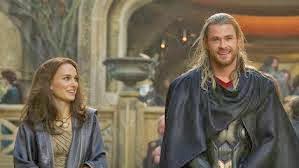
This is Kate Middleton
This is Kate Middleton's hair on Natalie Portman's head
The picture does not do the hair justice. If this hair was an athlete, it would be soooooo juiced. It would be Lance Armstrong, who managed to win yet another Tour de France in 2075, despite being clinically dead, because of all the performance enhancing drugs in his system. (Does that make any sense?) If this hair was potatoes, it would be potatoes after being distilled seven thousand times into the purest vodka ever vodka-ed. It is to hair what Hollywood CGI battle scenes are to toddler gymnastic classes.
Her hair is unbelievable. Possibly the most unbelievable thing in a movie about prehistoric elves in spaceships.
Anyway, Natalie's very awkward date is interrupted by Kat Denning as her research assistant with some kind of handheld device showing "readings." Which causes Natalie to ditch the date in order to go Do Science! Because she is a Scientist! Who discovers Anomalies! But in between chucking shoes and car keys into the Anomaly! she gets sucked into one and ends up in the kind of Vast Underground Cathedral-sized Space (TM) that you naturally build when you are trying to hide something Very Dangerous. I mean, you carve out something large enough to house all those Dark Elf space ships, and you "contain" the Red Matter Aether by putting it between two slabs of columnar rock with the opening to the Aether right at hand height? And then this stuff sort of--smells?--the presence of a human (none of which were present at the previous battle, which was all Norse Gods and space aliens, so how does it recognize?) and then attacks her, by which we mean insinuates itself into her body and then deposits her back where she came from.
There is some (alleged) comic miscommunication as Dr. Natalie Portman hollers at Kat, because Kat shouldn't have called the police. Why? Because now the police will want to Do Science? "But," sputters Kat, "you disappeared for five hours." And then Thor shows up.
Let's take a break here for a new game we're calling "Reality versus Movie Tropes." It's fun! See, I give you the set up, and you guess what Movie Trope will force to have happen, because it is entirely NOT what would happen in real life. Ready? Hands on your buzzers!
Thor shows up. It's been two entire years since he disappeared from Dr. Natalie's life. Two years with no contact, and she's been pining for his fjords SO HARD that she actually stopped doing science. This Norse God of a giant blond slab of hunkitude reappears to save her from a life of Chris O'Dowd dates. What will Dr. Natalie Portman do?
A. She will run to him and make up for two years of no Thor by kissing the hell out of him.
B. She will get shy and awkward--it's been two years. A lot could have happened, and maybe he's not interested anymore?
C. She will be too busy with the Science of Anomalies! and being arrested to properly process his presence.
D. She will be relieved that he's healthy and alive (lots of fighting in Asgard you know).
E. She will play cool and casual, while trying to find out what happened and why he is there now.
Got your answer picked out and written down? Good, and the correct response is--
Ding! Ding! Ding! Ding! Trick question! The answer is--none of the above. Because all of those are actual possible human responses, and THIS is a comic book movie! We're going for the broadest of cliches and unrealistic responses!
Thor re-appears after a two year absence, and Natalie slaps him. Twice. Of course she does. Because domestic abuse is always funny! And because she's so tiny, and he's a powerful Norse God of thunder so its like he wouldn't even notice her puny human emotions! That makes it even funnier, right?
It isn't funny. It's just formulaic. It's what you totally expect to have happen, so it happens, and it's lazy lazy screenwriting.
Meanwhile, the police are going nuts, and trying to arrest her for something, and the level of panic is entirely ridiculous. The cop tries to take her into custody for trespassing or some fool thing, and he puts a hand on her arm and BOOM! A flash of red and the police are blown back 30 feet!
So then, without asking her, or warning her, or anything that might smack of treating her like an adult woman who might have opinions on anything, Thor hijacks her to Asgard. Why? Because he's had his personal stalker (Heimdall) tracking her every move, and Heimdall couldn't see her so obviously she needs to locked up in Asgard where Thor can keep her under his control. And that isn't at all creepy.
So we're back in Asgard, where the royal family apparently lives in a giant pipe organ.
So the first thing that happens is that somebody decides that she needs some kind of medical care, because she's got some kind of infection. Yeah, that's what the explosion was--an infection. So she's plopped on a table, where mystical golden glitter makes vaguely CT scan shapes in the air above her.
Yeah. Let's think about this. Dr. Natalie is a scientist. She's been delivered to a "medical" facility that's run in a place where everybody wears body armor ALL THE TIME because of all the swords and axes and daggers fighting that breaks out all the time. Where everything continues to be basically medieval. Where the medical equipment is glitter. Yeah, I'm thinking she's going to be skeptical that there's any kind of scientific method going on around here.
Odin shows up, and he diagnoses that she's got a case of the Aether. And she accepts that--because of science!
[The theory of aether was originally an attempt to explain what space was made out of. It was what supposedly held the stars in the sky, roughly equivalent to the way water surrounds fish. As a "scienctist," I would expect Dr. Natalie to be insisting on some kind of evidenced based medicine, treatment protocols, etc. But then I remember--this is a COMIC BOOK movie.]
So the treatment for her condition seems to be to drape her in medieval clothes with a little light armor and to go walking around with Thor. They also recreate some scenes from the Star Wars prequels, because nobody's going to remember those, right?
Meanwhile, back on Earth--
Stellan Skarsgaard is caught on television running around Stonehenge naked, and taken to the male geriatic psychiatric ward--which is full of elderly men, because only the elderly and decrepit go mad? Because despite being so significant a threat to normal people that he has to be incarcerated in a psychiatric ward, if they just put him in a room of old people, and he goes berserk--again--who cares? They are old? Anyway, Stellan Skarsgaard brings the audience up to speed by exposition dumping about Convergence of the Nine Worlds and Stan Lee makes his contractually obligated cameo.
Fortunately, because he is just that smart (even though he is also crazy), he has apparently already built camera tripods that will something something Save The Day at the end of the film, even though he hasn't any clue about the existence of the Big Bad Red MatterMacGuffin Aether because nobody knows about it yet! Yay science! And he has them with him! So when Kat Dennings and generic additional comedic intern show up and pretend to be relatives, nobody has to do any more science!
At some point, and the chronology is getting confused in my head, Christopher Eccleston wakes up from his vaguely Christ-like pose on his Sooper Sekkrit Spaceship, and swiftly becomes Eric Bana from the Star Trek reboot, and comes looking for Natalie Portman's blood Aether.
Christopher Eccleston as Malekith
Eric Bana as Nero
I TOLD you guys--you've seen this movie before! Both these guys have "lost their home worlds" and they want to punish the people who hurt them (Aasgard in Thor, Vulcan in Star Trek) so they come swooping in with their black spaceships and lay waste to everything around them. Malekith is still pretty neolithic, since despite having space technology, he pretty much just plows the spaceship into all the stone columns he can find, thus literally toppling Aasgard.
Nero at least managed to explode the Vulcan planet, so points to him for efficacy.
The bad guys slaughter all the Aasgard guards and go let everybody else out of the Aasgard prison, except for Loki. Which was their error. Who wouldn't want a pissed off and snake hipped god on their side?
We all would.
Anyway, Malekith manages to not find Jane but kills Frigga anyway, and then goes away because it's only Act II and thus too early for a final showdown. So Rene Russo is dead, although she was a pretty bad-ass fighter for someone with only a short sword and an whole lot of stupid extra fabric which got in the way of her ninja moves. So she's dead, and we get all the manpain of Odin and Thor and even Loki, and they launch her body in a Viking boat and (unlike on Game of Thrones) (where we saw this most recently) the archer hits it with his flaming arrow the first time and then the boat goes over the waterfall and we see all the rest of the boats for all the rest of the fallen guards killed by the elves, and they are all on fire and then everybody at Aasgard has a light up Christmas ornament that they release into the sky and the horns swell and I'm thinking. . .
. . .where the hell did all those boats come from? Does Asgard have a major dinghy manufacturing economy? Does everybody in Asgard have prepaid Viking funeral insurance plans, where they keep these boats around, just in case they all die at once? What kind of gods are these?
Pretty mortal ones, I guess, since in all the fighting they do--with medieval weaponry for the most part, because that's what you want against a bunch of space ships--they seem to be as vulnerable as humans. In face, their only fighting advantage seems to be that they are fast, so if you can get a blade on them, they are just as dead as anybody else. I guess this is why they also wear body armor all the damn time too--because they aren't actually gods, they aren't actually immortal, they are just like us only with a weird fetish for horned helmets.
Sidebar--I mean, what the heck is the deal with these people? There's Idris Elba as the all-seeing Heimdall, who can see all the trillions of souls in all nine worlds, and he wears an enormous helmet--full time.
Is he afraid somebody is going to sneak up behind him and hit him with a sword, and he's not going to see them coming?
Anyway, Thor and Odin have a difference of opinion on how to prepare for the return of Malekith. Thor thinks he should take on the space ships alone, with his hammer. Odin thinks its better to just wait until Malekith comes back to Asgard, and then they will attack the space ships with soldiers and spears. (Hey, it worked in Avatar!) Then Malekith will get bored of killing everybody, or tired of all the bodies piling up and surrender? I do not think either of these "plans" is likely to work very well. But Norse mythology tends to lean toward raucous brawling and away from military strategy, so what do we expect?
Let's cut to the chase--by which we mean all the action sequences, because this review is already too damn long.
So Thor sneaks out of Asgard with Dr. Natalie after freeing Loki from prison, because Thor isn't good at sneaky and Loki is. They try a showdown with Malekith on some desolate plain, where Malekith gets the Aether out of Natalie, and Loki gets killed and dies pathetically as Thor tries manfully to save him.
That didn't go so well.
Wait--haven't we seen this before? Why yes! We have!
What? Oh, no, Loki wasn't wearing a full coverage helmet. So I guess it's totally different. Okay then.
There's another battle at Asgard, I think, and then the entire universe converges around the center point of the Naval Observatory at Greenwich in England, so Malekith goes there to set off his weapon. Meanwhile, Thor and Dr. Natalie are ostensibly marooned wherever they are, since Loki was the one who knew how to get back, and now he's dead. [Spoiler--he's not really dead! He's a trickster! He's also the breakout character and no way is Marvel going to off Tom Hiddleston.] But hey! There's a bunch of shoes and the car keys and Chris O'Dowd is calling on the cell phone. Anomalies to the rescue!
There is much running around and shooting and blowing things up and CGI destruction of the lovely Greenwich grounds, and somehow Malekith is sucked into his spaceship and his body gets exploded and all the Dark Elves are miraculously killed, and Kat Dennings gets a boyfriend and the world is saved hooray!
Some random thoughts:
So the threat is to the entirety of the universe. All life is going to be snuffed out for all time, and the universe returned to it's pre-Big Bang state. Well, you wouldn't want to interrupt any of the other Avengers for anything like that. I mean, Hawkeye probably has some bows to restring, and Tony Stark is ordering in some shawarma baskets. Probably best to leave them out of this one. (H/T to Mark Lisanti at Grantland for pointing that out.)
What is the deal with Natalie Portman's forehead? Seriously, you guys, it's like her hairline has receded, and it's just so darn bulbous. Is this to provide more room for all the Science Brains she supposedly has but never actually uses in this movie?
There is one totally gratuitous skin shot, where the camera pans and lingers over the dewy golden curves and hollows of....Chris Hemsworth's torso. Which is probably what winning the Oscar gave Portman--the right to nix any nudes scenes. And while it is refreshing to see this kind of soft core scene NOT about the female form, equal opportunity sexism kind of points out how unnecessary such a scene really is.
3D--was there any point to it? No.
It is worth seeing? Honestly, you've already decided by now. If you like this kind of movie, in which case you have already seen it. If you don't like this kind of movie, this one isn't going to change your mind. It's exactly what you expect, and full of things you've seen before. It's professionally executed, and sufficiently pretty to look at. It makes no sense, is overlong and bogs down in Asgard. But Hemsworth acquits himself well enough and looks good, Hiddleston continues to own the character and to be shortchanged by not enough to do, and everybody else earns their paychecks.